
Introduction
A merger is a corporate restructuring strategy in which two or more companies combine their businesses to achieve objectives such as business expansion, cost reduction, improved competitiveness, and greater operational efficiency. Mergers are important in corporate finance, strategic management, company accounting, and business economics because they influence ownership structures, asset management, liabilities, profitability, and shareholder value.
Companies may merge to enter new markets, acquire technology, strengthen their supply chains, reduce competition, or achieve economies of scale. However, a merger does not automatically guarantee financial success. Integration costs, cultural differences, excessive acquisition costs, and regulatory restrictions can affect its outcome.
For UPSC Commerce & Accountancy Optional candidates, understanding mergers requires more than memorising definitions. Aspirants should distinguish between different types of mergers, understand their strategic objectives, examine their financial implications, and connect corporate restructuring with accounting standards and regulatory frameworks.
This article explains the meaning, classification, objectives, advantages, limitations, accounting considerations, and examination relevance of mergers, with practical examples and UPSC Mains answer-writing guidance.
What Is a Merger?
A merger is a combination of two or more businesses into one corporate organisation or a unified business structure. Depending on the transaction, one company may survive while another is absorbed, or the combining businesses may form a new entity.
The precise legal structure depends on the applicable company law and the terms of the transaction.
Example of a Merger
Suppose Company A manufactures electrical equipment, while Company B produces complementary electrical components. If they combine their operations to reduce production costs, coordinate distribution, and improve market coverage, the transaction may be structured as a merger.
The expected benefit is not simply an increase in company size. The real objective is to create greater economic value through operational coordination, financial efficiency, or strategic advantages.
Objectives of a Merger
Companies undertake mergers for several reasons:
- Economies of scale: Larger operations may reduce average production costs.
- Market expansion: A company can enter new geographical markets or customer segments.
- Operational efficiency: Combining facilities, distribution networks, and administrative functions may eliminate duplication.
- Diversification: A company may expand into different products or industries.
- Access to technology: A merger may provide access to intellectual property, skilled employees, or research capabilities.
- Financial restructuring: Combining businesses may improve access to finance or support the restructuring of operations.
- Competitive positioning: Companies may seek stronger bargaining power with suppliers and customers.
These objectives must be evaluated against transaction costs, integration risks, and the possibility that expected benefits may not materialise.
Types of Mergers
Mergers are commonly classified according to the relationship between the businesses involved and the strategic purpose of the combination.
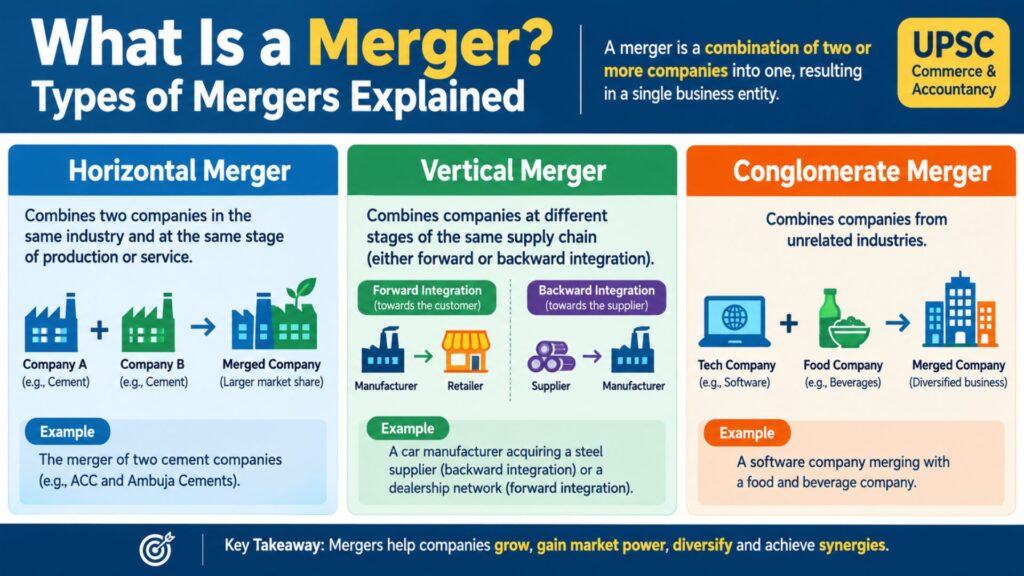
1. Horizontal Merger
A horizontal merger occurs when two companies operating in the same industry and at the same stage of the production or distribution process combine.
Example: Two competing cement manufacturers merge to consolidate production facilities and distribution networks.
Objectives:
- Increase market coverage.
- Reduce duplicated operating costs.
- Improve production efficiency.
- Strengthen competitive capabilities.
Critical analysis: Horizontal mergers can create market concentration. Therefore, potential efficiency gains must be assessed alongside competition concerns and consumer interests.
2. Vertical Merger
A vertical merger combines companies operating at different stages of the same supply chain.
It can involve a supplier and a manufacturer or a manufacturer and a distributor.
Example: An automobile manufacturer combines with a component supplier to improve supply reliability and production coordination.
Vertical integration may reduce transaction costs, improve quality control, and lower dependence on external suppliers. However, it may also require substantial investment and create difficulties when coordinating previously independent operations.
3. Conglomerate Merger
A conglomerate merger combines businesses operating in unrelated industries.
Example: A consumer electronics company merges with a business providing food-processing services.
The main objectives may include diversification, entry into new markets, and reducing dependence on a single industry.
However, diversification does not automatically reduce risk in every circumstance. Managing unrelated businesses can increase organisational complexity and weaken management’s focus on core operations.
4. Market-Extension Merger
A market-extension merger combines companies that sell similar products in different geographical markets or customer markets.
Example: A regional banking services company combines with another company serving a different geographical region, subject to applicable regulatory requirements.
The objective is to expand the customer base and geographical reach without necessarily developing an entirely new product.
5. Product-Extension Merger
A product-extension merger combines companies that sell related or complementary products within the same general market.
Example: A company manufacturing laptops combines with a company manufacturing computer accessories.
The merger may allow both businesses to offer a wider product range, cross-sell products, and share distribution channels.
6. Congeneric Merger
A congeneric merger involves businesses operating in related industries or serving overlapping customer groups but offering different products or services.
For example, a company providing payment-processing technology may combine with a related financial software provider.
The classification overlaps with product-extension mergers in some business literature. The terminology should therefore be interpreted according to the framework specified in an examination question or academic text.
7. Cash Merger and Stock Merger
Mergers can also be classified by the consideration offered to the shareholders of the company being acquired.
Cash merger: Shareholders receive cash as consideration for their shares or interests, according to the transaction terms.
Stock merger: Shareholders receive shares in the acquiring or resulting company.
A transaction may also use a combination of cash, shares, and other permitted consideration. These terms describe the payment structure rather than the industrial relationship between the businesses.
Merger vs Acquisition
A merger and an acquisition are related but distinct concepts.
| Basis | Merger | Acquisition |
|---|---|---|
| Meaning | Businesses combine into a unified structure | One company obtains control of another |
| Structure | May involve absorption or formation of a new entity | The acquired company may remain a separate legal entity |
| Control | Depends on the agreed structure | Usually passes to the acquiring company |
| Consideration | May involve cash, shares, or other arrangements | May involve cash, shares, or other arrangements |
| Main objective | Business combination and value creation | Obtaining control, assets, capabilities, or market access |
In practice, a transaction described commercially as a merger may legally be structured as an acquisition. The legal documentation and substance of the transaction determine its actual treatment.
Accounting Treatment of Mergers
Accounting treatment depends on the transaction’s substance, the applicable accounting framework, and the reporting entity.
Accounting Standard in India
Ind AS 103, Business Combinations, provides the principal framework for business combinations within its scope for entities applying Indian Accounting Standards.
It generally requires the acquisition method for business combinations within its scope, subject to the standard’s specific requirements and exceptions.
Under the acquisition method, the acquirer identifies the acquisition date, recognises identifiable assets acquired and liabilities assumed subject to the applicable recognition and measurement requirements, and determines goodwill or a bargain purchase gain as prescribed by the standard.
Goodwill Calculation
A simplified conceptual expression is:
Goodwill = Consideration transferred + Non-controlling interest + Fair value of any previously held interest − Net identifiable assets acquired
This expression applies to relevant acquisition-method calculations. The actual calculation must follow Ind AS 103, including its rules for measuring the components and accounting for any bargain purchase.
Numerical Illustration
Suppose Company A acquires Company B with the following illustrative figures:
- Consideration transferred: ₹100 lakh
- Non-controlling interest: Nil
- Previously held interest: Nil
- Fair value of identifiable net assets acquired: ₹80 lakh
Calculation:
Goodwill = ₹100 lakh − ₹80 lakh
Answer: Goodwill = ₹20 lakh
The goodwill represents the excess of the relevant consideration over the fair value of identifiable net assets in this simplified example. It may reflect expected synergies, workforce-related benefits that cannot be separately recognised, or other factors supporting the acquisition price.
Goodwill is not a separately identifiable tangible asset. Subsequent accounting depends on the applicable reporting framework.
Common-Control Business Combinations
Business combinations involving entities or businesses under common control may require different accounting treatment. Under Ind AS 103, Appendix C addresses common-control business combinations and generally prescribes the pooling-of-interests method for transactions within its scope.
Therefore, students should not assume that every merger uses the acquisition method.
Advantages and Limitations of Mergers
Advantages
- Economies of scale and potential cost savings.
- Access to new customers and markets.
- Better utilisation of assets and capabilities.
- Potential improvements in technology and operational efficiency.
- Opportunities for product diversification and strategic growth.
Limitations
- High transaction and integration costs.
- Cultural and managerial conflicts.
- Difficulty integrating information systems and business processes.
- Risk of overpaying for the target business.
- Potential job losses or organisational disruption.
- Competition-law concerns arising from excessive market concentration.
The success of a merger depends on the quality of due diligence, the valuation of the businesses, the integration plan, and the realisation of expected synergies.
Legal and Regulatory Considerations in India
Mergers involving Indian companies may require consideration of the Companies Act, 2013, applicable provisions governing schemes of arrangement, and the role of the National Company Law Tribunal where relevant.
Depending on the parties and the transaction, competition-law review under the Competition Act, 2002, may also apply. Listed companies, regulated financial institutions, and cross-border transactions may face additional requirements.
The applicable obligations depend on the transaction structure, parties involved, current law, and relevant regulatory thresholds. Students should distinguish general academic explanations from transaction-specific legal advice.
Why This Topic Matters for UPSC
Mergers connect several areas of the UPSC Commerce & Accountancy Optional syllabus.
- Corporate accounting: Understanding business combinations, goodwill, identifiable assets, liabilities, and consolidated financial statements.
- Financial management: Evaluating acquisition costs, financing choices, cost of capital, and shareholder value.
- Strategic management: Analysing diversification, integration, economies of scale, and competitive advantage.
- Auditing: Understanding financial due diligence, valuation evidence, asset verification, and the reliability of financial information.
- Business economics: Examining market concentration, competition, productivity, and consumer welfare.
- General Studies and Essay: Applying business-restructuring concepts to broader discussions about industrial development and economic efficiency.
A strong examination answer should explain not only why companies merge but also whether the proposed combination creates value and what risks may prevent success.
UPSC Mains Answer Writing Approach
10-Mark Answer
Suggested structure:
- Define a merger.
- Explain horizontal, vertical, and conglomerate mergers.
- Provide one practical example.
- Conclude by noting that merger success depends on synergies, valuation, and integration.
15-Mark Answer
Suggested structure:
- Define a merger and explain its strategic background.
- Classify mergers using industry relationships and business objectives.
- Discuss economies of scale, diversification, and market expansion.
- Explain accounting and financial implications, including goodwill.
- Evaluate integration risks and competition concerns.
- Conclude with a balanced assessment of value creation.
20-Mark Answer
Suggested structure:
- Introduce mergers as a form of corporate restructuring.
- Explain the major types with relevant examples.
- Compare mergers with acquisitions.
- Analyse strategic, operational, financial, and economic implications.
- Explain the relevant accounting framework, including Ind AS 103 where applicable.
- Evaluate valuation, goodwill, integration costs, and competition concerns.
- Present a balanced conclusion based on sustainable value creation.
Model Answer Framework: Explain the Types of Mergers and Their Strategic Significance
A merger is a business combination intended to achieve strategic, operational, or financial objectives. The principal types include horizontal mergers between competitors, vertical mergers between businesses at different supply-chain stages, and conglomerate mergers between unrelated businesses. Market-extension and product-extension mergers focus on expanding customer reach and product offerings.
Mergers can generate economies of scale, improve resource utilisation, and provide access to new markets. From an accounting perspective, the transaction may require recognition and measurement of identifiable assets, liabilities, goodwill, and other relevant items under the applicable framework. However, integration difficulties, overvaluation, and reduced competition may undermine the expected benefits.
Thus, a merger should be assessed through strategic fit, financial valuation, accounting compliance, regulatory requirements, and the ability to achieve sustainable economic value.
UPSC Prelims Quick Revision
- A horizontal merger combines businesses at the same stage of an industry.
- A vertical merger combines businesses at different stages of a supply chain.
- A conglomerate merger combines businesses from unrelated industries.
- A market-extension merger expands reach into additional markets.
- A product-extension merger expands related product offerings.
- Cash and stock mergers are classified by the consideration offered.
- Ind AS 103 deals with business combinations within its scope.
- The acquisition method generally applies to business combinations within Ind AS 103’s scope, subject to exceptions.
- Common-control business combinations are addressed by Appendix C of Ind AS 103.
- Goodwill may arise when the relevant acquisition calculation produces a positive residual.
- A merger does not automatically eliminate competition concerns or guarantee increased shareholder value.
Likely UPSC-Style Questions
- Define a merger and critically explain the major types of mergers with suitable business illustrations.
- Distinguish between horizontal, vertical, and conglomerate mergers. Evaluate their strategic advantages and limitations.
- Explain the accounting treatment of a business combination under Ind AS 103, with particular reference to goodwill and identifiable net assets.
- “A merger creates value only when the expected synergies exceed the associated costs and risks.” Critically examine this statement from a financial management perspective.
- Explain the distinction between mergers and acquisitions and discuss the significance of accounting, valuation, and regulatory considerations in corporate restructuring.
Frequently Asked Questions
1. What is a merger in business?
A merger is a business combination in which two or more companies combine their operations into a unified corporate structure to pursue strategic, operational, or financial objectives.
2. What are the three main types of mergers?
The three commonly discussed types are horizontal mergers, vertical mergers, and conglomerate mergers. They are classified according to the relationship between the businesses involved.
3. What is the difference between a merger and an acquisition?
A merger combines businesses into a unified structure, whereas an acquisition involves one company obtaining control of another. Actual legal and accounting treatment depends on the transaction’s substance.
4. How is goodwill calculated in a business combination?
Under the relevant acquisition-method calculation, goodwill is determined by comparing the prescribed acquisition components with the fair value of identifiable net assets acquired. The calculation must follow the applicable accounting standard.
5. Why should UPSC Commerce & Accountancy aspirants study mergers?
Mergers connect corporate accounting, financial management, strategic management, auditing, and business economics. They also provide practical examples for analytical answers about valuation, goodwill, synergy, and corporate restructuring.
Conclusion
A merger is an important corporate restructuring mechanism that can support business expansion, operational efficiency, diversification, and competitive positioning. Its major types differ according to the relationship between the businesses involved, while its financial and accounting implications depend on the transaction’s structure and applicable reporting framework.
For UPSC Commerce & Accountancy aspirants, the key is to connect classification with strategic objectives, valuation, accounting treatment, regulatory considerations, and practical risks. Understanding these relationships enables candidates to develop precise, balanced, and analytically strong examination answers.