How B.Com Students Can Build a High-Income Career with Digital Marketing (2026 Guide)
Introduction
A Bachelor of Commerce (B.Com) degree is one of the most popular undergraduate programs in India. Every year, thousands of students graduate with knowledge in accounting, taxation, banking, finance, auditing, business law, marketing, and entrepreneurship. Many students aspire to become accountants, bankers, auditors, tax consultants, finance executives, or business owners. While these are excellent career choices, the modern business environment has changed significantly.
Today, almost every business has an online presence. Customers search for products on Google, compare services on social media, watch educational videos on YouTube, and make purchasing decisions based on digital content. Whether it is a local grocery store, a Chartered Accountant, a bank, an insurance advisor, or a multinational company, digital platforms have become essential for reaching customers.
From our experience at WorkSEO Academy, students who already have strong subject knowledge—such as commerce, engineering, or science—often learn digital marketing more effectively because they can create content around topics they already understand. Over the years, we have seen that combining domain expertise with digital marketing skills helps students build stronger personal brands and discover more career opportunities than relying on digital skills alone.
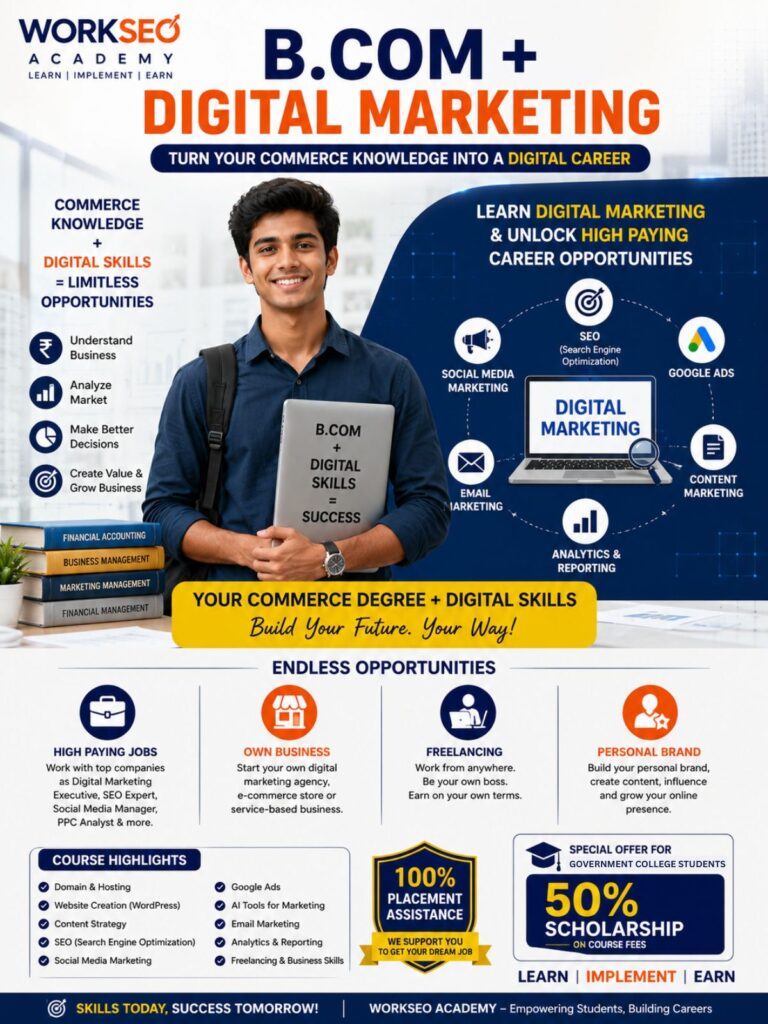
This shift has created new opportunities for commerce graduates.
Your B.Com degree gives you strong business knowledge, but digital marketing helps you present that knowledge to the world. Instead of limiting yourself to traditional career paths, you can build a professional website, create educational content, start a YouTube channel, publish blogs, promote businesses, generate leads, or even establish your own consulting brand.
For example, if you understand accounting, you can create accounting tutorials for students or business owners. If you know Income Tax and GST, you can publish articles explaining tax concepts in simple language. If banking interests you, you can educate people about loans, financial planning, and digital banking. Every subject you study in B.Com has practical applications, and digital marketing helps people discover your expertise.
Digital marketing is not only about advertising. It includes building websites, creating valuable content, improving search engine visibility through SEO, managing social media, understanding customer behaviour, and helping businesses grow online.
This article explains how B.Com students can combine their commerce knowledge with digital marketing to create better career opportunities, build a personal brand, explore freelancing, and even start their own business.
Accounting + Digital Marketing
Accounting is often called the language of business because every organisation depends on financial records to make decisions. During your B.Com course, you learn bookkeeping, journal entries, ledgers, trial balance, profit and loss accounts, balance sheets, cash flow statements, and financial reporting.
These skills are valuable far beyond a traditional accounting job.
Thousands of business owners search online every day for answers to questions like “How do I maintain business accounts?”, “How do I prepare a balance sheet?”, or “Which accounting software is suitable for my business?” If you understand accounting concepts, you can create blogs, videos, infographics, or downloadable guides that answer these questions.
You can also build a professional website showcasing your accounting knowledge, publish educational content regularly, and improve its visibility through Search Engine Optimization (SEO). Over time, this can establish your credibility and attract opportunities from businesses, students, and professionals.
Accounting firms also need digital marketing to reach new clients. A commerce graduate who understands accounting and digital marketing can help accounting firms manage their websites, create educational articles, improve Google rankings, and generate client enquiries.
An accountant who can also run a website and rank on Google effectively competes with entire firms — you don’t need a large team to build a client base anymore, just consistent, well-optimized content.
In our SEO projects, we’ve found that websites publishing clear, experience-based accounting content tend to earn more trust from readers than sites with generic marketing articles. When accounting knowledge is combined with consistent SEO practices, it can gradually attract relevant visitors from search engines.
Income Tax + Digital Marketing
Income Tax is one of the most practical subjects taught in B.Com. Every year, salaried employees, freelancers, business owners, and companies need guidance on filing Income Tax Returns, understanding deductions, choosing tax regimes, and complying with tax regulations.
Before consulting a professional, many people search online for answers. Questions such as “How to file Income Tax Return?”, “What documents are required for ITR?”, or “How can I save Income Tax legally?” receive significant interest every year.
As a commerce graduate, you already understand many of these concepts. Digital marketing allows you to transform this knowledge into useful educational content.
You can publish beginner-friendly tax guides, create YouTube videos explaining common tax concepts, share tax-saving tips on LinkedIn, or build a personal website where people can learn about taxation in simple language.
Tax consultants, Chartered Accountants, and accounting firms also require SEO, website management, content writing, and social media marketing to attract clients. Your understanding of taxation gives you an advantage because you can create accurate and relevant financial content.
Tax queries spike every filing season, and most searchers pick whoever answers clearly on page one — that’s a seat at the table you can claim with the right content and SEO, long before you have a large client roster.
From working on SEO campaigns across multiple industries, we have observed that educational tax content often performs well when it answers common user questions in simple language. Clear explanations and regular updates are generally more valuable than publishing a large number of similar articles.
GST + Digital Marketing
Goods and Services Tax (GST) is an essential part of India’s business environment. Every registered business must understand GST registration, invoicing, return filing, compliance, and Input Tax Credit (ITC). During your B.Com studies, you learn these concepts and understand how GST affects businesses.
Many entrepreneurs, startups, and small business owners search online for practical guidance before approaching a consultant. They want to know how GST registration works, which returns must be filed, what documents are required, and how to avoid common compliance mistakes.
This creates an excellent opportunity for commerce students.
By combining GST knowledge with digital marketing, you can create valuable educational resources that help businesses understand GST more easily. You can write blog articles, publish explainer videos, create social media posts, and share practical checklists for entrepreneurs.
Accounting firms and GST consultants also need professionals who can improve their online visibility. You can assist them by creating SEO-friendly content, managing websites, publishing educational blogs, maintaining social media pages, and helping their services appear in Google Search results.
One well-ranked GST compliance guide can generate more enquiries in a month than months of one-on-one consultations — that’s the leverage digital skills add to subject knowledge you already have.
Based on our experience optimizing business websites, practical GST guides that solve real problems often receive more engagement than promotional content. Businesses are more likely to trust websites that consistently provide useful information.
Banking & Loans + Digital Marketing
Banking is one of the most important subjects in a B.Com degree because every individual and business depends on financial institutions. During your course, you learn about savings accounts, current accounts, fixed deposits, recurring deposits, internet banking, mobile banking, digital payments, credit and debit cards, RBI regulations, customer relationship management, and financial services.
In addition to banking, you also gain knowledge about different types of loans, including home loans, education loans, business loans, vehicle loans, gold loans, personal loans, and MSME financing. Understanding these financial products helps you recognize how banks support individuals, entrepreneurs, and businesses throughout different stages of life.
Today, before visiting a bank, most people search online.
They want answers to questions such as:
- Which bank offers the best home loan?
- How can I apply for an education loan?
- What documents are required for a business loan?
- What is the difference between NEFT, RTGS, and IMPS?
- How does internet banking work?
- How can I improve my CIBIL score?
- Which bank provides the lowest interest rate?
- How is EMI calculated?
These searches create opportunities for professionals who can explain financial concepts in a simple and trustworthy manner.
A B.Com graduate already understands many of these banking concepts. By learning digital marketing, you can share your knowledge through blogs, YouTube videos, LinkedIn articles, educational social media posts, and professional websites.
For example, you can publish articles explaining:
- How to choose the right bank account.
- Home Loan vs Personal Loan.
- Steps to apply for an Education Loan.
- Understanding EMI calculations.
- Banking tips for first-time entrepreneurs.
- Safe digital banking practices.
Instead of keeping your knowledge limited to classroom notes, you transform it into valuable educational content that helps thousands of people.
Banks, financial institutions, loan consultants, and NBFCs also require professionals who understand both finance and digital marketing. They need websites, SEO, social media marketing, email marketing, lead generation, and educational content to attract new customers.
A commerce graduate with digital marketing skills becomes much more valuable because they understand both the financial products and how to communicate those products effectively to potential customers.
Loan and EMI questions are searched year-round, not seasonally like tax — which makes banking content one of the more reliable, evergreen niches for a commerce graduate building a long-term content asset.
Our experience managing SEO for service-based businesses shows that educational financial content can help build long-term trust. Articles explaining loans, banking, and financial concepts clearly often continue attracting visitors over time because these are topics people search for throughout the year.
Over the years, we have worked with students from commerce, engineering, science, arts, and management backgrounds. One consistent pattern we have observed is that students who combine their existing academic knowledge with digital marketing are often able to create more useful content, build stronger personal brands, and identify specialized career opportunities in their own field.
Career Opportunities After Learning Digital Marketing
Many students ask,
“What can I do after completing B.Com along with Digital Marketing?”
The answer is simple.
Digital marketing expands your existing commerce knowledge instead of replacing it.
You can choose traditional commerce careers while also developing modern digital skills that employers increasingly value.
Some of the most popular career opportunities include:
Digital Marketing Executive
Help businesses improve their online visibility, manage campaigns, create content, and generate leads.
SEO Specialist
Improve website rankings on Google and help businesses receive organic traffic.
Content Marketing Specialist
Write educational blogs, articles, newsletters, and website content related to finance, taxation, banking, or business.
Social Media Manager
Manage business pages, create content strategies, and increase audience engagement.
Financial Content Writer
Many accounting firms, finance companies, banks, and fintech businesses require writers who understand commerce concepts.
Tax & GST Consultant
Use your taxation knowledge while promoting your services through websites, blogs, and social media.
Banking Marketing Executive
Help banks and financial institutions attract customers through digital campaigns.
Freelancer
Provide SEO, website development, content writing, or digital marketing services to accounting firms, tax consultants, insurance companies, and startups.
Entrepreneur
Start your own digital marketing agency, financial consultancy, blogging website, YouTube channel, or online education platform.
Personal Branding
Build your professional identity by sharing useful content regularly. A strong personal brand increases credibility, networking opportunities, and client enquiries.
Digital marketing also allows you to earn from multiple sources instead of depending on a single job. You may work full-time while also building your own website, YouTube channel, blog, or freelance business.
This flexibility makes digital marketing one of the most valuable complementary skills for commerce graduates.
Why Every B.Com Student Should Learn Digital Marketing
Business has changed significantly over the past decade.
Earlier, businesses depended mainly on newspapers, television, radio, banners, and word-of-mouth marketing.
Today, customers search online before making almost every decision.
They compare products, read reviews, visit websites, watch YouTube videos, check Instagram pages, and search on Google before contacting a business.
As a commerce student, you already understand how businesses operate.
You study:
- Accounting
- Banking
- Income Tax
- GST
- Financial Management
- Marketing
- Entrepreneurship
- Business Communication
- Consumer Behaviour
Digital marketing complements these subjects by showing you how businesses attract customers in the digital world.
Instead of only understanding business operations, you also learn how businesses generate enquiries, increase sales, build customer relationships, and strengthen their brands online.
At WorkSEO Academy, students learn practical skills such as:
- Domain Name Registration
- Web Hosting
- WordPress Website Development
- Search Engine Optimization (SEO)
- Google Business Profile Optimization
- Content Marketing
- Social Media Marketing
- AI Tools for Business
- Personal Branding
- Freelancing Fundamentals
By the end of the training, students understand not only digital marketing concepts but also how to apply them to their own field of study.
Whether you become an accountant, banker, entrepreneur, tax consultant, or business owner, digital marketing helps you communicate your expertise, reach the right audience, and stay competitive in today’s digital economy.
Digital marketing is no longer an optional skill.
It has become an important professional skill that complements commerce education and opens new career opportunities across almost every industry.
Conclusion
A B.Com degree provides a strong foundation in business, finance, taxation, banking, accounting, auditing, marketing, and entrepreneurship. These subjects are essential for understanding how businesses operate, manage finances, and make strategic decisions.
However, today’s business environment is very different from what it was a decade ago. Customers no longer depend only on newspapers, television, or physical stores to find products and services. They search on Google, watch YouTube videos, compare businesses on social media, read online reviews, and visit websites before making purchasing decisions.
This is why digital marketing has become an important skill for every commerce graduate.
Learning digital marketing does not mean changing your career. Instead, it enhances the knowledge you already have. Whether you become an accountant, banker, tax consultant, entrepreneur, auditor, or finance professional, digital marketing helps you showcase your expertise, build your professional reputation, educate people, and connect with potential employers or clients.
For students who dream of starting their own business, digital marketing provides practical skills to build a website, create valuable content, attract customers, and grow a brand online. For those seeking employment, it adds an industry-relevant skill that is valued by businesses across every sector.
At WorkSEO Academy, our goal is to help students combine their academic knowledge with practical digital marketing skills. Through hands-on training, live projects, SEO, website development, AI tools, and personal branding, we prepare students for modern career opportunities while encouraging continuous learning and professional growth.
Your B.Com degree teaches you how businesses work.
Digital Marketing teaches you how businesses grow.
When these two skills are combined, they create exciting opportunities for employment, freelancing, consulting, entrepreneurship, and lifelong career development.
Frequently Asked Questions (FAQ)
1. Is Digital Marketing a good career option after B.Com?
Yes. Digital marketing complements the knowledge gained in a B.Com degree. It creates opportunities in SEO, content marketing, social media marketing, Google Ads, email marketing, website management, and digital business development. It is also useful for students planning careers in banking, finance, taxation, and entrepreneurship.
2. Do I need coding knowledge to learn Digital Marketing?
No. Basic computer knowledge is sufficient to start learning digital marketing. Most digital marketing activities, such as SEO, content creation, WordPress website management, social media marketing, and Google Business Profile optimization, do not require programming skills.
3. Can B.Com students become SEO Specialists?
Yes. SEO (Search Engine Optimization) is one of the most in-demand digital marketing skills. B.Com students who enjoy research, business strategy, and content creation can build successful careers as SEO Specialists while working with businesses from various industries.
4. Can I start freelancing after learning Digital Marketing?
Yes. Many businesses hire freelancers for SEO, website development, content writing, social media management, Google Ads, and digital marketing consulting. Freelancing allows you to work with multiple clients while gaining practical experience.
5. Is Digital Marketing useful for banking and finance careers?
Absolutely. Banks, financial institutions, insurance companies, and fintech organizations increasingly use digital marketing to educate customers, promote financial products, generate leads, and improve customer engagement. Understanding digital marketing can provide an additional advantage during recruitment.
6. Can I start my own business after completing a B.Com and Digital Marketing course?
Yes. Many graduates use digital marketing to promote family businesses, launch e-commerce stores, create consulting services, establish digital agencies, or build personal brands. Digital marketing helps businesses reach customers more effectively through online platforms.
7. Which Digital Marketing skills are most useful for B.Com students?
Some of the most valuable skills include:
- Search Engine Optimization (SEO)
- WordPress Website Development
- Content Marketing
- Google Business Profile Optimization
- Social Media Marketing
- Email Marketing
- AI Tools
- Google Analytics
- Personal Branding
These skills complement commerce education and improve career opportunities.
8. Can I create educational content related to commerce?
Yes. Students can create blogs, YouTube channels, LinkedIn articles, podcasts, or social media content covering topics such as accounting, taxation, GST, banking, budgeting, entrepreneurship, financial planning, and business management. Sharing useful content helps build credibility and professional visibility.
9. What are the career opportunities after learning Digital Marketing?
Commerce graduates can pursue careers such as:
- Digital Marketing Executive
- SEO Specialist
- Content Marketing Executive
- Social Media Manager
- Financial Content Writer
- Business Development Executive
- Tax Consultant
- GST Consultant
- Freelancer
- Entrepreneur
- Personal Branding Consultant
- Agency Owner
The combination of commerce knowledge and digital marketing skills creates diverse career opportunities across industries.
10. Why should I choose WorkSEO Academy?
WorkSEO Academy focuses on practical learning rather than theory alone. Students gain hands-on experience in website development, SEO, content marketing, AI tools, personal branding, and digital marketing strategies through real-world projects. The objective is to help learners apply their knowledge confidently in employment, freelancing, or business.
Final Thoughts
The future belongs to professionals who combine domain knowledge with digital skills.
Your B.Com degree already gives you valuable knowledge in accounting, taxation, banking, finance, business management, and entrepreneurship. Instead of limiting these skills to a classroom or a traditional office environment, digital marketing enables you to reach a wider audience, build trust, establish a professional identity, and create meaningful career opportunities.
Whether your goal is securing a better job, becoming a freelancer, supporting your family business, or launching your own startup, learning digital marketing can strengthen your career journey.
Invest in your knowledge. Learn practical digital skills. Continue growing throughout your career.
About WorkSEO Academy
WorkSEO Academy provides practical digital marketing training for students, job seekers, entrepreneurs, freelancers, and business owners. The training covers website development, SEO, content marketing, Google Business Profile, AI tools, social media marketing, and personal branding, helping learners apply digital strategies in real-world business environments.