
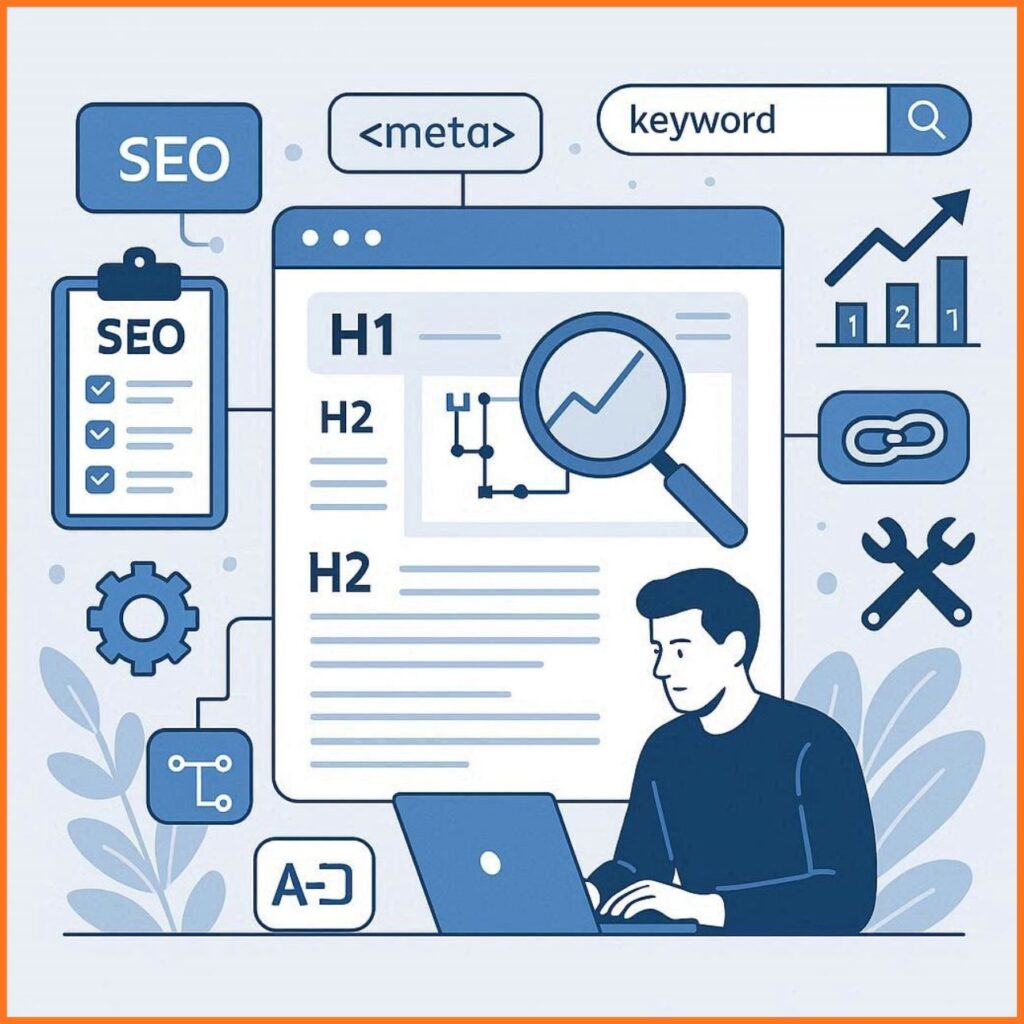
If your website isn’t ranking on Google—even after publishing content regularly—there’s a high chance your on-page SEO is weak.
On-page SEO is not just about adding keywords. In 2026, it’s about content quality, user intent, structured optimization, and AI-friendly signals.
In this complete guide, you’ll learn:
- What on-page SEO really means
- Proven techniques that actually work
- A practical checklist you can apply today
- Real examples to improve your rankings
What is On-Page SEO?
On-page SEO refers to optimizing individual web pages to rank higher in search engines and attract relevant traffic.
It includes:
- Content optimization
- HTML elements (title, meta, headings)
- Internal linking
- User experience improvements
👉 In simple terms:
On-page SEO = Everything you control directly on your website.
On-page SEO is the foundation of every successful SEO strategy. Before building backlinks or running campaigns, your website must clearly communicate its value to search engines and users.
When done correctly, on-page SEO helps search engines:
- Understand your content topic
- Identify the relevance of your page
- Match your page with the right search queries
- Rank your page for targeted keywords
At the same time, it improves user experience by:
- Making content easy to read
- Structuring information logically
- Helping users find what they need quickly
Key areas involved in on-page SEO:
- Content relevance: Writing content that directly answers user queries
- Keyword placement: Adding keywords naturally in titles, headings, and content
- Page structure: Using proper heading hierarchy (H1, H2, H3)
- Internal linking: Connecting related pages within your website
- Media optimization: Using images with alt text and proper compression
Why it matters:
- Improves organic rankings
- Increases click-through rates (CTR)
- Boosts engagement and dwell time
- Reduces bounce rate
👉 In 2026, on-page SEO is not just optimization—it’s about creating helpful, structured, and intent-driven content that both users and search engines trust.
Why On-Page SEO is Important in 2026
Search engines like Google have evolved. With AI-driven algorithms, they now focus heavily on:
- User intent matching
- Content depth & usefulness
- Page experience signals
- Topical authority
Without proper on-page SEO:
- Your content won’t rank—even if it’s good
- Competitors will outrank you
- Your traffic will stay near zero
In 2026, search engines are no longer just scanning keywords—they are understanding context, meaning, and user satisfaction. This shift makes on-page SEO more critical than ever before.
Modern ranking systems evaluate:
- Search intent accuracy: Does your content fully answer what the user is looking for?
- Content structure: Is your page easy to scan with headings, bullets, and clarity?
- Engagement signals: Do users stay, read, and interact with your content?
- Trust signals: Does your website appear reliable and authoritative?
How On-Page SEO impacts your growth:
- Better rankings: Proper optimization helps Google rank your page faster
- Higher CTR: Optimized titles and meta descriptions attract more clicks
- Improved engagement: Structured content keeps users on your page longer
- Conversion boost: Clear and helpful content leads to more inquiries or sales
What happens if you ignore it?
- Poor visibility in search results
- Low-quality traffic or irrelevant visitors
- High bounce rates
- Missed opportunities for leads and revenue
👉 In simple terms, on-page SEO acts as the bridge between your content and Google’s understanding.
If that bridge is weak, even the best content will fail. But if it’s strong, your website can consistently attract targeted traffic, better rankings, and long-term SEO success.
On-Page SEO Ranking Factors (Google Signals)
Google evaluates multiple signals to rank your page:
- Content relevance & intent match
- Keyword placement (title, headings, intro)
- Content depth & coverage
- Internal linking structure
- Page speed & Core Web Vitals
- Mobile friendliness
- E-E-A-T (Experience, Expertise, Authority, Trust)
- Structured data (schema markup)
Core Elements of On-Page SEO
1. Title Tag Optimization
Your title is the first thing users see in search results.
Best Practices:
- Include primary keyword
- Keep it under 60 characters
- Add emotional or power words
✅ Example:
What is On-Page SEO? Checklist & Techniques (2026 Guide)
2. Meta Description
This influences click-through rate (CTR).
Tips:
- Keep it under 155 characters
- Add a call-to-action
- Include your keyword naturally
3. URL Structure
Clean URLs improve both SEO and user experience.
❌ Bad:/page?id=123
✅ Good:/on-page-seo-checklist
4. Heading Tags (H1–H6)
- Use H1 only once
- Use H2s and H3s for structure
- Include keywords naturally
5. Keyword Optimization
Don’t overuse keywords—Google is smarter now.
Focus on:
- Primary keyword
- Secondary keywords
- Semantic keywords (LSI)
👉 Example:
- Primary: On-page SEO
- Secondary: On-page SEO checklist
- Semantic: content optimization, SEO techniques
6. Content Quality (Most Important)
Google ranks helpful content, not just keyword content.
Your content should:
- Solve user problems
- Be easy to read
- Provide real value
How to Improve E-E-A-T with On-Page SEO
Google rewards trustworthy content.
Improve E-E-A-T by:
- Adding author bio with expertise
- Sharing real experience or results
- Including case studies
- Linking to trusted sources
- Showing business/contact details
7. Internal Linking
Internal links help:
- Distribute SEO authority
- Improve crawling
- Increase user engagement
👉 Example:
Link your blog to related posts like:
- Technical SEO
- Link Building Guide
Internal Linking Strategy (Advanced)
- Use hub & spoke model
- Link blogs to service pages
- Use keyword-rich anchor text
- Avoid orphan pages
8. Image Optimization
Images also impact SEO.
Checklist:
- Use compressed images
- Add alt text
- Use descriptive file names
9. Page Speed & Mobile Friendliness
A slow website = lower rankings.
Improve:
- Loading speed
- Mobile usability
- Core Web Vitals
10. User Experience (UX Signals)
Google tracks:
- Bounce rate
- Time on page
- Engagement
👉 Better UX = Better rankings
Complete On-Page SEO Checklist (2026)
Use this checklist before publishing any page:
Content Checklist
- ✅ Keyword included in title
- ✅ Keyword in first 100 words
- ✅ Content length > 1000 words
- ✅ Covers user intent fully
Technical Checklist
- ✅ SEO-friendly URL
- ✅ Proper heading structure
- ✅ Internal links added
- ✅ External authority links
Optimization Checklist
- ✅ Images optimized
- ✅ Meta description written
- ✅ Mobile-friendly design
- ✅ Fast loading speed
On-Page SEO Techniques That Work in 2026
1. Search Intent Optimization
Understand what the user wants:
- Informational
- Transactional
- Navigational
👉 Match your content accordingly.
2. Topical Authority Building
Instead of one article, create content clusters.
Example:
- On-page SEO
- Technical SEO
- Off-page SEO
This builds trust and authority.
3. Content Depth & Coverage
Don’t write surface-level content.
Cover:
- Definitions
- Examples
- Case studies
- FAQs
4. AI-Friendly Content Structuring
Google AI prefers:
- Clear headings
- Bullet points
- Structured answers
5. Featured Snippet Optimization
To rank in position #0:
- Answer questions clearly
- Use short paragraphs
- Add FAQs
Step-by-Step On-Page SEO Workflow
- Keyword research
- Analyze competitors
- Identify search intent
- Create content outline
- Optimize title & headings
- Write valuable content
- Add internal links
- Optimize images
- Add schema markup
- Publish & track results
Real Example of On-Page SEO
Let’s say your keyword is:
“Digital Marketing Course in Chennai”
Optimized Page Includes:
- Title with keyword
- Content answering course-related queries
- Internal links to related services
- Location-based optimization
👉 Result: Higher rankings + local traffic
Mini Case Study: On-Page SEO Results
Before Optimization:
- Low impressions
- No clicks
After Optimization:
- Improved content depth
- Better keyword placement
- Strong internal linking
👉 Results:
- Increased impressions
- Ranking improvements
Schema Markup for Better Rankings
Use structured data to improve visibility:
- FAQ schema
- Article schema
- Breadcrumb schema
- Local business schema
👉 Benefits:
- Rich snippets
- Higher CTR
- Better indexing
Best Tools for On-Page SEO
- Google Search Console – Track performance
- Ahrefs – Keyword research
- SEMrush – Competitor analysis
- Yoast SEO – Basic optimization
- Rank Math – Advanced SEO
Common On-Page SEO Mistakes to Avoid
Avoid these errors:
- ❌ Keyword stuffing
- ❌ Thin content
- ❌ Duplicate content
- ❌ Ignoring mobile optimization
- ❌ Missing internal links
On-Page SEO vs Off-Page SEO
| On-Page SEO | Off-Page SEO |
|---|---|
| Done on your website | Done outside your website |
| Content & structure | Backlinks & authority |
| Fully controllable | Partially controllable |
👉 Both are important—but on-page is the foundation.
Content Update Strategy (Freshness SEO)
To maintain rankings:
- Update content every 3–6 months
- Add new data & examples
- Improve outdated sections
- Refresh keywords
Final Thoughts
On-page SEO is not optional—it’s the core of your ranking strategy.
If your page is not optimized:
- Google won’t understand it
- Users won’t engage
- Rankings won’t improve
👉 Start with strong on-page SEO, then build backlinks.
FAQs
What is on-page SEO?
On-page SEO is the process of optimizing individual web pages to improve rankings and attract organic traffic.
What are the most important on-page SEO factors?
Key factors include content quality, keyword usage, title tags, internal linking, and user experience.
How long does on-page SEO take to work?
Typically, results can be seen within 2–6 weeks, depending on competition and optimization level.
Is on-page SEO enough to rank?
No. On-page SEO builds the foundation, but backlinks and authority are also needed for competitive keywords.
Conclusion
If you want consistent rankings in 2026:
👉 Focus on user intent + content quality + technical optimization
That’s the real on-page SEO strategy.