
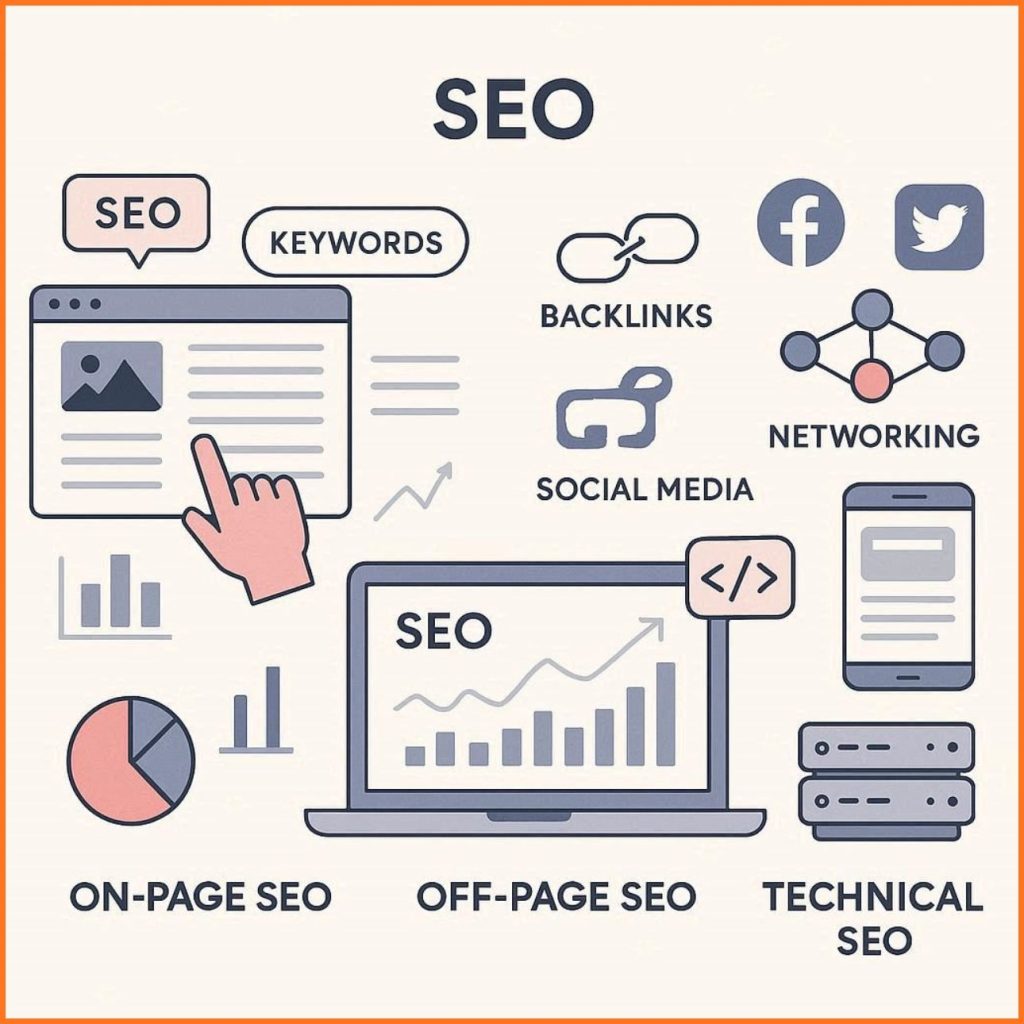
Search Engine Optimization (SEO) is the backbone of digital visibility. But SEO is not just one single strategy—it is a combination of multiple techniques working together to improve your website’s rankings.
In this complete guide by WorkSEO, we break down the three main types of SEO: On-Page SEO, Off-Page SEO, and Technical SEO, along with examples, strategies, and actionable tips for 2026.
What are the Types of SEO?
SEO is broadly categorized into three main types:
- On-Page SEO
- Off-Page SEO
- Technical SEO
Each type plays a critical role in improving your website’s performance on search engines like Google, Bing, and Yahoo.
To rank higher in search results, you must implement all three effectively.
1. On-Page SEO (Content & Page Optimization) – विस्तृत விளக்கம்
On-Page SEO refers to optimizing all the elements inside your website pages to improve search engine rankings and user experience.
In 2026, On-Page SEO is not just about keywords — it’s about:
- Search intent satisfaction
- Content depth
- User engagement
- Semantic relevance
Search engines like Google now prioritize helpful, experience-driven content rather than keyword-heavy pages.
🔍 Advanced Key Elements of On-Page SEO
🔹 1. Keyword Optimization (Beyond Basics)
Keyword optimization is no longer about repeating the same keyword—it’s about context and relevance.
✅ Best Practices:
- Use primary keyword in:
- Title (H1)
- First 100 words
- URL
- Add LSI keywords (related terms)
- Use semantic variations
💡 Example:
Primary keyword: Types of SEO
Related keywords:
- SEO techniques
- SEO methods
- On-page vs off-page SEO
👉 This helps search engines understand topic depth.
🔹 2. Search Intent Optimization (MOST IMPORTANT 🔥)
Understanding why a user searches is critical.
Types of Intent:
- Informational (learn something)
- Navigational (find a website)
- Transactional (buy/service)
💡 Example:
Keyword: “Types of SEO”
👉 Intent: Informational
So your content should:
- Explain clearly
- Use simple language
- Provide examples
🔹 3. High-Quality Content (E-E-A-T Focus)
Content must follow E-E-A-T principles:
- Experience
- Expertise
- Authoritativeness
- Trustworthiness
✅ Content Optimization Tips:
- Add real examples
- Use case studies
- Write in-depth (1500+ words)
- Keep content updated
🔹 4. Content Structure & Readability
Well-structured content improves both SEO and user experience.
Best Practices:
- Use H1, H2, H3 properly
- Keep paragraphs short (2–3 lines)
- Use bullet points
- Add visuals (images, infographics)
👉 Easy readability = lower bounce rate
🔹 5. Title Tags Optimization (CTR Booster)
Title tags directly impact rankings and clicks.
Formula:
Primary Keyword + Benefit + Year
Example:
Types of SEO: Complete Guide with Examples (2026)
Tips:
- Keep under 60 characters
- Add power words (Complete, Guide, Best)
🔹 6. Meta Description Optimization
Meta description improves click-through rate (CTR).
Example:
Learn the different types of SEO including On-Page, Off-Page, and Technical SEO with examples and strategies for 2026.
Tips:
- Keep under 155–160 characters
- Add CTA (Learn, Discover, Explore)
🔹 7. URL Structure Optimization
Clean URLs help both users and search engines.
✅ Good URL:
workseo.in/types-of-seo
❌ Bad URL:
workseo.in/page?id=12345
🔹 8. Internal Linking Strategy (Authority Flow)
Internal linking is a powerful SEO tactic often ignored.
Benefits:
- Passes link equity
- Helps indexing
- Improves user navigation
💡 Example:
Link this blog to:
- SEO Guide
- Keyword Research Blog
- Technical SEO Blog
🔹 9. Image Optimization (Visual SEO)
Images improve engagement and rankings.
Best Practices:
- Compress images
- Use descriptive filenames
- Add keyword-rich alt text
👉 Example Alt Text:
“On-page SEO optimization process illustration”
🔹 10. Core Web Vitals & UX Signals
User experience is a ranking factor.
Important Metrics:
- Page load speed
- Mobile usability
- Layout stability
Tools:
Use Google PageSpeed Insights to analyze performance.
🔹 11. Content Freshness (Update Strategy)
Updating content improves rankings.
What to update:
- Add latest data
- Improve structure
- Add new sections
👉 Google prefers fresh, updated content.
🧠 On-Page SEO Example (Advanced)
Let’s take a real scenario for WorkSEO:
Target Keyword:
“SEO services in Chennai”
Optimization Steps:
- Add keyword in title & headings
- Create 2000+ word content
- Add FAQs with schema
- Internal link to related blogs
- Optimize images
👉 Result:
- Higher rankings
- Increased dwell time
- Better conversions
📊 On-Page SEO Checklist (Advanced Version)
Content Optimization
- ✅ Keyword + LSI keywords used
- ✅ Search intent satisfied
- ✅ E-E-A-T followed
Technical Elements
- ✅ SEO-friendly URL
- ✅ Optimized title & meta
- ✅ Proper heading structure
User Experience
- ✅ Mobile-friendly design
- ✅ Fast loading speed
- ✅ Easy readability
Linking & Media
- ✅ Internal links added
- ✅ Optimized images
- ✅ Engaging visuals
🚀 Pro Tips from WorkSEO
- Focus on topic clusters, not single keywords
- Write for users first, search engines second
- Add FAQs to capture featured snippets
- Use structured data for better visibility
On-Page SEO is the foundation of your entire SEO strategy. Without proper on-page optimization, even strong backlinks and technical SEO cannot deliver results.
Mastering On-Page SEO ensures:
- Better rankings
- Higher engagement
- More conversions
2. Off-Page SEO (Authority Building) – Complete Guide
Off-Page SEO refers to all the activities performed outside your website to improve its authority, trust, and relevance in search engines.
In 2026, Off-Page SEO is not just about backlinks—it’s about building a strong digital reputation across the web.
Search engines like Google evaluate your website based on:
- Authority
- Trust signals
- Popularity
- Brand presence
👉 The stronger your off-page signals, the higher your chances of ranking.
🎯 Goal of Off-Page SEO
The main goal is to:
- Build domain authority
- Increase brand visibility
- Earn high-quality backlinks
- Improve search rankings
🔍 Advanced Key Elements of Off-Page SEO
🔹 1. Backlinks (Most Powerful Ranking Factor)
Backlinks remain one of the strongest ranking signals.
However, in 2026, quality matters more than quantity.
✅ Types of Backlinks:
- DoFollow backlinks (pass SEO value)
- NoFollow backlinks (indirect value)
- Editorial backlinks (most powerful)
- Guest post backlinks
💡 High-Quality Backlink Example:
A backlink from Forbes or HubSpot carries more weight than 100 low-quality links.
🚫 Avoid:
- Spam backlinks
- Paid link schemes
- Link farms
👉 These can lead to penalties.
🔹 2. Guest Posting (Authority + Traffic Strategy)
Guest posting is one of the safest and most effective link-building strategies.
Benefits:
- Build authority
- Gain backlinks
- Reach new audiences
- Improve brand recognition
💡 Pro Strategy:
- Target niche-relevant blogs
- Provide high-value content
- Use natural anchor text
🔹 3. Social Media Marketing (Amplification Engine)
Social signals may not be direct ranking factors, but they increase visibility and traffic, which indirectly boosts SEO.
Key Platforms:
Best Practices:
- Share every blog post
- Use engaging captions
- Add hashtags
- Encourage sharing
🔹 4. Brand Mentions (Linkless SEO 🔥)
Search engines now recognize brand mentions without links.
Types:
- Linked mentions
- Unlinked mentions
Example:
If “WorkSEO” is mentioned on multiple websites, it builds trust signals—even without backlinks.
🔹 5. Influencer Outreach (Trust Building Strategy)
Collaborating with influencers helps you reach a wider audience.
Benefits:
- High-quality backlinks
- Increased credibility
- Targeted traffic
Strategy:
- Partner with niche influencers
- Offer valuable collaborations
- Create shareable content
🔹 6. Directory Submissions (Local SEO Boost)
Submitting your website to high-quality directories improves visibility.
Examples:
- Google Business Profile
- Local business directories
- Industry-specific listings
👉 Helps in local SEO rankings.
🔹 7. Forum & Community Engagement
Participating in forums builds authority and trust.
Platforms:
- Quora
- Industry forums
Tips:
- Answer questions
- Provide value
- Add links naturally
🔹 8. Content Marketing & Distribution
Creating content is not enough—you must promote it.
Distribution Channels:
- Social media
- Email marketing
- Content syndication
👉 More visibility = more backlinks.
🔹 9. Broken Link Building (Smart Strategy 💡)
This involves:
- Finding broken links on other websites
- Suggesting your content as a replacement
👉 High success rate strategy.
🔹 10. Digital PR (Advanced SEO Strategy 🚀)
Digital PR helps you earn mentions and backlinks from news sites.
Example:
Getting featured on media websites like BBC or TechCrunch
👉 This significantly boosts authority.
📊 Off-Page SEO Example (Advanced)
Let’s take a practical scenario for WorkSEO:
Strategy:
- Publish high-quality blog
- Build 15 backlinks from niche sites
- Share on social media platforms
- Get featured in industry blogs
Result:
- Increased domain authority
- Higher keyword rankings
- More organic traffic
- Strong brand recognition
📈 Off-Page SEO Checklist (Advanced Version)
Backlink Strategy
- ✅ High-quality backlinks built
- ✅ Anchor text optimized
- ✅ Toxic links removed
Content Promotion
- ✅ Social media sharing
- ✅ Email outreach
- ✅ Content distribution
Authority Building
- ✅ Guest posts published
- ✅ Influencer collaborations
- ✅ Brand mentions tracked
Advanced Strategies
- ✅ Broken link building
- ✅ Digital PR campaigns
- ✅ Directory submissions
⚠️ Common Off-Page SEO Mistakes
Avoid these to protect your rankings:
- ❌ Buying backlinks
- ❌ Using spammy directories
- ❌ Over-optimized anchor text
- ❌ Ignoring link quality
- ❌ No content promotion strategy
🚀 Pro Tips from WorkSEO
- Focus on relevance over quantity
- Build backlinks gradually (natural growth)
- Combine content + promotion strategy
- Track backlinks using tools like Ahrefs
Off-Page SEO is what builds your website’s reputation on the internet.
Without strong off-page signals:
- Your content won’t rank easily
- Your authority will remain low
👉 Strong Off-Page SEO = Higher Trust + Better Rankings + More Traffic
3. Technical SEO (Website Performance Optimization) – Complete Guide
Technical SEO focuses on optimizing your website’s infrastructure and backend elements so that search engines can efficiently crawl, index, and rank your pages.
In 2026, Technical SEO is not optional—it’s critical for ranking success, especially with increasing competition and AI-driven algorithms.
Search engines like Google prioritize websites that are:
- Fast
- Secure
- Mobile-friendly
- Technically optimized
👉 Even the best content won’t rank if your technical SEO is weak.
🎯 Goal of Technical SEO
The primary goal is to:
- Improve crawlability
- Ensure proper indexing
- Enhance website performance
- Deliver excellent user experience
🔍 Advanced Key Elements of Technical SEO
🔹 1. Website Speed (Performance Optimization)
Page speed is a direct ranking factor.
Why It Matters:
- Reduces bounce rate
- Improves user experience
- Increases conversions
Best Practices:
- Compress images
- Enable browser caching
- Minify CSS & JavaScript
- Use CDN (Content Delivery Network)
🔧 Tool:
Use Google PageSpeed Insights to analyze and improve speed.
🔹 2. Mobile-Friendliness (Mobile-First Indexing)
Search engines now primarily use the mobile version of your website for ranking.
Best Practices:
- Responsive design
- Fast mobile loading
- Easy navigation
- Readable fonts
👉 Mobile optimization is mandatory in 2026.
🔹 3. XML Sitemap (Search Engine Guide)
An XML sitemap helps search engines discover and understand your site structure.
Benefits:
- Faster indexing
- Better crawl coverage
- Improved visibility
Example:
workseo.in/sitemap.xml
🔹 4. Robots.txt (Crawl Control)
The robots.txt file tells search engines which pages to crawl or ignore.
Example:
- Allow important pages
- Block admin or duplicate pages
👉 Incorrect setup can block your entire website from indexing.
🔹 5. HTTPS Security (Trust Signal 🔒)
Secure websites use HTTPS instead of HTTP.
Benefits:
- Builds trust
- Protects user data
- Improves rankings
👉 SSL certificate is essential.
🔹 6. Core Web Vitals (User Experience Metrics)
Core Web Vitals measure real user experience.
Key Metrics:
- LCP (Largest Contentful Paint) → Loading speed
- FID (First Input Delay) → Interactivity
- CLS (Cumulative Layout Shift) → Visual stability
👉 These directly impact rankings.
🔹 7. Crawlability & Indexability
Search engines must be able to:
- Crawl your pages
- Index your content
Best Practices:
- Fix crawl errors
- Avoid orphan pages
- Use proper internal linking
🔹 8. URL Structure Optimization
Clean URLs improve SEO and usability.
✅ Good Example:
workseo.in/technical-seo-guide
❌ Bad Example:
workseo.in/page?id=9876
🔹 9. Canonical Tags (Duplicate Content Control)
Canonical tags tell search engines which version of a page is the original.
Use Case:
Avoid duplicate content issues.
🔹 10. Structured Data (Schema Markup) 🚀
Structured data helps search engines understand your content better.
Benefits:
- Rich snippets in search results
- Higher click-through rate
- Better visibility
Examples:
- FAQ schema
- Article schema
- Review schema
🔹 11. Broken Links & Error Fixing
Broken links harm user experience and SEO.
Fix:
- Identify 404 errors
- Redirect using 301 redirects
🔹 12. Website Architecture (SEO Foundation)
A well-structured website improves:
- Navigation
- Crawlability
- User experience
Best Practice:
- Keep pages within 3 clicks from homepage
🔹 13. Log File Analysis (Advanced SEO 🔥)
Analyzing server logs helps you understand:
- How search engines crawl your site
- Which pages are indexed
- Crawl frequency
👉 Advanced strategy used by SEO experts.
📊 Technical SEO Example (Advanced)
Let’s take a real scenario for WorkSEO:
Issues:
- Slow loading pages
- Broken links
- Poor mobile experience
Optimization Steps:
- Improved page speed (under 2 seconds)
- Fixed crawl errors
- Implemented mobile-friendly design
- Added structured data
Result:
- Faster indexing
- Improved rankings
- Better user engagement
📈 Technical SEO Checklist (Advanced Version)
Performance Optimization
- ✅ Fast loading speed (<2 seconds)
- ✅ Optimized images & scripts
- ✅ CDN implemented
Crawl & Indexing
- ✅ XML sitemap submitted
- ✅ Robots.txt configured
- ✅ No crawl errors
User Experience
- ✅ Mobile-friendly design
- ✅ Core Web Vitals optimized
- ✅ Easy navigation
Technical Setup
- ✅ HTTPS enabled
- ✅ Canonical tags added
- ✅ Clean URL structure
Advanced Optimization
- ✅ Structured data implemented
- ✅ Broken links fixed
- ✅ Log file analysis done
⚠️ Common Technical SEO Mistakes
Avoid these critical errors:
- ❌ Blocking pages in robots.txt
- ❌ Slow website speed
- ❌ Duplicate content issues
- ❌ Missing sitemap
- ❌ Poor mobile optimization
🚀 Pro Tips from WorkSEO
- Perform monthly technical audits
- Use automation tools for monitoring
- Fix errors immediately
- Combine technical SEO with content strategy
Technical SEO is the foundation of your entire SEO strategy.
Without it:
- Your content won’t be indexed properly
- Your rankings will suffer
- Your user experience will decline
👉 Strong Technical SEO = Better Performance + Higher Rankings + Long-Term Growth
Difference Between On-Page, Off-Page & Technical SEO
| SEO Type | Focus Area | Example |
|---|---|---|
| On-Page SEO | Content & structure | Keyword optimization |
| Off-Page SEO | Authority & trust | Backlinks |
| Technical SEO | Performance & coding | Page speed optimization |
How These SEO Types Work Together
SEO success comes from combining all three types.
Example Strategy:
- On-Page → Create optimized content
- Off-Page → Build backlinks
- Technical → Improve site performance
👉 Result: Higher rankings and better user experience.
Common SEO Mistakes to Avoid
- ❌ Ignoring technical SEO
- ❌ Buying low-quality backlinks
- ❌ Keyword stuffing
- ❌ Duplicate content
- ❌ Slow website speed
SEO Trends in 2026
SEO continues to evolve rapidly with advancements in technology and changing user behavior. In 2026, search engines are becoming smarter, focusing more on delivering highly relevant, user-first results rather than just keyword-matched content.
🔑 Key Trends:
- AI-Powered Content Optimization
AI tools are now assisting in content creation, keyword clustering, and optimization. However, human expertise and originality remain crucial for ranking. - Voice Search SEO
With the rise of smart assistants, users are searching using conversational queries. Optimizing for natural language and question-based keywords is essential. - Visual Search
Image-based search is growing. Optimizing images with proper alt text, file names, and structured data helps improve visibility. - E-E-A-T Focus
Experience, Expertise, Authoritativeness, and Trustworthiness are critical ranking factors, especially for competitive niches. - User Experience (UX) as a Ranking Factor
Fast-loading, mobile-friendly, and easy-to-navigate websites perform better in search rankings.
Search engines like Google are prioritizing helpful, experience-driven content more than ever.
👉 The future of SEO lies in combining technology + human value + user intent for sustainable rankings.
Final Thoughts
Understanding the different types of SEO is essential for building a strong online presence. On-Page SEO helps optimize your content, Off-Page SEO builds authority, and Technical SEO ensures your website performs well.
By combining all three, businesses can achieve long-term success in search rankings.
Want to rank your website on the first page?
👉 Contact WorkSEO today and grow your business with expert SEO strategies!
About WorkSEO
WorkSEO is a results-driven digital marketing agency specializing in SEO, content marketing, and lead generation. With over a decade of experience, WorkSEO helps businesses rank higher and generate consistent organic traffic.
FAQs
1. What are the 3 main types of SEO?
On-Page SEO, Off-Page SEO, and Technical SEO.
2. Which type of SEO is most important?
All three are equally important and work together.
3. How long does SEO take?
Typically 3–6 months for noticeable results.
4. Can I do SEO without technical knowledge?
Basic SEO is possible, but technical SEO requires expertise.