
Introduction
Financial indifference point is an important concept in financial management that helps a company compare alternative financing plans involving debt and equity. It represents the level of Earnings Before Interest and Taxes (EBIT) at which two alternative capital structures produce the same Earnings Per Share (EPS) for equity shareholders.
In corporate finance, a company may raise funds by issuing equity shares, borrowing through debt, or combining both sources. Each financing option affects shareholders differently. Equity financing may dilute ownership, while debt financing introduces a fixed interest obligation. The financial indifference point helps management understand how these financing alternatives affect earnings available to shareholders at different levels of operating profit.
For UPSC Commerce & Accountancy Optional aspirants, this concept connects capital structure, financial leverage, cost of financing, risk and return, and numerical problem-solving. Understanding its formula and interpretation is essential for analysing financing decisions rather than simply memorising equations.
This article explains the meaning of the financial indifference point, its formula, step-by-step numerical calculations, managerial applications, limitations and relevance to UPSC answer writing.
1. Meaning of Financial Indifference Point
The financial indifference point is the level of EBIT at which the EPS under two alternative financing plans is equal.
It is also called the EBIT-EPS indifference point.
Suppose a company considers two financing plans:
Plan A: The company raises funds entirely through equity shares.
Plan B: The company raises part of its funds through debt and the remainder through equity shares.
Under Plan A, there may be no interest expense. Under Plan B, interest must be paid before calculating earnings available to equity shareholders.
At a particular EBIT, both plans may generate exactly the same EPS. That EBIT is the financial indifference point.
Key characteristics
It compares alternative financing plans rather than different investment projects.
It is expressed as a level of EBIT.
It is determined by the interest burden, tax rate and number of equity shares under each plan.
It helps explain the relationship between financial leverage and shareholder earnings.
It does not automatically identify the financing plan with the lowest risk or the highest overall company value.
2. Understanding EBIT and EPS
Before calculating the indifference point, students must understand two fundamental terms.
Earnings Before Interest and Taxes (EBIT)
EBIT represents operating earnings before deducting interest and income tax. It is commonly used to examine how financing choices affect shareholder earnings while holding operating earnings constant.
Earnings Per Share (EPS)
EPS measures the earnings attributable to each outstanding equity share.
Where:
EBITEBITEBIT = Earnings Before Interest and Taxes
III = Interest expense
TTT = Applicable income tax rate, expressed as a decimal
NNN = Number of equity shares outstanding
This formula assumes positive taxable earnings, a constant tax rate, and no other adjustments to earnings available to equity shareholders.
When there is no debt interest, I=0I=0I=0. When debt is used, interest reduces the earnings available to shareholders.
3. Financial Indifference Point Formula
The financial indifference point is calculated by equating the EPS of two financing plans.
For two alternative financing plans:
Where:
I1I_1I1 and I2I_2I2 represent the interest expenses under the two plans.
N1N_1N1 and N2N_2N2 represent their respective numbers of equity shares.
If both plans have the same tax rate and tax treatment, the common tax factor cancels out. The equation becomes:
Solving for EBIT gives:
Here, EBIT∗EBIT^*EBIT∗ denotes the financial indifference point, provided N1≠N2N_1\ne N_2N1=N2.
The formula assumes that the two plans differ in their financing terms but are being compared under consistent operating and tax assumptions. If tax treatments differ, the full EPS equations must be used instead.
4. Numerical Illustration: Calculation of the Financial Indifference Point
Consider a company evaluating two financing alternatives. The following figures are hypothetical and are used only to explain the calculation.
Given information
Particulars | Plan A: Equity | Plan B: Debt and equity |
|---|---|---|
Equity shares outstanding | 1,00,000 | 60,000 |
Interest expense | ₹0 | ₹2,00,000 |
Tax rate | 30% | 30% |
Assume that both plans finance the same business operations and that no preference shares are involved.
Step 1: Write the EPS equations
For Plan A:
For Plan B:
Step 2: Equate the two EPS values
At the financial indifference point:
Cancel the common tax factor of 0.70:
Cross-multiplying:
Step 3: Verify the result
At EBIT of ₹5,00,000:
Particulars | Plan A | Plan B |
|---|---|---|
EBIT | ₹5,00,000 | ₹5,00,000 |
Less: Interest | ₹0 | ₹2,00,000 |
Earnings before tax | ₹5,00,000 | ₹3,00,000 |
Tax at 30% | ₹1,50,000 | ₹90,000 |
Earnings available to equity shareholders | ₹3,50,000 | ₹2,10,000 |
Number of equity shares | 1,00,000 | 60,000 |
EPS | ₹3.50 | ₹3.50 |
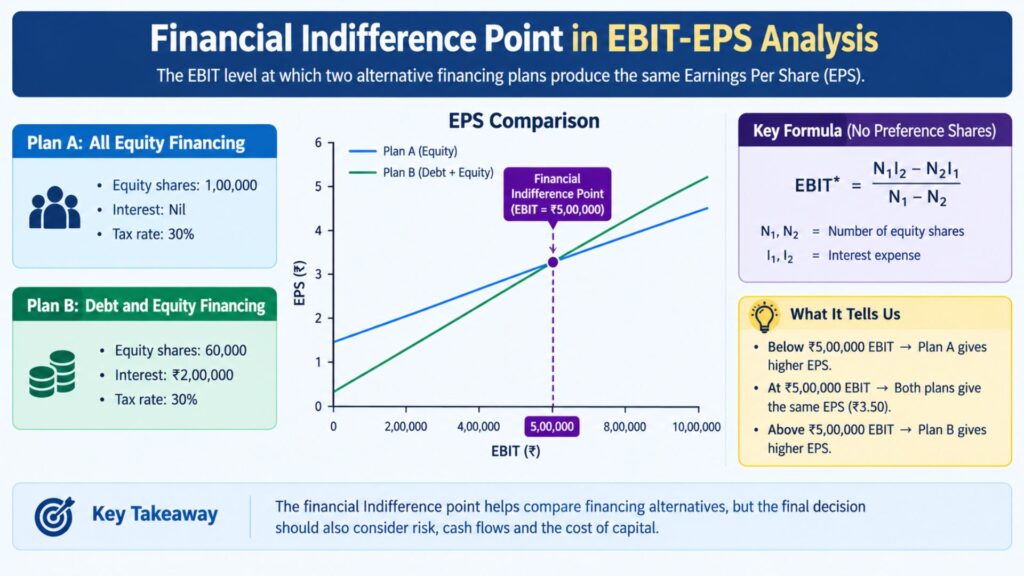
Interpretation: The financial indifference point is ₹5,00,000 EBIT. At this operating earnings level, both plans produce an EPS of ₹3.50.
The example demonstrates how debt financing reduces earnings through interest but may also reduce the number of shares over which earnings are distributed.
5. What Happens Above and Below the Indifference Point?
The indifference point helps explain the relationship between operating earnings and financial leverage. The implications depend on the financing plans being compared.
Below ₹5,00,000 EBIT
In the example, Plan A generates higher EPS because the debt-financed plan must meet interest costs despite lower operating earnings.
At ₹5,00,000 EBIT
Both financing plans generate the same EPS of ₹3.50.
Above ₹5,00,000 EBIT
Plan B generates higher EPS in this example because the benefit of having fewer equity shares outweighs its fixed interest burden.
These conclusions apply to the stated example and its assumptions; they are not universal rules for every financing structure. EBIT-EPS analysis compares shareholder earnings, not the full economic value or risk of a company. Standard financial management teaching materials use this equality-of-EPS approach to calculate the indifference point.
6. Financial Indifference Point When Preference Shares Are Involved
When preference shares are part of a financing plan, preference dividends must also be considered. Unlike interest expense, preference dividends are generally paid out of earnings after tax and are not deducted when calculating taxable income.
The general EPS expression becomes:
Where PDPDPD represents preference dividends.
For two plans with potentially different interest expenses, preference dividends and share counts, equate their complete EPS expressions:
Solving this equation gives the indifference EBIT, if a unique solution exists.
Important distinction: Do not deduct preference dividends before calculating tax. Interest and preference dividends have different treatments in the conventional EBIT-EPS model.
7. Advantages and Limitations of EBIT-EPS Indifference Analysis
Advantages | Limitations |
|---|---|
Compares EPS under alternative financing plans. | Does not directly measure shareholder wealth or market value. |
Supports capital structure analysis. | Depends on assumptions about EBIT, interest and share counts. |
Demonstrates the effect of financial leverage. | Does not fully capture the probability of financial distress. |
Provides a useful numerical framework for financial decisions. | A higher EPS does not necessarily mean a lower cost of capital. |
Helps analyse different operating earnings scenarios. | Ignores several real-world factors unless separately incorporated. |
Managers should therefore consider the indifference point alongside debt-servicing capacity, cash flows, business risk, cost of capital, market conditions and long-term financial flexibility.
Why This Topic Matters for UPSC
The financial indifference point is relevant to the Financial Management portion of UPSC Commerce & Accountancy Optional because it combines financial theory with quantitative analysis.
Conceptual understanding: Explains how capital structure affects earnings available to equity shareholders.
Numerical problem-solving: Requires candidates to formulate EPS equations, equate them and solve for EBIT.
Analytical answer writing: Helps explain the relationship between debt, interest obligations, financial leverage and shareholder returns.
Case-based questions: Can be applied when a company must choose between equity financing and debt-equity financing.
Financial interpretation: Demonstrates why EPS should be analysed alongside financial risk and cost of capital.
General Studies and Essay: Provides supporting knowledge for discussions involving corporate finance, investment decisions and business sustainability, where relevant.
Candidates should understand both the calculation and the limitations of using EPS as the sole basis for a financing decision.
UPSC Mains Answer Writing Approach
10-Mark Answer
Suggested structure:
Define the financial indifference point.
State the EPS equation for two alternative financing plans.
Explain the role of interest, tax and equity shares.
Give a short numerical example.
Conclude by noting that equal EPS does not imply equal financial risk.
15-Mark Answer
Suggested structure:
Introduce EBIT-EPS analysis and its purpose.
Explain financial indifference point and derive the formula.
Discuss the effect of debt and equity financing.
Present a numerical illustration and interpretation.
Analyse the usefulness and limitations of the technique.
Conclude with the need to consider risk and cost of capital.
20-Mark Answer
Suggested structure:
Define the concept and establish its place in capital structure decisions.
Explain EBIT, EPS, financial leverage and the assumptions of the model.
Derive the indifference-point equation for two financing plans.
Calculate and interpret a numerical example.
Analyse EPS differences above and below the indifference point.
Discuss preference dividends where relevant.
Critically examine limitations, including financial distress risk and the distinction between EPS and shareholder wealth.
Conclude with a balanced assessment of the technique.
Short Model Answer Framework
Question: Explain the financial indifference point and its significance in capital structure decisions.
Introduction: The financial indifference point is the level of EBIT at which two alternative financing plans generate equal EPS.
Explanation: It is calculated by equating the EPS expressions of the two plans and solving for EBIT. The result depends on the interest obligations, number of equity shares and relevant tax assumptions.
Illustration: If an all-equity plan has 1,00,000 shares and a debt-equity plan has 60,000 shares with annual interest of ₹2,00,000, the indifference point is ₹5,00,000 EBIT, assuming identical tax rates and no preference shares.
Analysis: Below this level, the all-equity plan produces higher EPS in the illustration; above it, the debt-equity plan produces higher EPS. However, debt also creates fixed financial obligations.
Conclusion: The indifference point is a useful capital structure analysis tool, but the final financing assessment should also consider risk, cash flows and the cost of capital.
UPSC Prelims Quick Revision
Financial indifference point: EBIT at which EPS is equal under two financing plans.
Related concept: EBIT-EPS analysis.
EBIT: Earnings before interest and taxes.
EPS: Earnings available to equity shareholders divided by the number of equity shares.
Interest expense: Deducted before calculating profit before tax in the standard model.
Preference dividends: Deducted after tax when calculating earnings available to ordinary equity shareholders.
Tax assumption: A common tax rate may cancel when equating EPS expressions if both plans have the same tax treatment.
Financial leverage: Arises from fixed financial costs such as interest on debt.
Interpretation: The indifference point concerns equal EPS, not equal risk or equal firm value.
Graphical representation: The point at which the EPS lines of two financing plans intersect.
Important Formulas to Remember
1. Earnings Per Share
Meaning: Earnings available to ordinary equity shareholders per share under the conventional model.
Use: Calculating EPS under a financing plan that may include debt and preference shares.
2. Indifference Point: Two Plans
Meaning: EPS under Plan 1 equals EPS under Plan 2.
Use: Finding the indifference EBIT when the plans may differ in interest, preference dividends or share counts.
3. Simplified Indifference Point
When preference dividends are absent and both plans have the same tax rate:
Meaning: The EBIT at which both plans produce the same EPS, provided the denominator is non-zero and the stated assumptions hold.
Use: Quickly solving conventional debt-equity versus equity-financing numerical problems.
5 Likely UPSC-Style Questions
1. Define the financial indifference point. Explain its significance in EBIT-EPS analysis and capital structure decisions.
2. Derive the formula for calculating the EBIT-EPS indifference point between two alternative financing plans. Explain the assumptions underlying the formula.
3. A company has two financing alternatives. Plan A consists of 1,00,000 equity shares with no debt, while Plan B consists of 60,000 equity shares and debt carrying annual interest of ₹2,00,000. Assuming identical tax rates and no preference shares, calculate the financial indifference point and interpret the result.
4. Critically examine the usefulness and limitations of EBIT-EPS analysis in determining an appropriate capital structure. Why should EPS maximisation not be treated as the sole objective of financial management?
5. Distinguish between the financial indifference point and the financial break-even point. Explain their significance in analysing financial leverage and shareholder earnings.
Frequently Asked Questions (FAQs)
1. What is the financial indifference point?
The financial indifference point is the level of EBIT at which two alternative financing plans generate the same earnings per share. It helps compare the effect of different capital structures on shareholder earnings.
2. What is the formula for the financial indifference point?
For two financing plans with no preference dividends and the same tax rate, the formula is:
Here, N1N_1N1 and N2N_2N2 are the numbers of equity shares, while I1I_1I1 and I2I_2I2 are the interest expenses under the respective plans.
3. Why is the financial indifference point important?
It identifies the operating earnings level at which alternative financing plans produce equal EPS. This helps management analyse the potential effects of debt and equity financing on shareholder earnings.
4. What happens when EBIT is above the financial indifference point?
In a conventional comparison between an all-equity plan and a debt-equity plan, the debt-equity plan may generate higher EPS above the indifference point because fewer shares participate in the remaining earnings. The result depends on the assumptions and financing terms.
5. Is the financial indifference point the same as the financial break-even point?
No. The financial indifference point is the EBIT at which two financing plans produce equal EPS. Financial break-even generally refers to the EBIT level at which EPS becomes zero after accounting for relevant fixed financial charges and preference dividends. The two concepts address different questions.
Conclusion
The financial indifference point is a fundamental tool in financial management for comparing alternative capital structures. By identifying the EBIT level at which two financing plans generate equal EPS, it clarifies how interest obligations and equity share counts influence shareholder earnings.
However, equal EPS does not mean equal financial risk, cash-flow obligations or business value. For sound financial decisions, managers must evaluate the indifference point alongside financial leverage, debt-servicing capacity and the cost of capital.
For UPSC Commerce & Accountancy aspirants, mastering the definition, formula, numerical calculation and limitations of this concept provides a strong foundation for both numerical questions and analytical answers.