
Introduction
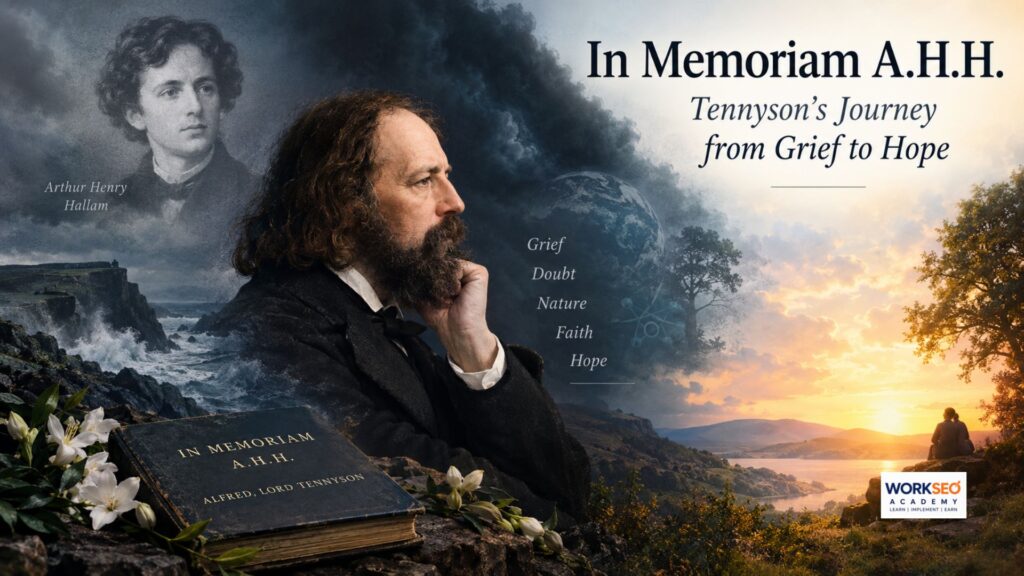
Alfred, Lord Tennyson’s In Memoriam A.H.H. is one of the most significant elegies in Victorian English literature. Written in response to the death of his close friend Arthur Henry Hallam, the poem explores the painful journey from personal loss and spiritual doubt towards a renewed, though not entirely unquestioning, sense of faith and hope. It examines how an individual confronts death, questions divine justice, struggles with scientific ideas about nature, and searches for meaning in a seemingly indifferent universe.
Published in 1850, In Memoriam reflects the intellectual and spiritual uncertainties of Victorian society. Religious belief faced new questions arising from scientific inquiry, geological discoveries, and changing ideas about humanity’s place in nature. Tennyson transforms his private grief into a broader meditation on faith, love, mortality, and human progress.
For UPSC English Literature aspirants, understanding In Memoriam: From Doubt and Bitter Grief to Certainty and Hope involves more than summarising its themes. It requires examining the elegiac tradition, the structure of the poem, Tennyson’s use of imagery and symbolism, and the relationship between personal suffering and Victorian intellectual history.
1. Background of In Memoriam A.H.H.
Alfred, Lord Tennyson (1809–1892) was a major Victorian poet whose works frequently explore mortality, doubt, faith, and the conflict between emotional experience and intellectual inquiry.
Arthur Henry Hallam, a gifted young intellectual and Tennyson’s close friend, died suddenly in 1833 at the age of twenty-two. His death deeply affected Tennyson. The poet composed a series of lyrics over several years, eventually arranging them into the larger work known as In Memoriam A.H.H., published in 1850.
The initials A.H.H. refer to Arthur Henry Hallam. The poem is an elegy, a poetic form that expresses grief for the dead while reflecting on loss, memory, and the possibility of consolation.
Unlike a conventional elegy that moves relatively directly from mourning to consolation, In Memoriam presents grief as a prolonged and uneven psychological and spiritual process. Moments of hope coexist with renewed sorrow and doubt.
2. From Bitter Grief to Spiritual Uncertainty
The personal experience of loss
At the beginning of the poem, Tennyson struggles to accept Hallam’s death. Memory intensifies the pain because the dead friend remains emotionally present but physically absent. Familiar places and ordinary experiences become reminders of the loss.
The speaker’s grief is not merely sadness. It challenges his understanding of life, friendship, justice, and divine purpose. If a person of such promise can die so young, what meaning can be assigned to human existence?
Tennyson gives grief intellectual depth by connecting private suffering with universal questions. The loss of one friend becomes a means of investigating the human condition.
The failure of immediate consolation
The poem does not present religious faith as an easy solution. The speaker repeatedly discovers that familiar beliefs cannot immediately resolve the emotional reality of death.
This tension makes the elegy psychologically convincing. The mind may accept religious teachings while the heart continues to experience anguish. Tennyson recognises the difference between inherited belief and faith tested by suffering.
3. Doubt and the Victorian Intellectual Crisis
One of the most important dimensions of In Memoriam is its treatment of doubt. Tennyson wrote during a period when scientific and historical developments were challenging traditional interpretations of humanity and the natural world.
Geological discoveries suggested that the Earth was far older than many traditional readings of biblical chronology had assumed. Scientific investigations increasingly emphasised natural processes that did not appear to operate according to immediate human moral needs.
The poem reflects anxiety about a universe in which suffering and death appear to be integral to natural existence.
Nature and the problem of suffering
Tennyson does not always portray nature as a comforting expression of divine goodness. Nature can appear beautiful and creative, yet also violent, wasteful, and indifferent to individual life.
The famous description of nature as “red in tooth and claw” presents a world shaped by struggle and destruction. The image captures the speaker’s difficulty in reconciling the natural world with a belief in a benevolent Creator.
This conflict is especially significant because Hallam’s death forces the speaker to confront abstract intellectual questions through personal pain.
Faith versus intellectual doubt
Tennyson’s doubt is not equivalent to a simple rejection of religion. Instead, the poem dramatises the struggle to maintain belief when experience seems to contradict it.
The speaker moves between scepticism and faith, demonstrating that spiritual conviction can involve questioning rather than the complete absence of uncertainty.
4. The Movement from Doubt to Certainty and Hope
The poem’s movement towards hope is gradual rather than absolute. Tennyson does not erase the reality of suffering or provide a demonstrable explanation for death. Instead, he explores forms of consolation that become possible through love, memory, moral reflection, and renewed spiritual belief.
Love as a response to death
The enduring relationship between the speaker and Hallam becomes central to the poem’s search for meaning. Physical separation cannot entirely destroy the emotional and intellectual bond formed during life.
Memory allows the speaker to preserve Hallam’s significance without pretending that the loss has been reversed. Love therefore becomes a force that resists the apparent finality of death.
The recovery of faith
As the poem progresses, the speaker increasingly considers whether human love reflects a larger spiritual reality. The possibility that personal relationships participate in a divine order helps restore hope.
However, this hope remains connected to struggle. The speaker’s faith emerges through confrontation with doubt, not through the simple suppression of difficult questions.
The meaning of hope
The poem’s concluding movement towards reconciliation is symbolically reinforced by its association with marriage and the continuation of life. Its final sections suggest renewal, continuity, and the possibility of harmony between human experience and a larger spiritual purpose.
Nevertheless, the conclusion should not be interpreted as proof that every earlier question has been resolved. Tennyson presents hope as a hard-won orientation towards life rather than a complete intellectual explanation of suffering.
5. Major Themes in In Memoriam
Key concepts for UPSC English Literature revision
Theme | Explanation |
|---|---|
Grief and mourning | The emotional consequences of Hallam’s death and the difficulty of accepting loss. |
Faith and doubt | The conflict between religious belief and intellectual scepticism. |
Love and friendship | The enduring emotional connection between the living and the dead. |
Nature and suffering | The apparent conflict between natural destruction and belief in a benevolent God. |
Immortality | The possibility that human identity and love continue beyond physical death. |
Human progress | The hope that humanity may develop morally and spiritually. |
Memory and time | The relationship between past experience, present suffering, and future consolation. |
These themes make In Memoriam both a personal elegy and a philosophical poem. Its significance lies in its attempt to reconcile emotional experience, scientific awareness, and spiritual aspiration.
6. Literary Techniques and Poetic Structure
Elegiac form
An elegy is a poem of mourning that often moves towards consolation or reflection. Tennyson develops this tradition by making grief an extended process of questioning. The poem does not follow a simple, uninterrupted progression from sadness to acceptance.
The In Memoriam stanza
The poem consists of 133 numbered sections, together with a prologue and an epilogue. Its characteristic stanza contains four lines written in iambic tetrameter, with an ABBA rhyme scheme. This enclosed rhyme pattern gives the stanzas a sense of formal unity, even when the speaker experiences emotional instability.
The regular structure provides a contrast to the uncertainties expressed within it. Form becomes a means of containing and examining grief.
Symbolism and imagery
Tennyson frequently uses natural images, including flowers, seasons, darkness, and changing landscapes, to express emotional and spiritual conditions.
Flowers can suggest beauty, affection, and the fragility of life. Seasonal change evokes the passage of time and the possibility of renewal. Images of darkness and destruction communicate doubt and despair, while images associated with light and continuity suggest hope.
Personification and metaphor
Tennyson gives abstract experiences such as grief, time, and nature an almost personal presence. This makes philosophical problems emotionally immediate.
The metaphor of nature as “red in tooth and claw” is particularly important because it expresses the apparent violence of natural processes. Rather than presenting nature as an uncomplicated source of spiritual reassurance, Tennyson makes it a challenge that faith must confront.
7. Victorian Context and Critical Interpretation
The Victorian period witnessed substantial changes in scientific knowledge, religious thought, and social attitudes. These changes made questions about creation, human identity, death, and immortality increasingly significant in literature.
Published in 1850, In Memoriam predates Charles Darwin’s On the Origin of Species (1859). Although Tennyson’s poem should not be treated as a response to Darwin’s later book, its engagement with nature, struggle, and human origins reflects broader nineteenth-century intellectual uncertainties.
A useful critical approach is to understand the poem through three interconnected perspectives:
Psychological: grief alters the speaker’s emotions, memories, and sense of identity.
Philosophical: the poem examines whether suffering can be reconciled with divine justice and a meaningful universe.
Historical: the speaker’s doubts reflect wider Victorian concerns about the relationship between religion and emerging scientific knowledge.
These interpretations are complementary rather than mutually exclusive. The poem’s strength lies in its ability to combine personal experience with larger intellectual questions.
8. Comparison with Other Elegies
In Memoriam belongs to a long tradition of English elegiac poetry, but its treatment of grief has distinctive features.
Work | Author | Key concern |
|---|---|---|
Lycidas | John Milton | The death of a young friend, pastoral mourning, and spiritual consolation. |
Adonais | Percy Bysshe Shelley | Mourning John Keats and exploring poetic immortality. |
In Memoriam A.H.H. | Alfred, Lord Tennyson | Personal bereavement, religious doubt, nature, and the recovery of hope. |
Milton’s Lycidas draws strongly on pastoral conventions and Christian consolation. Shelley’s Adonais presents the dead poet’s continuing existence through a more explicitly idealist vision of poetic immortality. Tennyson, by contrast, gives sustained attention to the instability of belief and the difficulty of reconciling suffering with faith.
This comparison helps students identify both continuity within the elegiac tradition and the distinctive intellectual concerns of Victorian poetry.
9. Why This Topic Matters for UPSC
In Memoriam: From Doubt and Bitter Grief to Certainty and Hope is useful for UPSC preparation because it connects close textual analysis with literary history and philosophical interpretation.
UPSC English Literature: Helps students analyse elegy, poetic structure, imagery, symbolism, Victorian poetry, and Tennyson’s treatment of faith and mortality.
General awareness: Provides context for understanding Victorian intellectual history and nineteenth-century debates about religion and science.
UPSC Mains: Develops the ability to construct an argument, support interpretations with textual evidence, and distinguish a poem’s themes from its literary techniques.
Essay writing: Offers ideas about grief, resilience, uncertainty, human relationships, and the search for meaning.
Reading comprehension: Encourages careful interpretation of metaphor, tone, contrast, and shifts in the speaker’s thinking.
Vocabulary and language: Introduces terms such as elegy, bereavement, scepticism, consolation, immortality, and spiritual reconciliation.
The central examination skill is to explain how Tennyson transforms grief into a search for hope, rather than simply listing grief, faith, and love as separate themes.
10. UPSC Mains Answer Writing Approach
The question may ask how the poem moves from grief to hope, how Tennyson treats Victorian doubt, or how the work develops the English elegiac tradition. The answer should combine argument, historical context, and textual evidence.
10-mark answer
Introduction: Identify In Memoriam A.H.H. as Tennyson’s elegy for Arthur Henry Hallam.
Major points: Explain personal grief, doubt about divine justice, and the gradual recovery of faith.
Example: Discuss the “red in tooth and claw” image as an expression of conflict between nature and religious belief.
Conclusion: Emphasise that hope emerges through the struggle with grief rather than through its denial.
15-mark answer
Introduce the poem and its Victorian background.
Explain the psychological effects of Hallam’s death.
Analyse the conflict between natural suffering and religious faith.
Discuss love, memory, and immortality as sources of consolation.
Examine the stanza form and recurring natural imagery.
Conclude that the poem offers a qualified movement towards spiritual reconciliation.
20-mark answer
Establish the poem’s position within Victorian poetry and the elegiac tradition.
Explain its autobiographical background and the significance of Hallam.
Analyse grief, doubt, nature, faith, love, immortality, and human progress.
Examine the relationship between poetic form and emotional uncertainty.
Compare Tennyson’s approach with Milton’s Lycidas or Shelley’s Adonais.
Conclude by evaluating hope as an achievement of sustained reflection, not a complete resolution of every doubt.
Short model answer framework
Question: How does Tennyson move from doubt and bitter grief to certainty and hope in In Memoriam A.H.H.?
Introduction: Tennyson’s In Memoriam A.H.H. transforms the personal grief caused by Hallam’s death into a sustained exploration of faith, mortality, and human meaning.
Analysis: The speaker initially struggles with bereavement and questions the justice of a universe in which promising lives end prematurely. The image of nature as “red in tooth and claw” intensifies his doubts about divine goodness. Yet love and memory preserve Hallam’s significance, while the possibility of immortality gradually supports a renewed spiritual outlook. The poem’s regular stanza form gives shape to this unsettled journey.
Conclusion: Tennyson does not simply replace sorrow with certainty. He presents hope as a developing faith that has confronted suffering and intellectual doubt.
11. UPSC Prelims Quick Revision
Author: Alfred, Lord Tennyson (1809–1892).
Work: In Memoriam A.H.H.
Publication year: 1850.
Subject: The death of Arthur Henry Hallam, Tennyson’s close friend.
Literary period: Victorian age.
Genre: Elegy and philosophical poetry.
Structure: 133 numbered sections, a prologue, and an epilogue.
Stanza form: Four-line stanzas, iambic tetrameter, ABBA rhyme scheme.
Major themes: Grief, faith, doubt, nature, love, immortality, and hope.
Historical context: Victorian debates concerning religious belief, science, and humanity’s place in nature.
Important distinction: The poem predates Darwin’s On the Origin of Species (1859).
Key image: Nature “red in tooth and claw,” expressing the apparent violence of natural existence.
12. Likely UPSC-Style Questions
Definition: What is an elegy? Explain the characteristics of the elegiac form with reference to Tennyson’s In Memoriam A.H.H.
Analysis: Discuss how In Memoriam A.H.H. traces the movement from personal grief to spiritual hope.
Critical evaluation: Examine the conflict between religious faith and the apparent cruelty of nature in In Memoriam.
Comparison: Compare Tennyson’s treatment of mourning and consolation with that of Milton in Lycidas.
Historical context: How does In Memoriam A.H.H. reflect the religious and intellectual uncertainties of Victorian England?
13. Frequently Asked Questions (FAQs)
1. What is In Memoriam A.H.H. about?
It is a long elegiac poem by Alfred, Lord Tennyson, written in response to the death of Arthur Henry Hallam. It explores grief, friendship, faith, doubt, nature, immortality, and the search for consolation.
2. Why is In Memoriam considered a Victorian poem?
Published in 1850, the poem reflects Victorian concerns about religious belief, scientific knowledge, natural suffering, and humanity’s place in the universe. Its intellectual questioning is central to its Victorian character.
3. How does Tennyson present nature in In Memoriam?
Tennyson presents nature as beautiful but also violent and seemingly indifferent to individual suffering. This tension challenges the speaker’s belief in a benevolent divine order and becomes an important source of doubt.
4. What is the significance of the ABBA rhyme scheme in In Memoriam?
The four-line stanza with an ABBA rhyme scheme creates formal unity and enclosure. Its regularity contrasts with the speaker’s emotional instability, helping Tennyson give poetic form to an extended process of mourning and reflection.
5. What is the central message of In Memoriam A.H.H.?
The poem suggests that love, memory, and spiritual reflection can help people confront death and uncertainty. Its movement towards hope is gradual, and its conclusion does not eliminate every intellectual or emotional difficulty.
Conclusion
Alfred, Lord Tennyson’s In Memoriam A.H.H. presents grief as both a deeply personal experience and a challenge to religious and philosophical understanding. Through the death of Arthur Henry Hallam, Tennyson explores the apparent cruelty of nature, the instability of faith, and the enduring power of love and memory.
The poem’s movement from doubt towards hope is neither simple nor absolute. Its lasting significance lies in its recognition that faith can emerge through questioning and that consolation need not depend on denying suffering. For UPSC English Literature aspirants, the work offers valuable opportunities to connect poetic form, symbolism, Victorian intellectual history, and critical interpretation.