
Introduction
The capital market is an important component of the financial system through which long-term funds are raised and invested. It connects entities that require capital—such as companies and governments—with investors who have surplus funds and are willing to invest in financial securities.
In India, the capital market broadly includes markets for equity and long-term debt, with the securities market divided into the primary market and secondary market. The primary market facilitates the issue of new securities, while the secondary market enables trading in securities that have already been issued.
For UPSC Commerce & Accountancy aspirants, understanding the capital market is important because it connects financial management, investment decisions, corporate finance, securities markets, economic development and financial regulation. A good understanding of the topic also helps candidates write analytical answers rather than merely reproducing definitions.
Capital Market: Meaning
A capital market is a financial market where long-term funds are raised and invested through instruments such as equity shares and debt securities.
According to SEBI’s educational material, capital markets deal with long-term debt and equity funds and include both the issuance and trading of such securities.
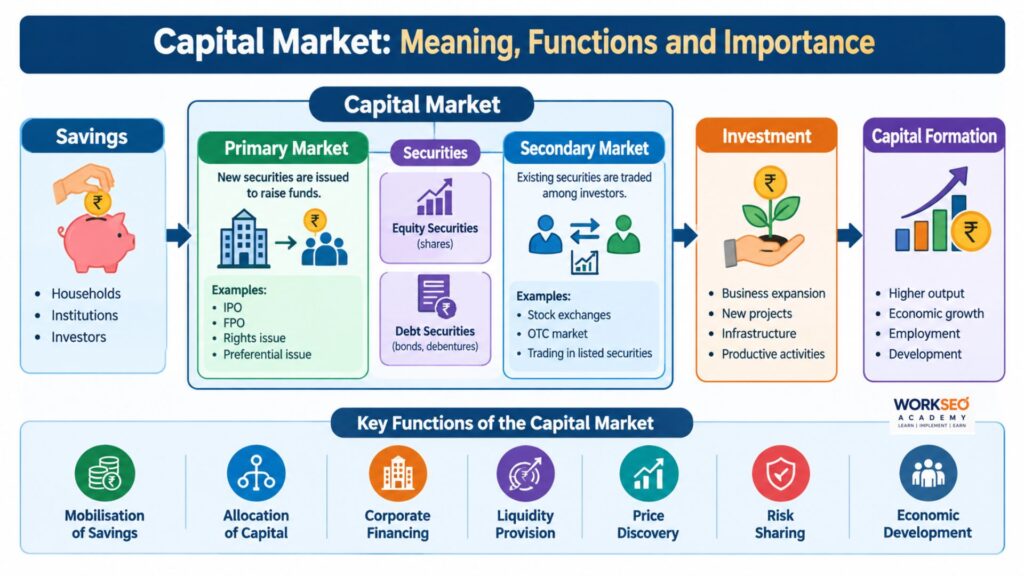
The basic mechanism can be represented as:
Savings → Financial Intermediaries/Markets → Investment → Productive Activities → Economic Development
For example, a company planning to establish a new manufacturing plant may require substantial long-term finance. It may raise equity capital by issuing shares or borrow through appropriate debt instruments. Investors, in turn, acquire financial claims on the company.
Thus, the capital market performs an important financial intermediation and resource-allocation function.
Main Characteristics of Capital Market
1. Deals primarily with long-term finance
The capital market is concerned mainly with funds required for relatively long-term purposes, unlike the money market, which focuses on short-term funds.
2. Facilitates mobilisation of savings
It channels savings from individuals and institutions towards investment opportunities.
3. Provides different investment avenues
Investors can participate through equity and debt instruments, depending on their risk-return preferences.
4. Provides marketability
The secondary market allows investors to buy and sell previously issued securities. This provides liquidity to investments.
5. Supports price discovery
Continuous buying and selling in the secondary market helps determine market prices based on available information, demand, supply and investor expectations.
6. Operates through regulated institutions and intermediaries
The Indian securities market involves stock exchanges, intermediaries and regulatory mechanisms. SEBI’s regulatory framework covers areas such as market regulation, intermediaries, corporate finance and investor protection.
Structure of the Capital Market
1. Primary Market
The primary market is the market for new securities. Here, securities are issued to investors for the purpose of raising funds.
Examples include:
- Initial Public Offer (IPO)
- Follow-on Public Offer (FPO)
- Rights issue
- Preferential issue
- Qualified Institutional Placement (QIP), subject to the applicable regulatory framework
SEBI describes the primary market as the channel through which new securities are created and sold.
Example
Suppose Company A issues new equity shares to raise ₹100 crore for expansion.
The sequence is:
Company → New Securities → Investors → Capital raised by Company
The funds raised can be used for purposes such as expansion, investment or other permitted corporate requirements.
2. Secondary Market
The secondary market deals with securities that have already been issued.
For example, if an investor purchases shares of a listed company from another investor through a stock exchange, the transaction occurs in the secondary market.
The basic distinction is:
| Basis | Primary Market | Secondary Market |
|---|---|---|
| Nature | New securities | Existing securities |
| Main purpose | Raising capital | Trading existing securities |
| Parties | Issuer and investors | Investors among themselves |
| Capital directly received by issuer | Yes | Generally no |
| Example | IPO | Stock exchange trading |
SEBI notes that the secondary market enables holders of securities to transact their holdings and provides an important platform for trading.
Major Functions of Capital Market
1. Mobilisation of Savings
The capital market converts savings into productive investment.
Households and institutions with surplus funds can invest in securities rather than keeping all savings in relatively idle forms.
2. Allocation of Capital
Capital is directed towards enterprises and projects requiring finance.
Efficient allocation of capital can support investment, production and business expansion.
3. Facilitates Corporate Financing
Companies can obtain long-term funds through equity and debt securities.
This gives businesses alternatives to relying exclusively on internal funds or bank borrowing.
4. Provides Liquidity
Secondary markets allow investors to convert securities into cash through sale, subject to prevailing market conditions.
Liquidity makes securities more attractive because investors are not necessarily locked into their investments until maturity or liquidation.
5. Price Discovery
Market transactions generate information about the prices at which securities can be bought and sold.
Price discovery therefore helps investors and companies assess market perceptions of risk, return and expected performance.
6. Encourages Investment and Economic Development
Capital markets facilitate the transfer of financial resources towards productive activities. SEBI’s investor education material identifies allocation of savings towards entities requiring funds as a primary function of the securities market and links such investment with economic development.
7. Facilitates Risk Sharing
Different financial instruments allow investors to select investments according to their tolerance for risk and expected return.
Equity investors, for example, bear business risk differently from holders of debt securities.
8. Provides a Monitoring Mechanism
The secondary market generates information through security prices and trading activity. SEBI has also described the secondary market as a mechanism through which information and price discovery can guide management decisions
Importance of Capital Market
The capital market has significance at several levels.
For Companies
It provides access to long-term finance for:
- Expansion
- Modernisation
- Diversification
- New projects
- Restructuring and other financing requirements
For Investors
It provides investment opportunities involving different combinations of:
- Risk
- Return
- Liquidity
- Maturity
- Ownership or creditor claims
For the Economy
An efficient capital market can:
- Mobilise household and institutional savings
- Support capital formation
- Improve allocation of financial resources
- Facilitate entrepreneurship
- Support business expansion
- Contribute to economic development
Capital Market and Financial Management
Capital markets are closely connected with financial management.
A financial manager has to consider questions such as:
- How much capital is required?
- Should the company issue equity or debt?
- What will be the cost of financing?
- How will financing affect financial risk?
- What impact will financing have on ownership and control?
- How should the company’s capital structure be designed?
Thus, the capital market provides the external environment within which important corporate financial decisions are made.
For example, the decision between issuing equity and borrowing affects the firm’s capital structure, cost of capital, financial risk and shareholder interests.
Capital Market and the Money Market
A frequent examination distinction is between the capital market and money market.
| Basis | Capital Market | Money Market |
|---|---|---|
| Main focus | Long-term funds | Short-term funds |
| Typical instruments | Equity and long-term debt securities | Treasury bills, commercial paper, certificates of deposit, etc. |
| Main purpose | Capital formation and long-term financing | Short-term liquidity management |
| Participants | Companies, governments, investors and financial institutions | Banks, financial institutions, government and other eligible participants |
| Risk-return characteristics | Generally varies substantially by instrument | Generally associated with short-term financing |
The distinction should not be treated as absolute in every institutional context; rather, it is primarily based on the maturity and purpose of financial instruments.
Role of SEBI in the Indian Capital Market
The Securities and Exchange Board of India (SEBI) is the principal securities-market regulator in India.
Its statutory mandate includes protecting investors, promoting the development of the securities market and regulating the securities market.
Its regulatory framework covers areas including:
- Primary markets
- Secondary markets
- Market intermediaries
- Corporate finance
- Investment management
- Surveillance
- Investor protection
- Research analysts and investment advisers
SEBI’s current regulatory materials include, among others, a 2026 Master Circular on Issue of Capital and Disclosure Requirements (ICDR) and a 2026 Master Circular on securities-market surveillance.
For UPSC answers, it is useful to connect the capital market with the three broad regulatory objectives of investor protection, market development and market regulation.
Limitations and Challenges of Capital Markets
Capital markets also face certain challenges.
Market Volatility
Security prices can fluctuate because of changes in economic conditions, interest rates, corporate performance, expectations and investor sentiment.
Information Asymmetry
Investors may not possess identical information about issuers and securities.
Market Risk
Investment returns are not guaranteed, particularly for market-linked securities.
Regulatory Complexity
Issuers and intermediaries must comply with applicable disclosure, governance and market regulations.
Speculative Activity
Trading based predominantly on short-term price expectations can increase volatility and may disconnect market prices temporarily from fundamental assessments.
Therefore, an efficient capital market requires transparency, disclosure, investor awareness, sound regulation and effective market infrastructure.
Practical Illustration
Consider a company requiring ₹500 crore for expansion.
It could potentially use different financing sources, such as:
- Retained earnings
- Equity issuance
- Debt financing
- A combination of financing methods
If it raises ₹200 crore through a new issue of shares, the primary market helps transfer funds from investors to the company.
After the shares are listed, investors can trade them with one another in the secondary market.
Therefore:
Primary Market → Capital is raised
Secondary Market → Existing securities are traded and liquidity is provided
This distinction is fundamental for UPSC Commerce answers.
Why This Topic Matters for UPSC
Capital Market is relevant to UPSC Commerce & Accountancy because it connects several areas of the syllabus, particularly financial management and financial markets.
For the Commerce & Accountancy Optional, the topic helps candidates understand:
- Long-term financing decisions
- Equity and debt financing
- Capital structure
- Cost of capital
- Investment decisions
- Securities markets
- Risk and return
- Financial institutions and regulation
It also provides useful conceptual background for questions involving corporate finance and the broader financial system.
For General Studies and Essay preparation, the topic can support discussions involving capital formation, savings, investment, financial inclusion, corporate financing and economic development.
The key is to establish the relationship:
Savings → Capital Market → Investment → Capital Formation → Productive Capacity → Economic Activity
UPSC Mains Answer Writing Approach
10-Mark Answer
For a question such as “Explain the meaning and functions of capital market.”
Use this structure:
Introduction: Define capital market as a market for long-term funds.
Body:
- Mobilisation of savings
- Capital allocation
- Long-term corporate financing
- Liquidity
- Price discovery
- Risk sharing
Example: Distinguish an IPO from secondary-market trading.
Conclusion: Explain its role in connecting savings with productive investment.
15-Mark Answer
For “Discuss the importance of capital market in economic development.”
Structure the answer around:
- Definition
- Mobilisation of savings
- Investment and capital formation
- Corporate financing
- Liquidity and price discovery
- Risk sharing
- Economic development
- Regulatory dimension
- Brief limitations
A small flow diagram can improve presentation:
Savings → Financial Market → Investment → Capital Formation → Economic Growth
20-Mark Answer
For a broader question such as:
“Explain the structure and functions of the capital market and critically examine its significance for corporate financing.”
Include:
- Definition and conceptual foundation
- Primary and secondary markets
- Equity and debt financing
- Capital mobilisation
- Liquidity
- Price discovery
- Risk allocation
- Corporate financing decisions
- Role of regulation and investor protection
- Market risks and limitations
- Balanced conclusion
Short Model Answer Framework
Introduction: Capital market is the mechanism through which long-term financial resources are raised and traded.
Core argument: Its importance arises from its ability to connect savers with entities requiring long-term finance.
Analysis: Explain primary-market fund raising, secondary-market liquidity, price discovery, risk allocation and corporate financing.
Critical perspective: Market efficiency depends on transparency, disclosure, regulation, investor confidence and sound infrastructure.
Conclusion: An effective capital market supports efficient financial intermediation and capital formation while requiring appropriate regulatory safeguards.
UPSC Prelims Quick Revision
- Capital market primarily deals with long-term finance.
- It includes markets for equity and long-term debt.
- Primary market deals with new securities.
- Secondary market deals with previously issued securities.
- IPO is associated with the primary market.
- Trading of already issued listed shares occurs in the secondary market.
- The primary market directly facilitates capital raising by issuers.
- The secondary market provides liquidity and price discovery.
- SEBI’s statutory mandate includes investor protection, development and regulation of the securities market.
- Capital market should be distinguished from the money market, principally on the basis of financing horizon and instruments.
5 Likely UPSC-Style Questions
- Define capital market and explain its major functions in the mobilisation and allocation of financial resources.
- Distinguish between the primary market and secondary market. Explain their complementary roles in the functioning of the capital market.
- “The capital market performs both financing and liquidity functions.” Discuss the statement with suitable examples.
- Explain the significance of capital markets for corporate financial decisions relating to equity and debt financing.
- Discuss the role of regulation, transparency and investor protection in promoting an efficient capital market in India.
Frequently Asked Questions
1. What is a capital market?
A capital market is a financial market through which long-term funds are raised and invested, particularly through equity and long-term debt securities.
2. What are the two major segments of the capital market?
The securities market is broadly divided into the primary market, where new securities are issued, and the secondary market, where existing securities are traded.
3. What is the main function of the capital market?
Its fundamental function is to channel savings towards entities requiring funds for investment and productive activities.
4. What is the difference between capital market and money market?
The capital market primarily deals with long-term financing, whereas the money market deals mainly with short-term funds and instruments.
5. Why is capital market important for UPSC Commerce & Accountancy?
It connects financial-market theory with corporate finance, capital structure, investment, risk-return analysis, securities markets and financial regulation.
Conclusion
The capital market is a central mechanism for mobilising savings and directing them towards long-term investment. Its two principal securities-market segments—the primary and secondary markets—perform different but complementary functions: the primary market facilitates the raising of funds, while the secondary market facilitates trading, liquidity and price discovery.
For UPSC Commerce & Accountancy aspirants, the topic should therefore be studied not merely as a definition but as a link between financial markets, corporate financing, investment decisions, risk, liquidity, regulation and economic development. Conceptual clarity on these relationships enables stronger analytical and structured answers.