
Introduction
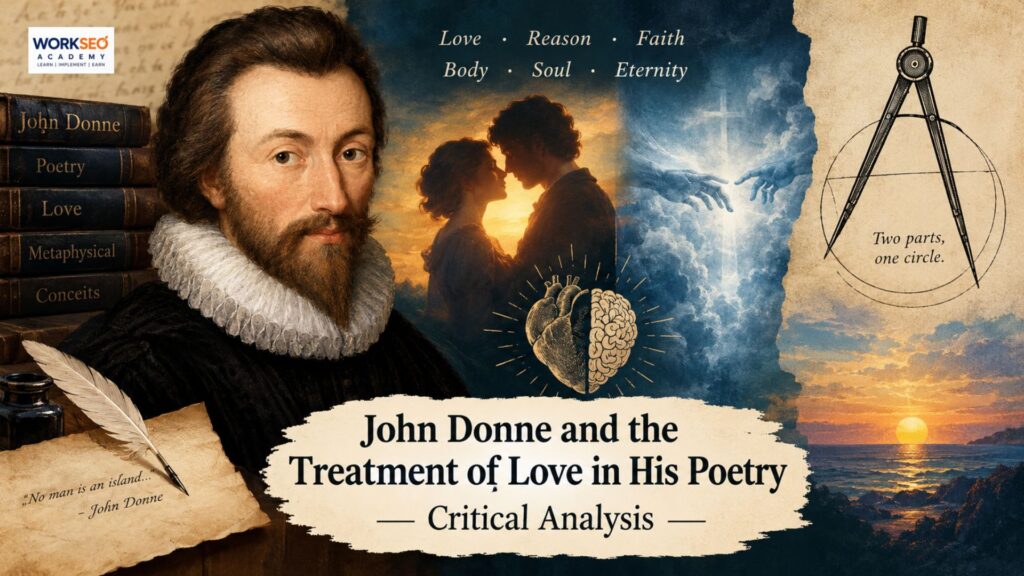
John Donne is one of the most significant poets of the seventeenth century and a leading representative of metaphysical poetry. His treatment of love is distinctive because he presents it not merely as an emotion but as an intellectual, physical, spiritual and philosophical experience. His love poems explore desire, intimacy, separation, faithfulness, jealousy and the complex relationship between body and soul.
Unlike poets who consistently portray love through idealised beauty and conventional romantic imagery, Donne often approaches love through argument, paradox, wit and striking comparisons known as conceits. In poems such as The Good-Morrow, The Sun Rising, The Canonization and A Valediction: Forbidding Mourning, he examines different dimensions of love and challenges conventional ideas about relationships.
For UPSC English Literature aspirants, studying John Donne’s treatment of love provides an opportunity to understand metaphysical poetry, seventeenth-century intellectual culture, poetic techniques and the relationship between personal experience and philosophical thought. This critical analysis examines his major themes, literary devices, representative poems and continuing literary significance.
Who Was John Donne? Literary and Historical Background
John Donne (1572–1631) was an English poet, prose writer and Anglican clergyman. His literary career developed during a period of religious controversy, intellectual change and political uncertainty in England.
Donne’s poetry is commonly associated with the metaphysical poets, a group of writers whose work combines intellectual argument, emotional intensity, unconventional imagery and philosophical reflection. Although the term metaphysical poets became prominent through later literary criticism, particularly that of Samuel Johnson in the eighteenth century, Donne is now widely regarded as one of its central figures.
His poetry reflects a complex understanding of human relationships. Love can unite two individuals, transform their perception of the world, challenge social conventions or become a means of contemplating spiritual truth.
The Major Characteristics of Love in John Donne’s Poetry
1. Love as an Intellectual Experience
One of Donne’s most important contributions is his presentation of love as an activity of the mind as well as the heart. His lovers do not simply express affection; they reason, debate, persuade and construct arguments about the meaning of their relationship.
In The Good-Morrow, the speaker reflects on the transformation that love has brought to his life. His earlier experiences seem insignificant compared with the fulfilment he discovers in his relationship.
The poem presents love as an awakening. The lovers enter a new world of emotional and intellectual awareness in which their relationship gives meaning to their existence.
This intellectual approach distinguishes Donne from more conventional love poetry. Emotion becomes more powerful because the poet subjects it to thought and argument.
2. Physical and Spiritual Love
Donne frequently explores the relationship between physical desire and spiritual intimacy. His poetry does not always separate the body from the soul; instead, it often presents bodily and emotional experiences as interconnected.
In The Ecstasy, the lovers’ souls communicate while their bodies remain physically present. The poem questions whether spiritual love can exist independently of the body and suggests that the body helps express and sustain the union of souls.
Similarly, A Valediction: Forbidding Mourning portrays love as a connection that survives physical separation. The speaker argues that a profound relationship does not depend entirely on physical proximity.
However, Donne’s poetry should not be reduced to the idea that all love is purely spiritual. In several poems, physical desire is central, while in others, bodily and spiritual dimensions coexist in tension.
3. Love as Mutual Union and Equality
Donne often represents successful love as a relationship in which both partners participate in a shared emotional world.
In The Good-Morrow, the lovers discover a mutual world through their relationship. Their identities remain distinct, yet their experiences become deeply interconnected.
The poem’s imagery of exploration suggests that genuine love opens up a new world. Rather than depending on external wealth or geographical discovery, the lovers find fulfilment within their mutual attachment.
This idea challenges the conventional treatment of the beloved as a distant, idealised figure. Donne’s lovers often engage with each other as active participants in an intellectual and emotional relationship.
Nevertheless, the representation of equality varies across his poems. The speaker’s confidence and persuasive rhetoric sometimes leave the beloved’s independent voice less clearly expressed.
4. Love as Defiance of Social Conventions
In The Canonization, Donne’s speaker responds to criticism of his love by presenting the lovers as worthy of sainthood. The poem uses religious language in an unexpected context, transforming a private relationship into a subject of public celebration.
The speaker suggests that love need not produce political achievements, economic success or social recognition to possess significance. The lovers create their own lasting identity through their relationship.
The poem’s title refers to canonization, the recognition of a person as a saint. Donne uses this religious concept playfully and seriously at once: the lovers are presented as figures whose devotion can inspire others.
The poem therefore illustrates how Donne uses wit and paradox to challenge conventional measures of achievement and respectability.
5. Love and Separation
Separation is another important theme in Donne’s poetry. Rather than treating distance as proof of emotional loss, he often presents it as a test of the strength of love.
In A Valediction: Forbidding Mourning, the speaker asks his beloved to accept their departure calmly. He contrasts their relationship with the fear and grief associated with ordinary separations.
The poem compares their love to the movement of a compass. One leg remains fixed at the centre while the other moves around it, yet both belong to the same instrument. The image suggests that physical distance does not necessarily weaken emotional unity.
This comparison is a classic example of a metaphysical conceit: an extended, intellectually inventive comparison that connects seemingly unrelated things to illuminate an emotional or philosophical idea.
6. Love as Desire, Persuasion and Irony
Donne’s treatment of love is not always idealistic. Some poems reveal desire through persuasion, exaggeration, humour and self-conscious argument.
In The Flea, the speaker uses a flea that has bitten both himself and his beloved as an argument for physical intimacy. Because their blood has mingled within the insect, he claims that the act of intimacy he desires should not be treated as a serious transgression.
The argument is deliberately ingenious and logically questionable. The flea becomes a miniature stage on which the speaker demonstrates his verbal skill.
The poem is important because it reveals the persuasive and sometimes manipulative dimensions of romantic language. The speaker’s cleverness should not automatically be equated with the poet’s personal beliefs.
Major Poems and Their Treatment of Love
Poem | Central treatment of love | Important technique |
|---|---|---|
The Good-Morrow | Love as awakening and mutual fulfilment | Exploration imagery, conceit |
The Sun Rising | Love as a world powerful enough to challenge external authority | Apostrophe, hyperbole, wit |
The Canonization | Love as a private experience that achieves symbolic immortality | Paradox, religious imagery |
The Flea | Physical desire expressed through persuasive argument | Conceit, irony |
The Ecstasy | Relationship between bodily presence and spiritual union | Philosophical argument, symbolism |
A Valediction: Forbidding Mourning | Enduring love despite physical separation | Compass conceit, analogy |
Love in The Sun Rising
In The Sun Rising, the speaker addresses the rising sun as an intrusive presence that disturbs the lovers. He dismisses its authority and claims that their private world is more significant than the routines of kings, courtiers and other worldly figures.
The poem uses apostrophe, a direct address to an absent person, an abstract idea or a non-human entity. By addressing the sun as though it were an intrusive visitor, Donne turns an ordinary natural phenomenon into a participant in a dramatic argument.
Hyperbole, or deliberate exaggeration, magnifies the importance of the lovers. The poem does not simply describe romantic affection; it imaginatively challenges the hierarchy between private experience and public power.
Love in A Valediction: Forbidding Mourning
This poem offers one of Donne’s most celebrated representations of enduring love. The speaker distinguishes the lovers’ bond from relationships that depend entirely on physical presence.
The compass conceit is especially significant because it combines emotional reassurance with geometric precision. The moving leg may travel away from the fixed leg, but the two remain connected.
The image demonstrates Donne’s ability to convert an abstract emotional experience into a concrete intellectual structure. It also illustrates the characteristic metaphysical combination of feeling and reasoning.
Literary Techniques in Donne's Love Poetry
Metaphysical Conceit
A metaphysical conceit is an elaborate comparison between apparently dissimilar objects or experiences. Donne’s compass in A Valediction: Forbidding Mourning and flea in The Flea are prominent examples.
Paradox
A paradox appears contradictory but reveals a deeper meaning. In Donne’s poetry, love can make two people into one while preserving their individuality. Such tensions make his poetry intellectually engaging.
Wit and Argument
Donne’s speakers often develop arguments through questions, objections, analogies and unexpected conclusions. Wit gives the poems energy, while the argumentative structure makes the experience of love appear active rather than passive.
Dramatic Voice and Colloquial Language
Many poems begin as though the reader has entered the middle of a conversation. Direct address, abrupt openings and conversational rhythms create a sense of immediacy. The speaker’s personality becomes central to the poem.
Religious and Scientific Imagery
Donne draws on religious concepts, geographical exploration, astronomy, mathematics and contemporary intellectual interests. These references reveal how love can become a means of exploring larger questions about knowledge, identity and existence.
Critical Evaluation: Is Donne's Love Always Idealistic?
Donne’s love poetry presents a rich but not entirely consistent vision of relationships. Some poems celebrate reciprocity, spiritual intimacy and emotional constancy. Others focus on physical desire, verbal persuasion or the speaker’s attempt to control a situation.
A critical reading should therefore distinguish between the poet and the dramatic speaker. The speaker of The Flea, for example, constructs a witty argument for intimacy, but the argument’s cleverness does not prove that the beloved accepts it or that the poem offers a straightforward moral statement.
Similarly, the spiritual intensity of A Valediction: Forbidding Mourning differs from the playful erotic persuasion of The Flea. These differences demonstrate Donne’s range rather than a single, fixed philosophy of love.
His poetry is most distinctive in its refusal to treat love as a simple emotion. Love becomes a subject for intellectual experiment, emotional discovery and critical questioning.
John Donne and Other Love Poets
Donne’s treatment of love can be better understood by comparing it with other literary traditions.
Feature | John Donne | Conventional Petrarchan tradition |
|---|---|---|
Beloved | Often addressed through direct argument | Frequently idealised and distant |
Imagery | Unusual intellectual comparisons | Familiar images of beauty and suffering |
Tone | Conversational, argumentative, witty | Often lyrical and idealising |
Love | Physical, spiritual, intellectual and sometimes ironic | Often expressed through longing and unfulfilled desire |
Technique | Metaphysical conceit and paradox | Conventional conceits and established poetic patterns |
This comparison is a useful general distinction, not an absolute rule. Petrarchan poetry is diverse, and Donne also draws on inherited conventions even as he transforms them.
Why This Topic Matters for UPSC
John Donne’s treatment of love is relevant to UPSC English Literature because it connects close textual analysis with literary history and critical interpretation.
English Literature preparation: Helps students analyse metaphysical poetry, conceits, paradoxes, imagery and poetic arguments.
Literary history: Develops understanding of Renaissance and early seventeenth-century poetry, religious thought and changing literary conventions.
Essay writing: Offers examples for essays on love, human relationships, reason and emotion, individuality and spirituality.
Reading comprehension and vocabulary: Improves the ability to interpret figurative language, irony, complex arguments and unfamiliar literary expressions.
Analytical answer writing: Encourages students to support interpretations with relevant poems and precise textual evidence.
For English Literature Optional preparation, students should prioritise the prescribed syllabus and previous-year questions. The topic also supports broader literary awareness, although it should not be treated as a standalone General Studies fact-recall priority.
UPSC Mains Answer Writing Approach
A strong answer should combine a clear argument, relevant poetic examples, literary terminology and a balanced conclusion.
Approach to a 10-Mark Answer
Introduction: Identify Donne as a major metaphysical poet.
Major points: Explain love as intellectual experience and as a union of body and soul.
Example: Refer to The Good-Morrow and The Ecstasy.
Conclusion: Emphasise the complexity of Donne’s treatment of love.
Approach to a 15-Mark Answer
Introduce Donne’s position in seventeenth-century English poetry.
Explain physical, spiritual and intellectual dimensions of love.
Analyse separation and mutual union through A Valediction: Forbidding Mourning.
Examine wit, paradox and conceit through The Flea and The Canonization.
Conclude by acknowledging the diversity of his poetic speakers and attitudes.
Approach to a 20-Mark Answer
Establish the historical and literary context of metaphysical poetry.
Examine love as desire, intellectual argument, spiritual union and emotional constancy.
Analyse imagery, paradox, dramatic voice and metaphysical conceit.
Compare Donne with Petrarchan conventions where relevant.
Evaluate tensions between idealism, persuasion and the beloved’s agency.
Conclude that Donne transforms love into a complex exploration of human experience.
Short Model Answer Framework
Question: Critically analyse the treatment of love in John Donne’s poetry.
Introduction: John Donne presents love as a multidimensional experience combining physical desire, intellectual inquiry and spiritual intimacy.
Main argument: In The Good-Morrow, love becomes an awakening that transforms the lovers’ understanding of the world. The Ecstasy explores the relationship between body and soul, while A Valediction: Forbidding Mourning uses the compass conceit to represent enduring love despite separation. In contrast, The Flea demonstrates how wit and elaborate argument can be employed to persuade, while The Canonization elevates private love through religious imagery and paradox.
Critical evaluation: These poems reveal that Donne does not offer one uniform definition of love. His speakers range from spiritually assured lovers to persuasive and ironic voices.
Conclusion: Donne’s originality lies in combining intense emotion with intellectual ingenuity, making love a subject of philosophical as well as personal significance.
UPSC Prelims Quick Revision
Author: John Donne (1572–1631).
Literary association: Metaphysical poetry.
Important critic associated with the term: Samuel Johnson, who discussed the metaphysical poets in The Lives of the Most Eminent English Poets.
The Good-Morrow: Love as awakening and mutual fulfilment.
The Sun Rising: The lovers’ world challenges external authority.
The Flea: Physical desire expressed through a witty argument.
The Canonization: Love represented through religious imagery and paradox.
The Ecstasy: Relationship between bodily presence and spiritual union.
A Valediction: Forbidding Mourning: Enduring love expressed through the compass conceit.
Metaphysical conceit: An elaborate, intellectually inventive comparison.
Paradox: An apparently contradictory statement that suggests a deeper truth.
Apostrophe: Direct address to a person, abstract idea or non-human entity.
Important distinction: Donne’s poetic speakers should not automatically be identified with Donne himself.
Five Likely UPSC-Style Questions
Critically examine John Donne’s treatment of love as an intellectual and emotional experience.
Discuss the significance of metaphysical conceits in Donne’s love poetry, with reference to The Flea and A Valediction: Forbidding Mourning.
Analyse the relationship between physical and spiritual love in John Donne’s poetry.
How does Donne challenge conventional Petrarchan representations of love? Illustrate your answer with suitable examples.
Evaluate the role of wit, paradox and dramatic argument in Donne’s treatment of love.
Frequently Asked Questions (FAQs)
1. What is John Donne’s treatment of love in his poetry?
John Donne presents love as a combination of physical desire, intellectual engagement, spiritual intimacy and emotional commitment. His poems explore both the joys and complexities of human relationships.
2. Why is John Donne called a metaphysical poet?
Donne is called a metaphysical poet because his poetry combines philosophical ideas, intellectual arguments, unusual comparisons, paradoxes and emotional intensity. His metaphysical conceits are among the most distinctive features of his work.
3. What is a metaphysical conceit in John Donne’s poetry?
A metaphysical conceit is an elaborate comparison between seemingly unrelated things. In A Valediction: Forbidding Mourning, Donne compares two lovers to the legs of a mathematical compass to illustrate their enduring connection despite physical separation.
4. Which John Donne poems are important for studying love?
Important poems include The Good-Morrow, The Sun Rising, The Flea, The Canonization, The Ecstasy and A Valediction: Forbidding Mourning. Each explores different aspects of desire, intimacy, spiritual union or emotional constancy.
5. How does John Donne differ from traditional love poets?
Donne often replaces conventional expressions of idealised love with conversational language, intellectual argument, paradox and unexpected imagery. His treatment can be physical, spiritual, playful or critical rather than consistently idealistic.
Conclusion
John Donne’s treatment of love is remarkable for its intellectual depth, emotional complexity and inventive use of language. His poetry moves beyond conventional romantic idealisation to examine desire, spiritual union, separation, mutual attachment and persuasion. Through metaphysical conceits, paradoxes, wit and dramatic argument, he transforms personal relationships into subjects of philosophical inquiry.
For UPSC English Literature aspirants, Donne offers an important example of how poetic form, historical context and critical interpretation work together. A strong understanding of his major poems and techniques enables students to develop precise, evidence-based and balanced literary answers.