
Introduction
Venture capital is a form of equity financing provided to businesses with high growth potential, particularly start-ups and innovative enterprises that may find it difficult to obtain funds through traditional sources such as bank loans. Venture capital investors provide financial resources in exchange for an ownership stake and seek returns through the future growth and appreciation of the business.
Venture capital plays an important role in entrepreneurship, innovation, employment generation and economic development. It helps entrepreneurs convert business ideas into commercial ventures while providing investors with opportunities to participate in the growth of emerging businesses.
From a financial management perspective, venture capital is closely related to capital structure, cost of capital, risk and return, equity financing, corporate governance and investment decisions. It is also relevant to entrepreneurship and the broader business environment.
For UPSC Commerce & Accountancy Optional aspirants, understanding venture capital requires more than memorising its definition. Students should understand its functions, financing stages, advantages, limitations and differences from other sources of finance. These concepts support analytical answer writing and the application of financial management principles to real-world business situations.
What Is Venture Capital?
Venture capital refers to investment in businesses that have significant growth potential but also carry considerable business and financial risk. It is generally provided by specialised investment firms, funds or investors who acquire an ownership interest in the enterprise.
Unlike a conventional lender, a venture capital investor generally does not receive fixed interest payments on the invested equity. Instead, the investor expects returns through an increase in the value of the ownership stake and, ultimately, an exit from the investment.
For example, an entrepreneur developing a technology platform may need funds to build the product, recruit employees and acquire customers. A venture capital fund may invest in the company in exchange for equity, enabling the business to expand without taking on the repayment obligations associated with a conventional loan.
Venture capital is therefore a form of risk-bearing equity finance that connects investors with entrepreneurs seeking funds for growth.
Nature and Characteristics of Venture Capital
The main characteristics of venture capital are:
Equity participation: Investors generally acquire shares or another ownership interest in the business.
High risk and potential return: The business may fail, but successful ventures may generate substantial returns.
Long-term investment perspective: Investors typically support business development over several years rather than seeking immediate repayment.
Growth orientation: Financing often supports innovation, market expansion, product development and commercialisation.
Active involvement: Investors may contribute strategic advice, industry contacts, recruitment support and governance expertise.
Exit-oriented investment: Investors generally seek to realise their returns through an exit, such as a sale of shares or an acquisition of the company.
Not every venture capital investment involves the same level of investor participation or uses identical contractual terms. The arrangement depends on the business, investment stage and negotiated agreement.
Functions of Venture Capital
Venture capital performs several important functions in business finance and entrepreneurship.
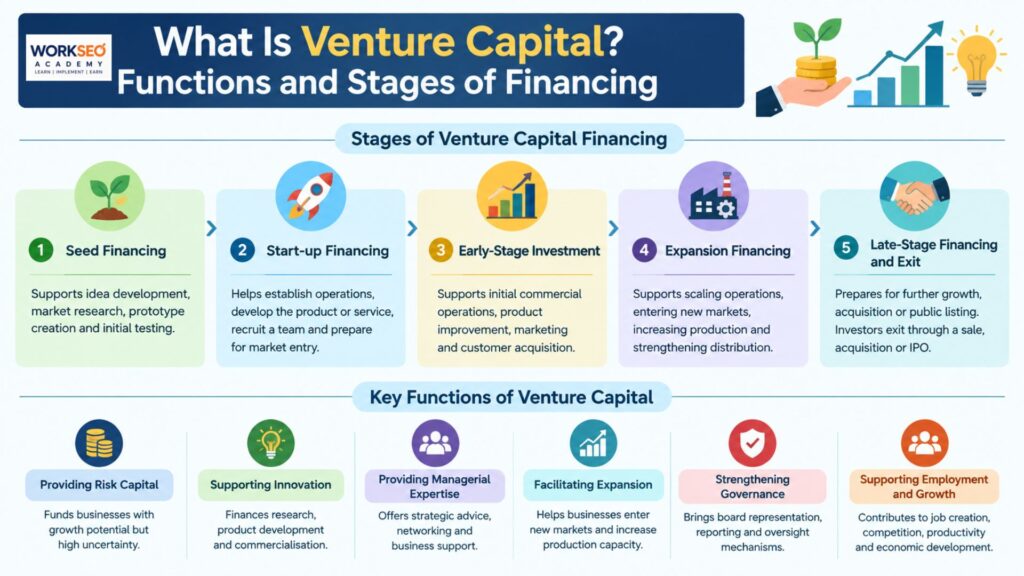
1. Providing Risk Capital
Start-ups often lack sufficient assets, operating history or stable cash flows to qualify for conventional loans. Venture capital provides equity funding to businesses that have growth potential but face substantial uncertainty.
2. Supporting Innovation and Research
Venture capital helps businesses develop new products, technologies and services. It can finance research, prototype development, testing and commercialisation.
3. Providing Managerial Expertise
Venture capital investors may assist entrepreneurs with strategic planning, financial management, recruitment, marketing and business development.
4. Facilitating Business Expansion
Growing enterprises may require additional funds to enter new markets, increase production capacity, expand distribution networks or develop new products. Venture capital can support these activities.
5. Strengthening Corporate Governance
Investors may negotiate board representation, reporting requirements and other governance arrangements to monitor performance and protect their investment.
6. Supporting Employment and Economic Development
By financing new and expanding enterprises, venture capital can contribute to employment creation, competition, productivity and innovation. These benefits depend on the performance and wider economic effects of the businesses receiving investment.
Stages of Venture Capital Financing
Venture capital financing is commonly described in stages according to a business’s development. The terminology varies among investors, and not every start-up passes through every stage.
Funds support idea development, market research, feasibility studies, prototype creation and initial product testing. At this stage, uncertainty is usually high because the business model may not yet be commercially validated.
Capital helps establish the business, develop its product or service, recruit an initial team and prepare for market entry. The enterprise may have limited or no revenue.
Funds support initial commercial operations, product improvement, marketing and customer acquisition. Investors assess market acceptance, customer feedback and the potential for sustainable revenue.
Capital supports scaling operations, entering new geographical markets, increasing production and strengthening distribution. Revenue, operating performance and unit economics become increasingly important.
5. Late-Stage Financing and Exit
More mature businesses may raise additional capital before a major expansion, acquisition or public listing. Investors may exit through a strategic sale, sale of their shares to another investor or an initial public offering (IPO), subject to applicable rules and market conditions.
Summary of Financing Stages
Stage | Main purpose | Typical business position |
|---|---|---|
Seed | Develop and test an idea | Concept or prototype |
Start-up | Establish operations | Product development or market entry |
Early stage | Build market traction | Initial customers and revenue |
Expansion | Scale the business | Growing sales and operations |
Late stage | Prepare for further growth or exit | More established enterprise |
These stages are a practical classification rather than a universal regulatory sequence. An IPO is an exit route, not itself a mandatory stage of venture capital financing.
How Venture Capital Financing Works
The financing process generally involves the following steps:
Identification: The investor identifies businesses that fit its investment strategy.
Due diligence: The investor examines the business model, market, financial projections, legal position, management and risks.
Valuation and negotiation: The parties negotiate the company’s valuation, investment amount, ownership stake and contractual rights.
Investment: Funds are provided under the agreed terms.
Monitoring and support: Investors monitor financial performance and may offer strategic assistance.
Exit: The investor seeks to realise the investment through a suitable exit route.
Simple Equity Illustration
Suppose a start-up receives an investment of ₹2 crore from a venture capital investor. Immediately after the investment, assume the company’s agreed post-money valuation is ₹10 crore.
Investor’s ownership percentage:
The investor therefore owns 20% of the company under these simplified assumptions. The pre-money valuation is ₹8 crore.
This illustration excludes transaction costs, complex share rights, convertible instruments and later dilution. The ownership percentage may change if the company raises further capital.
Venture Capital in India: Regulatory Context
In India, the regulatory framework depends on the legal structure of the fund and the nature of its activities. The Securities and Exchange Board of India (SEBI) regulates Alternative Investment Funds (AIFs) under the SEBI (Alternative Investment Funds) Regulations, 2012. These regulations replaced the earlier SEBI Venture Capital Funds Regulations, 1996, subject to transitional arrangements for existing funds and schemes.
Students should distinguish between a venture capital investment as a broad financing concept and a venture capital fund as a regulated fund structure. Not every investor who finances a start-up necessarily operates a SEBI-registered venture capital fund.
The Government of India’s Startup India initiative also explains equity financing as a source through which investors provide funds in exchange for ownership, with returns linked to capital appreciation rather than fixed interest payments.
For examination purposes, avoid quoting regulatory limits or compliance requirements without checking the applicable rules and amendments in force for the relevant period.
Advantages and Limitations of Venture Capital
Advantages | Limitations |
|---|---|
Provides funds to businesses that may struggle to obtain loans | Investors may demand significant ownership |
Generally avoids scheduled loan repayments on equity capital | Founders may experience dilution of control |
Can provide strategic guidance and business networks | Investors may impose performance expectations |
Supports innovation and business expansion | Funding is competitive and time-consuming to obtain |
Shares business risk between founders and investors | Failure can result in a substantial loss of invested capital |
Venture capital is not suitable for every business. An enterprise with modest growth ambitions or a preference for retaining complete ownership may prefer bootstrapping, bank finance or other funding sources.
Venture Capital vs. Angel Investment
Basis | Venture capital | Angel investment |
|---|---|---|
Typical investor | Professionally managed fund or investment firm | Individual investor investing personal capital |
Source of funds | Capital committed by fund investors | Personal wealth |
Common investment stage | Seed through growth stages, depending on fund strategy | Often very early stages |
Support | May include structured governance and institutional networks | May include personal mentoring and industry contacts |
Decision process | Usually follows a formal investment process | Depends on the individual investor |
These are general distinctions, not absolute rules. Both venture capital funds and angel investors can finance early-stage enterprises.
Why This Topic Matters for UPSC
Venture capital is relevant to UPSC Commerce & Accountancy because it connects financial theory with business practice.
Commerce & Accountancy Optional: Helps explain equity financing, capital structure, risk-return relationships and entrepreneurial finance.
Conceptual understanding: Clarifies the difference between equity funding and debt financing.
Analytical answer writing: Enables students to evaluate the benefits and limitations of risk capital.
Case-based questions: Provides a framework for analysing start-up funding decisions, investor ownership and business expansion.
General Studies and Essay: Connects entrepreneurship with innovation, employment, economic development and the business environment.
UPSC Mains Answer Writing Approach
10-Mark Answer
Define venture capital as risk-bearing equity finance.
Explain its principal functions, such as providing capital, supporting innovation and offering managerial expertise.
Briefly describe the seed, start-up, early and expansion stages.
Conclude by explaining its contribution to entrepreneurship and its inherent investment risks.
15-Mark Answer
Introduce the concept and explain its characteristics.
Discuss the major functions of venture capital.
Explain the different financing stages with examples.
Analyse its advantages, including access to capital and managerial support.
Examine limitations such as ownership dilution, investor influence and business failure risk.
Conclude with a balanced assessment of its role in entrepreneurial development.
20-Mark Answer
Define venture capital and distinguish it from conventional debt finance.
Explain the nature, characteristics and objectives of venture capital.
Discuss each financing stage, from seed funding to late-stage investment.
Analyse its financial implications, including equity ownership, valuation, risk and return.
Explain the role of due diligence, monitoring and corporate governance.
Discuss the Indian regulatory context and economic significance.
Critically evaluate limitations and alternative sources of business finance.
Conclude by relating venture capital to innovation, sustainable growth and responsible investment.
Topic-Specific Model Answer Framework
Question: Explain the functions and stages of venture capital financing. Discuss its significance for entrepreneurial development.
Introduction: Venture capital is a form of risk-bearing investment that provides equity capital to businesses with high growth potential.
Main body:
Functions: financing innovation, supporting commercialisation, providing managerial expertise and facilitating expansion.
Stages: seed, start-up, early-stage, expansion and late-stage financing.
Financial implications: ownership dilution, risk sharing, business valuation and potential capital appreciation.
Economic significance: entrepreneurship, innovation, competition and employment creation.
Limitations: uncertain returns, governance conflicts and the possibility of business failure.
Conclusion: Venture capital can bridge the financing gap faced by innovative businesses, but its effectiveness depends on sound investment decisions, responsible governance and viable business models.
UPSC Prelims Quick Revision
Venture capital is generally a form of equity or equity-linked financing.
Investors seek returns primarily through growth in investment value and an eventual exit.
Seed financing supports idea development, feasibility and prototype creation.
Start-up financing helps establish operations and prepare for market entry.
Early-stage financing supports initial commercialisation and customer acquisition.
Expansion financing supports scaling and market development.
Due diligence involves evaluating the commercial, financial, managerial and legal risks of an investment.
Equity financing does not ordinarily create the fixed interest and repayment obligations associated with conventional debt.
Pre-money valuation is the company’s valuation before a new investment.
Post-money valuation is the company’s valuation after the investment, under the agreed valuation framework.
In India, SEBI regulates Alternative Investment Funds under the applicable AIF framework.
An IPO is one possible exit route, not a compulsory stage for every venture capital investment.
Important Formulas to Remember
1. Investor’s Ownership Percentage
Formula:
Meaning: The investor’s proportional ownership based on the agreed valuation and investment terms.
Use: To estimate the equity stake received for a new investment in a simplified equity-financing transaction.
2. Post-Money Valuation
Formula:
Meaning: The agreed equity valuation after the new investment is included.
Use: To calculate an investor’s approximate ownership stake when the investment is structured as a straightforward equity transaction.
5 Likely UPSC-Style Questions
Define venture capital and critically examine its role in financing innovative enterprises.
Explain the major functions of venture capital. How does it differ from conventional debt financing?
Discuss the various stages of venture capital financing and explain how the financing requirements of a start-up change across these stages.
A venture capital fund invests ₹3 crore in a start-up at a post-money valuation of ₹15 crore. Calculate the investor’s ownership percentage and explain the implications for the founders.
Evaluate the contribution of venture capital to entrepreneurship and economic development in India. Discuss its limitations and the importance of corporate governance.
Frequently Asked Questions
1. What is venture capital in simple words?
Venture capital is money invested in businesses with high growth potential, usually in exchange for equity ownership. Investors accept substantial risk in the expectation of earning returns if the business grows successfully.
2. What are the main stages of venture capital financing?
The commonly described stages are seed financing, start-up financing, early-stage financing, expansion financing and late-stage financing. The sequence and terminology can vary across investors and businesses.
3. What is the difference between venture capital and a bank loan?
Venture capital generally provides equity or equity-linked funding, with returns linked to business performance. A conventional bank loan creates a repayment obligation and generally involves interest, regardless of whether the borrower achieves its growth targets.
4. How does a venture capital investor earn returns?
Investors generally seek returns by selling their ownership stake at a higher value, through an acquisition, a sale to another investor or an IPO. Returns are not guaranteed, and an investment may lose some or all of its value.
5. Is venture capital relevant for UPSC Commerce & Accountancy Optional?
Yes. It helps aspirants understand equity financing, capital structure, risk and return, business valuation, entrepreneurship and financial decision-making. It can also support analytical answers on business development and economic growth.
Conclusion
Venture capital is an important source of risk-bearing finance for businesses that require capital to develop innovative products, establish operations and expand into new markets. Its functions extend beyond funding to include strategic guidance, governance support and business development.
However, venture capital involves substantial risk and may lead to ownership dilution and differences between founders and investors. A sound understanding of its functions, financing stages, valuation principles and limitations helps UPSC Commerce & Accountancy aspirants connect financial management theory with practical business decisions.