
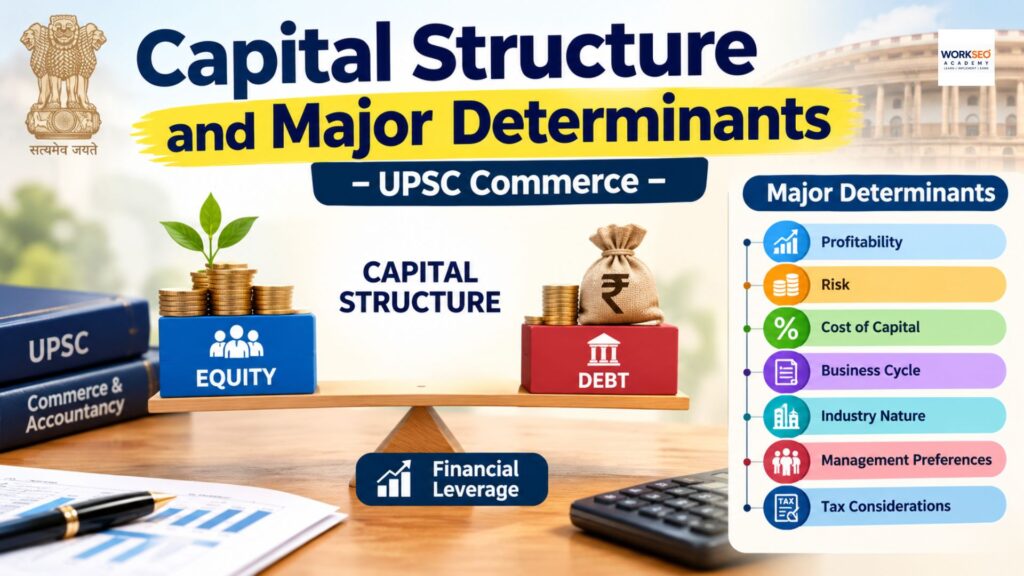
Capital structure refers to the mix of different long-term sources of finance used by a company to finance its assets, operations and growth. In simple terms, it explains how a business combines equity share capital, preference capital and debt to meet its long-term financial requirements.
Capital structure is an important concept in Financial Management because the choice between debt and equity affects the company’s cost of capital, financial risk, profitability, control and overall financial flexibility. The topic is particularly relevant for UPSC Commerce & Accountancy Optional because it connects financing decisions with concepts such as cost of capital, leverage, risk and return, shareholder value and financial planning.
A company therefore cannot consider financing merely as a question of raising money. It must determine an appropriate combination of different sources of finance.
Meaning of Capital Structure
Capital structure represents the proportion in which a company uses various long-term sources of finance.
The major components generally include:
- Equity share capital
- Preference share capital
- Retained earnings
- Long-term debt
- Debentures and bonds
- Other long-term borrowings
For example, suppose a company finances its long-term assets through:
- ₹40 lakh equity
- ₹10 lakh preference capital
- ₹50 lakh long-term debt
Its total long-term capital is ₹100 lakh.
Therefore:
| Source | Amount | Proportion |
|---|---|---|
| Equity | ₹40 lakh | 40% |
| Preference capital | ₹10 lakh | 10% |
| Debt | ₹50 lakh | 50% |
| Total | ₹100 lakh | 100% |
This combination represents the company’s capital structure.
Capital structure should be distinguished from financial structure. Financial structure can include both long-term and short-term sources of finance, whereas capital structure generally focuses on the long-term financing mix.
Components of Capital Structure
1. Equity Share Capital
Equity represents ownership capital. Equity shareholders are the owners of the company and generally have voting rights.
Equity does not normally create a compulsory fixed interest payment. However, equity investors expect returns through dividends and capital appreciation.
A higher reliance on equity generally reduces fixed financial obligations but may dilute ownership and control.
2. Preference Share Capital
Preference shareholders generally receive preferential treatment regarding dividend payment and repayment of capital.
Preference shares occupy an intermediate position between ordinary equity and debt in certain financial characteristics.
3. Debt Capital
Debt includes long-term loans, debentures and bonds.
Debt normally carries a contractual obligation to pay interest and repay principal according to agreed terms.
Debt can increase the financial leverage of a company, but excessive debt can increase financial risk.
4. Retained Earnings
Retained earnings represent profits retained in the business rather than distributed to shareholders.
They constitute an important internal source of finance and can reduce dependence on external financing.
Capital Structure vs Financial Structure
| Basis | Capital Structure | Financial Structure |
|---|---|---|
| Meaning | Mix of long-term sources of finance | Overall financing structure |
| Coverage | Mainly long-term capital | Long-term and short-term finance |
| Components | Equity, preference capital, long-term debt, etc. | Capital structure plus short-term liabilities |
| Main focus | Long-term financing decision | Overall financing pattern |
Thus, capital structure is a narrower concept within the broader financial structure.
Major Determinants of Capital Structure
There is no single capital structure suitable for every company. The appropriate mix depends on several financial, business and market factors.
1. Cost of Capital
The cost of different sources of finance is one of the most important considerations.
Debt may have a lower explicit cost than equity in many circumstances, but the overall decision must consider the company’s risk and the cost of all sources of capital.
The objective is not simply to select the cheapest individual source but to consider the effect of the financing mix on the overall cost of capital.
2. Business Risk
Business risk refers to the uncertainty associated with the operating performance of a business.
A company with stable and predictable cash flows may have greater capacity to service fixed financial obligations.
In contrast, a company with highly volatile earnings may face greater difficulty in meeting interest and principal obligations.
Therefore, the level of business risk influences the amount of financial risk that a company can reasonably undertake.
3. Financial Risk
Financial risk arises partly from the use of fixed financial obligations such as interest-bearing debt.
When debt increases, interest obligations generally increase. This can magnify the effect of changes in operating profit on earnings available to equity shareholders.
This relationship is closely connected with financial leverage.
A high degree of debt can increase potential returns to equity holders when operating performance is strong, but it can also magnify losses when operating performance deteriorates.
4. Stability of Cash Flows
The ability to generate stable cash flows is important when determining debt capacity.
Companies with relatively stable cash flows may be better positioned to meet regular interest and repayment commitments.
Businesses operating in highly uncertain industries may prefer greater financial flexibility and may therefore rely more heavily on equity or internally generated funds.
5. Nature and Size of the Business
Large and established companies may have better access to capital markets and institutional finance.
The nature of assets also matters. Companies possessing substantial tangible assets may sometimes have greater capacity to obtain secured borrowing because such assets can support borrowing arrangements.
Small or newly established businesses may have limited access to certain external financing sources.
6. Growth Opportunities
A rapidly growing company may require substantial funds for expansion, acquisitions, research and development or additional working capital.
The financing decision must consider whether future cash flows will be sufficient to service additional debt.
Growth opportunities can therefore influence both the amount and type of external financing selected.
7. Control Considerations
The choice between debt and equity can affect control.
Issuing additional equity shares may dilute the ownership percentage and voting influence of existing shareholders.
Debt financing generally does not involve the same type of ownership dilution, although it creates contractual financial obligations.
Therefore, existing owners may consider control implications when selecting a financing mix.
8. Flexibility
A sound capital structure should provide financial flexibility.
A company that uses a very high proportion of debt may have limited borrowing capacity when additional funds are required in the future.
Maintaining adequate financial flexibility can therefore be important for responding to unexpected opportunities or financial pressures.
9. Tax Considerations
In conventional corporate finance analysis, interest on qualifying debt may provide a tax advantage because it can generally be treated differently from equity distributions under applicable tax rules.
This creates the concept of the tax shield associated with debt.
However, tax considerations should not be viewed in isolation. Increasing debt also increases financial risk and may create additional costs.
10. Market Conditions
Conditions in capital and financial markets can influence financing decisions.
Factors such as:
- Interest rates
- Investor sentiment
- Availability of credit
- Equity market conditions
- Economic uncertainty
can affect the relative attractiveness and accessibility of debt and equity financing.
11. Industry Characteristics
Capital requirements differ significantly between industries.
For example, a capital-intensive infrastructure business may require substantial long-term funding, whereas an asset-light service business may have a different financing requirement.
Industry stability, asset intensity, profitability and cash-flow characteristics can therefore influence capital structure.
12. Management Attitude Towards Risk
Management’s attitude towards financial risk can influence financing decisions.
Conservative management may prefer relatively lower financial leverage, whereas management willing to accept greater financial risk may use more debt.
However, the financing decision should ultimately be evaluated in relation to the company’s cash flows, risk-bearing capacity and long-term objectives.
Theories of Capital Structure
Capital structure has been examined through several important theories.
Net Income Approach
The Net Income approach suggests that increasing the proportion of relatively lower-cost debt can reduce the overall cost of capital and increase firm value, subject to the assumptions of the model.
Net Operating Income Approach
The Net Operating Income approach takes a different position and assumes that the overall cost of capital remains constant despite changes in the capital structure under its assumptions.
Traditional Approach
The Traditional approach suggests that an optimum capital structure may exist.
Initially, increasing debt may reduce the overall cost of capital. Beyond a certain point, however, increasing financial risk may cause the cost of debt and equity to rise.
Thus, the relationship between leverage and overall cost of capital is not necessarily linear.
Modigliani and Miller Approach
The Modigliani–Miller framework provides an influential theoretical analysis of capital structure.
Under restrictive assumptions, including a perfect capital market, capital structure may not affect firm value in the basic no-tax model.
When corporate taxes are introduced into the framework, the tax deductibility of interest changes the analysis.
For UPSC answers, candidates should clearly state the assumptions behind theoretical models rather than presenting them as universally applicable business rules.
Simple Numerical Illustration
Suppose a company has:
- Equity capital = ₹60 lakh
- Debt = ₹40 lakh
Total capital = ₹100 lakh.
Therefore:
Debt proportion = 40 / 100 × 100 = 40%
Equity proportion = 60 / 100 × 100 = 60%
The company therefore has a capital structure consisting of 60% equity and 40% debt.
If the company increases debt substantially, its financial leverage will rise. The resulting effect on shareholder returns depends on operating profitability, cost of debt, taxes and the associated financial risk.
This demonstrates why capital structure cannot be evaluated simply by looking at the percentage of debt.
Advantages of an Appropriate Capital Structure
An appropriately designed capital structure can help a company:
- Manage its overall financing cost
- Balance risk and return
- Maintain financial flexibility
- Support business expansion
- Preserve appropriate ownership control
- Improve efficient use of financial resources
- Support long-term financial planning
However, the appropriate financing mix depends on the company’s individual circumstances.
Limitations of Excessive Debt
Excessive reliance on debt can create:
- Higher interest obligations
- Greater financial risk
- Pressure on cash flows
- Reduced borrowing capacity
- Greater vulnerability during economic downturns
- Potential difficulties in refinancing
Thus, debt can be useful as a financing instrument, but excessive leverage can increase financial vulnerability.
Capital Structure and Leverage
Capital structure is closely related to financial leverage.
Financial leverage arises from the use of fixed financial costs, particularly interest-bearing debt and certain preference financing arrangements.
A change in operating profit can produce a proportionately larger change in earnings available to equity shareholders when financial leverage is present.
Therefore, capital structure decisions should be examined alongside:
- Operating risk
- Financial risk
- Cost of capital
- Return expectations
- Cash-flow stability
Why This Topic Matters for UPSC
Capital structure is directly relevant to the study of Financial Management within Commerce & Accountancy. UPSC officially continues to publish Commerce and Accountancy as an optional subject, including separate Paper I and Paper II examinations.
For aspirants, the topic is useful because it connects several important concepts:
- Cost of capital
- Financial leverage
- Risk and return
- Financing decisions
- Shareholder value
- Dividend and corporate financial policy
- Financial planning
- Corporate strategy
It is particularly useful for analytical questions because candidates can connect theoretical models with practical determinants such as business risk, cash flows, taxes, control and market conditions.
UPSC Mains Answer Writing Approach
10-Mark Answer
Possible structure:
Introduction: Define capital structure as the mix of long-term sources of finance.
Body:
- Explain equity and debt.
- Discuss cost of capital.
- Explain business and financial risk.
- Mention control and flexibility.
Conclusion: State that an appropriate capital structure balances cost, risk and financial flexibility.
15-Mark Answer
A stronger answer should include:
- Definition
- Components of capital structure
- 4–5 major determinants
- Relationship with financial risk and leverage
- Tax and cost-of-capital considerations
- Brief conclusion
20-Mark Answer
A comprehensive answer can include:
- Definition and distinction from financial structure
- Components
- Major determinants
- Financial leverage
- Capital structure theories
- Cost of capital
- Business and financial risk
- Tax considerations
- Control and flexibility
- Practical limitations
- Balanced conclusion
Short Model Answer Framework
Question: What is capital structure? Discuss the major determinants of capital structure.
Introduction: Define capital structure as the long-term financing mix of a firm.
Core argument: Explain that the financing mix involves equity, preference capital, retained earnings and debt.
Major determinants: Discuss cost of capital, business risk, financial risk, cash-flow stability, growth opportunities, control, tax considerations, market conditions, industry characteristics and financial flexibility.
Analytical dimension: Explain that higher debt may provide financing advantages but also increases fixed obligations and financial risk.
Conclusion: An appropriate capital structure should balance cost, risk, control and long-term financial flexibility.
UPSC Prelims Quick Revision
- Capital structure: Mix of long-term sources of finance.
- Major sources: Equity, preference capital, retained earnings and long-term debt.
- Financial structure: Broader concept covering the overall financing structure, including short-term financing.
- Debt: Creates contractual financial obligations.
- Equity: Represents ownership capital.
- Financial leverage: Results from the use of fixed financial costs.
- Business risk: Risk arising from operating/business conditions.
- Financial risk: Additional risk associated with financing decisions and fixed financial obligations.
- Cost of capital: Important consideration in financing decisions.
- Capital structure theories: Include Net Income, Net Operating Income, Traditional and Modigliani–Miller approaches.
- Tax shield: Interest on qualifying debt can have tax implications under applicable tax rules.
- Optimum capital structure: Theoretical concept concerning an appropriate financing mix that balances relevant costs and risks.
Important Formulas to Remember
Debt Ratio
Debt Ratio = Debt / Total Capital × 100
Equity Ratio
Equity Ratio = Equity / Total Capital × 100
Debt-Equity Ratio
Debt-Equity Ratio = Total Debt / Shareholders’ Equity
Weighted Average Cost of Capital
WACC = Σ (Weight of each source × Cost of that source)
The WACC concept is useful for understanding how the financing mix affects the company’s overall cost of capital.
5 Likely UPSC-Style Questions
- What is capital structure? Explain its major components and distinguish it from financial structure.
- Discuss the major determinants of capital structure of a company.
- Explain the relationship between capital structure, financial leverage and financial risk.
- Critically examine the major theories of capital structure.
- “Capital structure is a balance between cost, risk and control.” Discuss with suitable examples.
Frequently Asked Questions
1. What is capital structure?
Capital structure is the mix of long-term sources of finance used by a company, such as equity, preference capital, retained earnings and long-term debt.
2. What are the major determinants of capital structure?
Major determinants include cost of capital, business risk, financial risk, cash-flow stability, growth opportunities, control considerations, taxation, market conditions, industry characteristics and financial flexibility.
3. What is the difference between capital structure and financial structure?
Capital structure generally focuses on long-term sources of finance, while financial structure has a broader meaning and includes both long-term and short-term financing.
4. How does debt affect capital structure?
Debt increases the proportion of borrowed capital and can increase financial leverage. While debt may provide financing and tax-related advantages under applicable rules, excessive debt can increase financial risk and fixed payment obligations.
5. Why is capital structure important for UPSC Commerce?
Capital structure is an important Financial Management concept because it connects financing decisions with cost of capital, leverage, risk, return, control and corporate financial policy.
Conclusion
Capital structure is a fundamental financial management decision concerning the combination of equity, preference capital, retained earnings and debt used by a company. Its importance extends beyond simply deciding how much money a business should borrow.
The choice of financing mix affects cost of capital, financial risk, leverage, control, flexibility and long-term financial performance. Determinants such as business risk, cash-flow stability, growth opportunities, taxation, market conditions and management’s risk considerations therefore need to be examined together.
For UPSC Commerce & Accountancy aspirants, capital structure provides an excellent framework for connecting theoretical financial management models with practical corporate financing decisions.