
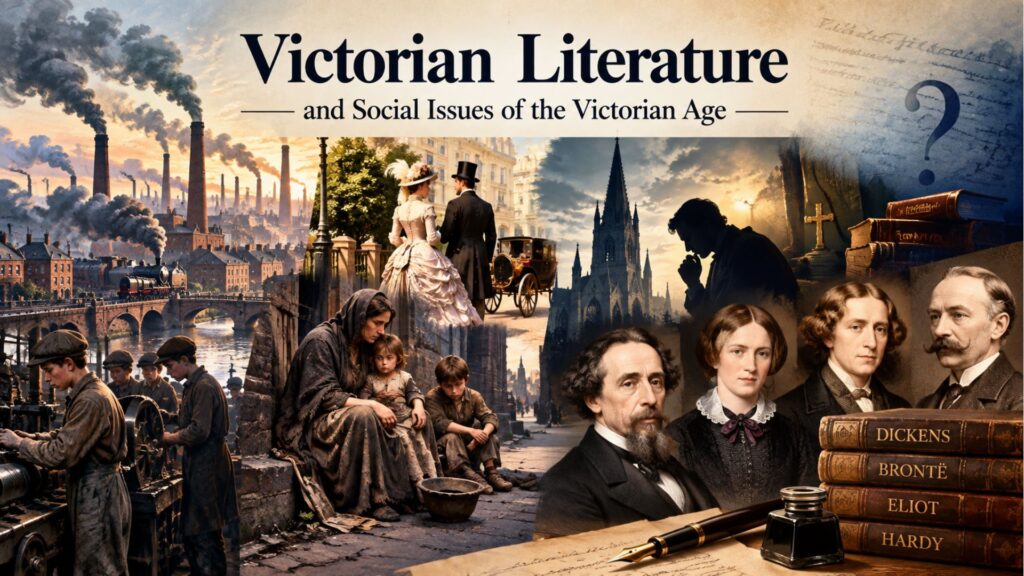
Introduction
Victorian Literature refers broadly to English literature produced during the reign of Queen Victoria, from 1837 to 1901. It was one of the most significant periods in English literary history because writers responded directly to the rapid social, economic, political, scientific, and religious changes taking place in nineteenth-century Britain.
The Victorian Age witnessed industrialisation, urbanisation, expansion of the British Empire, growing literacy, changing class relations, scientific discoveries, and increasing challenges to traditional religious beliefs. These developments created both confidence and anxiety. Britain was becoming an industrial and imperial power, yet poverty, child labour, overcrowded cities, exploitation, and social inequality remained serious problems.
Victorian writers did not simply record these changes. They questioned them, criticised them, and sometimes defended traditional values. Literature therefore became an important medium for understanding the contradictions of Victorian society.
For UPSC aspirants, Victorian Literature is important because it demonstrates how literature reflects social transformation. Understanding this relationship helps students analyse literary movements, historical change, social reform, industrialisation, religion, science, and changing moral values.
Historical Background of Victorian Literature
The Victorian period began in 1837 when Queen Victoria came to the throne and ended with her death in 1901.
The period was marked by enormous transformation. The Industrial Revolution changed Britain’s economy and society. Factories expanded, cities grew rapidly, and millions of people moved from rural areas to urban centres in search of employment.
At the same time, the expansion of education and printing increased the reading public. Newspapers, magazines, novels, and periodicals became important forms of mass communication.
Victorian literature therefore developed in close relationship with the changing society.
Major Features of the Victorian Age
| Aspect | Major Development |
|---|---|
| Political | Expansion of parliamentary democracy and reform |
| Economic | Industrialisation and capitalist growth |
| Social | Urbanisation and changing class relations |
| Scientific | Growth of geology, biology and scientific thought |
| Religious | Increasing questioning of traditional Christianity |
| Literary | Rise of the novel, dramatic monologue and social criticism |
| Education | Expansion of literacy and the reading public |
| Empire | Expansion and consolidation of the British Empire |
Social Issues in Victorian Literature
Industrialisation and Urbanisation
Industrialisation transformed Britain from a predominantly agricultural society into an industrial economy.
Cities such as London, Manchester and Birmingham expanded rapidly. However, industrial growth was accompanied by overcrowding, poor sanitation, disease and inadequate housing.
Victorian novelists frequently represented these conditions.
Charles Dickens is particularly important in this context. His novels such as Oliver Twist, Hard Times and Bleak House expose poverty, institutional failure, exploitation and social inequality.
In Hard Times, Dickens presents the industrial town of Coketown as a symbol of a society dominated by factories, machinery and utilitarian thinking.
Literature thus became a means of asking an important question: Can economic progress be considered genuine progress if it causes human suffering?
Poverty and Class Inequality
Victorian society was divided by significant differences in wealth and social status.
Industrial capitalism created immense wealth for some sections of society, while workers often experienced low wages, dangerous working conditions and limited social security.
The contrast between wealth and poverty became an important theme in Victorian literature.
Dickens repeatedly explored the experiences of the poor, children, workers and socially marginalised individuals. Elizabeth Gaskell’s Mary Barton also examines the difficult relationship between industrial employers and workers.
Victorian literature therefore provides an important cultural record of the class tensions created by industrial capitalism.
Child Labour and Social Reform
Children were employed in factories, mines and other forms of labour during the nineteenth century.
Victorian writers drew attention to the vulnerability of children.
In Oliver Twist, Dickens presents the suffering of an orphan within a harsh social system. Although the novel is not simply a historical documentary, its portrayal of poverty and institutional cruelty contributed to wider discussions about social reform.
Literature therefore interacted with contemporary debates about poverty, education and social responsibility.
Economic Issues of the Victorian Age
Industrial Capitalism
Industrial capitalism was one of the defining forces of Victorian Britain.
Factories, railways, banking and international trade expanded significantly. The middle class became increasingly influential, while industrial workers formed a growing urban population.
This created a fundamental tension between economic progress and human welfare.
Victorian literature frequently questioned whether material prosperity alone could create a just society.
Literature and the Industrial Question
| Economic Development | Social Consequence | Literary Response |
|---|---|---|
| Factory expansion | Growth of industrial workforce | Social novels |
| Urbanisation | Overcrowding and poverty | Realist fiction |
| Capital accumulation | Class inequality | Social criticism |
| Railways and technology | Greater mobility | Changing perceptions of time and space |
| Mass production | Mechanisation of life | Criticism of excessive materialism |
Utilitarianism
Victorian debates were influenced by utilitarianism, particularly the principle associated with Jeremy Bentham that actions should promote the greatest happiness of the greatest number.
Utilitarian ideas influenced public policy and social thought, but Victorian writers sometimes criticised an excessively mechanical application of such principles.
Dickens’s Hard Times offers one of the clearest literary criticisms of a system that reduces human beings to economic units and measurable facts.
The conflict was therefore not simply between rich and poor. It was also between human imagination and excessive rationalisation.
Religious Issues in Victorian Literature
Religion was one of the deepest sources of Victorian intellectual conflict.
Traditional Christian belief remained powerful, but scientific discoveries and historical scholarship challenged established interpretations of the Bible and religious doctrine.
Science and Religious Doubt
The publication of Charles Darwin’s On the Origin of Species in 1859 had a major intellectual impact.
Darwin’s theory of evolution through natural selection challenged traditional interpretations of human origins and encouraged wider debates about science and religion.
Victorian writers responded to this changing intellectual environment in different ways.
Alfred Lord Tennyson, for example, explored religious doubt, grief and uncertainty in In Memoriam A.H.H.
The poem does not simply reject faith. Instead, it represents the struggle between traditional belief, scientific uncertainty and the human desire for meaning.
The Crisis of Faith
Victorian religious doubt was closely connected with developments in science, biblical criticism and historical scholarship.
Writers increasingly asked questions such as:
- Can religious faith survive scientific explanation?
- How can suffering be reconciled with belief in a benevolent God?
- What happens when traditional beliefs are questioned?
- Can morality exist independently of religious certainty?
These questions contributed to what is often described as the Victorian crisis of faith.
Tennyson and Religious Uncertainty
In Memoriam A.H.H. is especially significant because it combines personal grief with broader intellectual concerns.
Tennyson struggles with the apparent conflict between faith and doubt. The poem ultimately moves toward a qualified form of hope rather than presenting absolute certainty.
This makes Tennyson an important representative of the Victorian tension between faith and modern doubt.
Women and Gender in Victorian Society
Victorian literature also reflects changing ideas about women’s education, marriage, work and social independence.
Women were expected to conform to restrictive social ideals, particularly the domestic ideal associated with the notion of the respectable Victorian woman.
However, women writers challenged many of these assumptions.
Important Women Writers
Charlotte Brontë’s Jane Eyre presents a female protagonist who seeks emotional, moral and intellectual independence.
George Eliot’s Middlemarch examines marriage, ambition, social expectations and the limitations placed on women.
Elizabeth Barrett Browning’s Aurora Leigh explores women’s intellectual aspirations and the relationship between gender and artistic identity.
These works demonstrate that Victorian literature was not merely concerned with external social reform. It also questioned the personal and psychological consequences of social expectations.
Major Victorian Writers and Their Social Concerns
| Writer | Important Work | Major Concerns |
|---|
| Charles Dickens | Hard Times | Industrialisation, poverty, education |
| Charles Dickens | Oliver Twist | Poverty, childhood, institutions |
| George Eliot | Middlemarch | Society, marriage, morality |
| Thomas Hardy | Tess of the d’Urbervilles | Gender, morality, social constraints |
| Charlotte Brontë | Jane Eyre | Gender, independence, morality |
| Alfred Tennyson | In Memoriam | Faith, grief, science and doubt |
| Matthew Arnold | Dover Beach | Loss of faith and cultural uncertainty |
| Robert Browning | My Last Duchess | Power, psychology and character |
| Elizabeth Barrett Browning | Aurora Leigh | Women, art and social expectations |
Victorian Literature as a Literature of Contradictions
Victorian Literature cannot be understood simply as optimistic or pessimistic.
It contained several opposing forces:
| Victorian Confidence | Victorian Anxiety |
|---|---|
| Industrial progress | Urban poverty |
| Scientific discovery | Religious doubt |
| Imperial expansion | Ethical questions about empire |
| Growing literacy | Unequal access to education |
| Economic growth | Class inequality |
| Social reform | Continuing exploitation |
| Technological progress | Fear of excessive mechanisation |
This tension is one of the defining characteristics of the age.
Victorian writers often believed in the possibility of improvement while simultaneously exposing the problems within Victorian society.
Literary Forms and Social Criticism
The novel became especially important during the Victorian period.
Its broad narrative structure allowed writers to represent families, workplaces, cities, institutions and different social classes.
The novel could therefore function as a form of social analysis.
The dramatic monologue, associated particularly with Robert Browning, offered another important Victorian form. In poems such as My Last Duchess, the speaker unintentionally reveals his own personality, values and moral limitations.
Victorian poetry also became a vehicle for exploring religious doubt, nature, morality and social change.
Thus, Victorian literature was diverse in form but united by a strong engagement with the problems of its age.
Why This Topic Matters for UPSC
Victorian Literature is useful for UPSC preparation because it connects literature with social and intellectual history.
For English Literature aspirants, it helps in understanding:
- Victorian literary characteristics
- Major authors and works
- Social realism
- Industrialisation and literature
- Religious doubt
- Darwinism and Victorian thought
- Class relations
- Gender and literature
- Literary responses to social change
For Essay and General Studies preparation, the period also provides useful examples for discussing:
- Industrialisation
- Social inequality
- Scientific progress
- Religion and modernity
- Women’s rights
- Education
- Human welfare and economic development
The broader lesson is that literature can act as a critical response to historical transformation.
UPSC Mains Answer Writing Approach
For a 10-Mark Answer
Question: Discuss the major social concerns reflected in Victorian Literature.
Structure:
Introduction: Define Victorian Literature and place it within nineteenth-century Britain.
Body:
- Industrialisation and urban poverty
- Class inequality
- Child labour and social reform
- Gender restrictions
- Religious and intellectual uncertainty
Use Dickens, Brontë, Eliot or Tennyson as examples.
Conclusion: Victorian writers reflected both the achievements and contradictions of modern industrial society.
For a 15-Mark Answer
Begin with the historical context.
Then analyse:
- Industrialisation
- Urbanisation
- Class conflict
- Women’s position
- Religious doubt
- Scientific change
Support each point with relevant writers and works.
End by explaining that Victorian literature transformed social problems into major literary themes.
For a 20-Mark Answer
A stronger answer should connect historical change, literary form and social criticism.
A possible structure is:
Introduction → Historical background → Economic transformation → Social inequality → Religious crisis → Gender issues → Literary responses → Examples from major writers → Critical assessment → Conclusion
A high-quality answer should not merely list Victorian problems. It should explain how those problems shaped literary themes, characters, settings and forms.
UPSC Prelims Quick Revision
- Victorian Age: 1837–1901
- Queen Victoria: British monarch during the period
- Charles Dickens: Major Victorian novelist and social critic
- Hard Times: Industrialisation, utilitarianism and social inequality
- Oliver Twist: Poverty, childhood and institutional hardship
- George Eliot: Major Victorian novelist; Middlemarch
- Charlotte Brontë: Jane Eyre
- Tennyson: In Memoriam A.H.H.
- Matthew Arnold: Dover Beach
- Charles Darwin: On the Origin of Species, published in 1859
- Major intellectual tension: Science and traditional religious belief
- Important literary form: Dramatic monologue
5 Likely UPSC-Style Questions
- Discuss the relationship between Victorian Literature and the social consequences of industrialisation.
- How did scientific developments contribute to the crisis of faith in Victorian Literature?
- Examine the representation of class inequality in the major novels of the Victorian Age.
- Victorian Literature reflects both confidence in progress and anxiety about modernity. Discuss.
- Analyse how Victorian writers responded to changing ideas about women, marriage and social identity.
Frequently Asked Questions
1. What is Victorian Literature?
Victorian Literature refers broadly to English literature produced during Queen Victoria’s reign from 1837 to 1901. It is characterised by strong engagement with industrialisation, social reform, religion, science, class and changing moral values.
2. What are the major themes of Victorian Literature?
Major themes include industrialisation, poverty, class inequality, social reform, religion, scientific change, moral conflict, gender, education and the tension between progress and anxiety.
3. Who are the major Victorian writers?
Important Victorian writers include Charles Dickens, George Eliot, Charlotte Brontë, Thomas Hardy, Alfred Tennyson, Robert Browning, Matthew Arnold and Elizabeth Barrett Browning.
4. Why did Victorian Literature focus on social problems?
Rapid industrialisation, urbanisation and social change created new forms of poverty and inequality. Writers used literature to represent these problems and question the values and institutions of their society.
5. How did Darwinism influence Victorian Literature?
Darwin’s theory of evolution contributed to wider intellectual debates about human origins, science and religious belief. Victorian writers such as Tennyson and Matthew Arnold explored the uncertainty and loss of confidence associated with these changing ideas.
Conclusion
Victorian Literature emerged from a period of extraordinary transformation. Industrial growth, urbanisation, class inequality, scientific discovery, religious doubt and changing ideas about gender reshaped British society and deeply influenced its literature.
Victorian writers responded in different ways. Dickens exposed social injustice, Brontë explored female independence, Eliot examined social and moral relationships, while Tennyson and Arnold confronted religious and intellectual uncertainty.
The significance of Victorian Literature therefore lies not merely in its major authors and texts but in its ability to capture the contradictions of an age caught between tradition and modernity. For UPSC aspirants, it offers an important example of how literature can reflect, question and interpret wider social and intellectual change.