
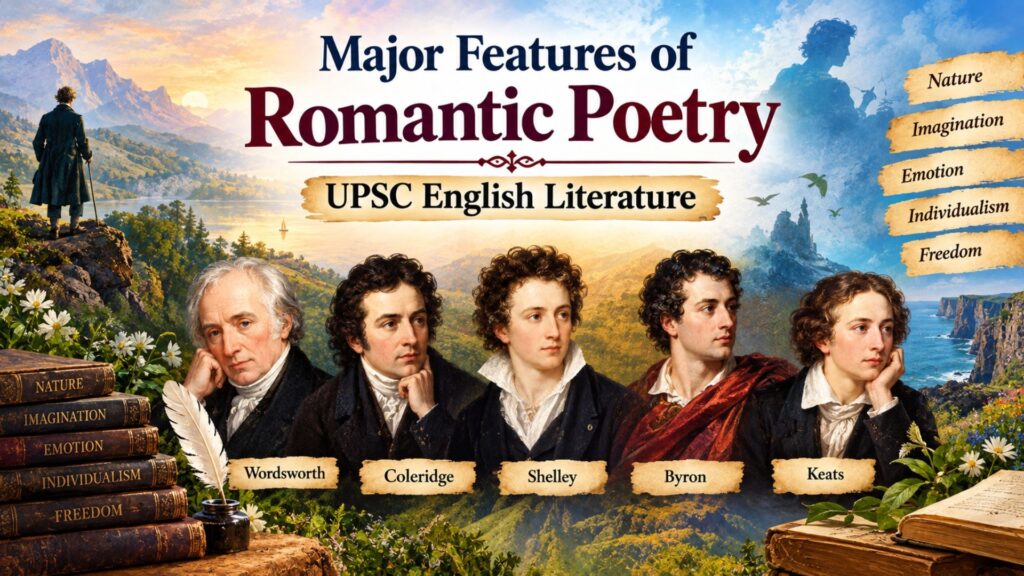
Romantic poetry marks a major shift in English literary history. Emerging in the late eighteenth century and becoming influential during the early nineteenth century, Romanticism challenged several assumptions associated with the preceding Neoclassical tradition. Romantic poets placed greater emphasis on imagination, emotion, nature, individual experience, freedom, and the ordinary human life.
The movement is closely associated with poets such as William Wordsworth, Samuel Taylor Coleridge, Lord Byron, Percy Bysshe Shelley, and John Keats. Their poetry differs considerably in subject, style, and philosophy, yet certain common features help define Romantic poetry as a literary movement.
For UPSC English Literature aspirants, understanding these features is important because Romantic poetry is not simply a collection of famous poems. It represents a broader transformation in ideas about the poet, nature, imagination, society, language, and the purpose of poetry. A strong answer should therefore connect individual poems with the historical and intellectual background of Romanticism.
Historical Background of Romantic Poetry
Romanticism developed during a period of significant political, social, and intellectual change in Europe.
The French Revolution of 1789, the Industrial Revolution, growing urbanisation, political debates about liberty, and changing attitudes towards traditional authority influenced the intellectual climate of the period.
The publication of William Wordsworth and Samuel Taylor Coleridge’s Lyrical Ballads in 1798 is conventionally regarded as a landmark in the development of English Romantic poetry. Its expanded second edition of 1800 included Wordsworth’s important Preface, which presented ideas about poetry, poetic language, emotion, and ordinary life.
However, Romanticism did not begin suddenly in 1798. Earlier poets such as William Blake and Robert Burns are often discussed in relation to the transition toward Romantic sensibilities.
Major Features of Romantic Poetry
1. Emphasis on Imagination
Imagination is one of the central concepts of Romantic poetry.
Romantic poets regarded imagination as more than a decorative poetic faculty. It could transform ordinary experience and help the poet perceive deeper relationships between human beings, nature, memory, and existence.
For Coleridge, imagination has a particularly important creative function. In Biographia Literaria, he distinguishes between the primary and secondary imagination and contrasts imagination with mere mechanical association.
Coleridge’s poetry, especially “The Rime of the Ancient Mariner” and “Kubla Khan,” demonstrates how imagination can transform experience into a symbolic and mysterious world.
2. Nature as a Major Theme
Nature occupies a central position in Romantic poetry.
For Romantic poets, nature is not merely scenery or background. It may function as a source of beauty, knowledge, moral reflection, emotional healing, and spiritual insight.
Wordsworth is particularly important in this context. In poems such as “Tintern Abbey,” “Lines Written in Early Spring,” and “The World Is Too Much with Us,” nature is closely connected with human consciousness.
Wordsworth’s relationship with nature also develops over time. In “Tintern Abbey,” nature is remembered through the mind and becomes connected with moral and emotional development.
3. Importance of Individual Experience
Romantic poetry frequently turns inward.
The poet’s personal emotions, memories, perceptions, doubts, hopes, and responses become important poetic subjects. This does not mean that Romantic poetry is merely autobiographical. Individual experience often becomes a means of exploring wider human questions.
Wordsworth’s poetry provides important examples of this movement from personal experience toward broader reflection.
His famous definition of poetry in the Preface to Lyrical Ballads connects poetry with powerful feeling and later reflection. The important point for UPSC students is that emotion and reflection operate together.
4. Celebration of Emotion
Romantic poetry gives a prominent place to emotion.
This contrasts with the stronger emphasis on order, restraint, and formal balance associated with much eighteenth-century Neoclassical poetry.
However, Romantic poetry should not be understood as uncontrolled emotional expression. The emotion is frequently shaped through memory, imagination, reflection, and artistic form.
Wordsworth’s poetry often demonstrates this relationship between immediate feeling and later contemplation.
5. Interest in the Ordinary and Rural Life
Wordsworth deliberately turned toward ordinary people and rural experience.
In the Preface to Lyrical Ballads, he explains his interest in the language and experiences of common people, particularly those living close to nature.
Poems such as “Michael,” “The Solitary Reaper,” and “We Are Seven” illustrate this interest.
This was significant because poetry had often been associated with elevated subjects and highly formal language. Romantic poets expanded the range of poetic subjects.
6. The Poet as a Sensitive Individual
The Romantic poet is often represented as a person with heightened sensitivity and imagination.
The poet does not merely describe the external world. He interprets it through consciousness.
Wordsworth’s conception of the poet emphasises greater sensitivity, imagination, and emotional responsiveness. This idea contributes to the Romantic understanding of poetry as a distinctive mode of perception.
7. Freedom from Conventional Rules
Romantic poets questioned rigid literary conventions.
They experimented with:
- poetic forms
- subject matter
- language
- imagery
- symbolism
- narrative structures
- tone
This did not mean that Romantic poets rejected form altogether. Shelley, Keats, Byron, Wordsworth, and Coleridge used a wide variety of established forms while also adapting them creatively.
Therefore, Romanticism is better understood as a movement toward artistic and imaginative freedom rather than complete rejection of poetic form.
8. Medievalism and Interest in the Past
Romantic poets frequently showed interest in medieval literature, folklore, legends, myths, and historical settings.
Coleridge’s “The Rime of the Ancient Mariner” uses a supernatural maritime narrative with an archaic atmosphere.
Keats’s “La Belle Dame sans Merci” also draws upon medieval romance traditions.
This interest in the past reflects the Romantic fascination with mystery, imagination, folklore, and cultures outside the dominant classical tradition.
9. Supernatural and the Mysterious
The supernatural is particularly significant in Coleridge’s poetry.
“The Rime of the Ancient Mariner” contains supernatural events, mysterious forces, and an uncertain boundary between the natural and supernatural worlds.
Coleridge’s achievement lies not simply in including supernatural elements but in presenting them in a manner that encourages the reader to temporarily accept the imaginative world of the poem.
This approach is important when discussing Romanticism’s relationship with imagination and poetic belief.
10. Revolutionary and Political Ideas
Romantic poetry developed during an era of political transformation.
The French Revolution initially inspired several young Romantic poets. Concepts such as liberty, equality, political reform, and resistance to oppression appear in the poetry of Byron and Shelley.
Shelley’s “The Mask of Anarchy” and “England in 1819” provide important examples of political poetry.
However, Romantic poets did not hold identical political positions throughout their careers. Their responses to revolution, authority, and social change varied.
11. The Sublime
The Romantic imagination is strongly connected with the concept of the sublime.
The sublime describes experiences of overwhelming grandeur, power, vastness, or terror that exceed ordinary human perception.
Mountains, storms, oceans, night landscapes, and immense natural spaces frequently become vehicles for such experiences.
This concept is important for understanding Romantic poetry because nature can produce both beauty and awe.
12. Childhood, Memory, and Innocence
Childhood becomes an important subject in Romantic poetry, particularly in Wordsworth.
In “Ode: Intimations of Immortality,” childhood is associated with a distinctive vision of the world, while memory becomes a means of recovering or contemplating earlier experience.
Romantic poetry therefore frequently connects childhood, memory, imagination, and identity.
13. Beauty and the Aesthetic Imagination
Keats represents another important dimension of Romanticism: the intense pursuit of beauty.
Poems such as “Ode on a Grecian Urn,” “Ode to a Nightingale,” and “To Autumn” explore beauty, mortality, art, sensation, and transience.
Keats’s poetry demonstrates how Romanticism can move beyond political and natural themes toward questions of art, beauty, mortality, and human consciousness.
Major Romantic Poets and Important Works
| Poet | Important Works | Major Romantic Concerns |
|---|---|---|
| William Wordsworth | Tintern Abbey, The Prelude, Ode: Intimations of Immortality | Nature, memory, childhood, imagination |
| S. T. Coleridge | The Rime of the Ancient Mariner, Kubla Khan | Imagination, supernatural, mystery |
| Lord Byron | Childe Harold’s Pilgrimage, Don Juan | Individualism, freedom, satire, politics |
| P. B. Shelley | Ode to the West Wind, To a Skylark, The Mask of Anarchy | Revolution, idealism, freedom, nature |
| John Keats | Ode on a Grecian Urn, To Autumn, Ode to a Nightingale | Beauty, imagination, mortality, art |
Romantic Poetry and Neoclassical Poetry
The difference between Romantic and Neoclassical poetry is useful for UPSC comparative answers.
| Aspect | Neoclassical Tendencies | Romantic Tendencies |
|---|---|---|
| Emphasis | Reason and order | Imagination and emotion |
| Subject | Classical and public subjects | Nature, individual and ordinary life |
| Nature | Often ordered and observed | Often emotionally and spiritually experienced |
| Language | Formal and elevated | Greater interest in ordinary language |
| Individual | Less central | Strongly emphasised |
| Supernatural | Often treated with restraint | Frequently explored imaginatively |
| Form | Strong respect for conventions | Greater experimentation |
This table describes broad tendencies rather than absolute rules. Individual poets often crossed these boundaries.
Critical Significance of Romantic Poetry
Romantic poetry transformed the understanding of literary creativity.
Wordsworth’s theory emphasised emotion, memory, ordinary life, and the relationship between poetry and human experience. Coleridge developed a sophisticated account of imagination and the creative process. Shelley associated poetry with imaginative and moral vision, while Keats explored beauty, art, uncertainty, and mortality.
Romantic poetry also expanded the relationship between human beings and the natural world. Nature could become a psychological, philosophical, and spiritual presence rather than merely a physical setting.
Its influence can be seen in later developments in English poetry, including Victorian and modern poetic traditions.
Why This Topic Matters for UPSC
For UPSC English Literature, Romantic poetry provides a foundation for understanding one of the major movements in English literary history. Questions can require students to connect poets, poems, historical circumstances, poetic theories, and literary characteristics.
The topic also helps with:
- Literary analysis: identifying themes, imagery, symbolism, and poetic techniques.
- Historical understanding: connecting literature with the French Revolution, Industrialisation, and changing intellectual attitudes.
- Comparative answers: distinguishing Romantic poetry from Neoclassical poetry.
- Essay writing: using ideas such as nature, imagination, freedom, individuality, and industrialisation in broader arguments.
- Vocabulary and language: understanding literary terms such as sublime, imagination, symbolism, lyricism, and pastoral.
- Analytical writing: moving beyond listing characteristics to explaining how particular poems demonstrate them.
UPSC Mains Answer Writing Approach
For a 10-Mark Answer
Introduction: Define Romantic poetry and mention its emergence in the late eighteenth century.
Main body:
- Imagination and emotion.
- Nature and individual experience.
- Ordinary life and freedom from rigid conventions.
Example: Use Wordsworth’s Tintern Abbey or Coleridge’s The Rime of the Ancient Mariner.
Conclusion: State that Romantic poetry broadened the subject matter and imaginative possibilities of English poetry.
For a 15-Mark Answer
Begin with the historical background of Romanticism. Discuss nature, imagination, emotion, individualism, ordinary life, supernaturalism, and political freedom. Support each major point with a relevant poet or poem.
A balanced answer should also acknowledge that Romantic poets differed considerably. Wordsworth’s treatment of nature is not identical to Keats’s aestheticism or Shelley’s revolutionary idealism.
For a 20-Mark Answer
A longer answer can examine Romantic poetry through multiple dimensions:
- Historical background.
- Romantic theories of poetry.
- Nature and the sublime.
- Imagination and emotion.
- Individual experience and memory.
- Political and social concerns.
- Medievalism and supernaturalism.
- Differences among major Romantic poets.
- Comparison with Neoclassical poetry.
- Critical significance.
Short Model Answer Framework
Question: Discuss the major features of Romantic poetry with suitable examples.
Framework: Begin by identifying Romanticism as a major literary movement associated with the transformation of English poetry around the turn of the nineteenth century. Explain its emphasis on imagination, emotion, nature, individual experience, ordinary life, and freedom from restrictive conventions. Use Wordsworth’s Tintern Abbey, Coleridge’s The Rime of the Ancient Mariner, Shelley’s Ode to the West Wind, and Keats’s odes as textual examples. Conclude by noting that Romantic poetry expanded the possibilities of poetic subject, perception, and expression.
UPSC Prelims Quick Revision
- 1798: Publication of Lyrical Ballads by Wordsworth and Coleridge.
- 1800: Important second edition of Lyrical Ballads.
- Wordsworth: Nature, memory, childhood, ordinary life.
- Coleridge: Imagination, supernaturalism, mystery.
- Byron: Individualism, political concerns, satire.
- Shelley: Idealism, revolution, freedom, nature.
- Keats: Beauty, art, mortality, imagination.
- Sublime: Experience of overwhelming grandeur or power.
- Romanticism: Associated with imagination, emotion, nature and individual experience.
- Important theoretical text: Wordsworth’s Preface to Lyrical Ballads.
- Important Coleridge text: Biographia Literaria.
- Common historical contexts: French Revolution and Industrial Revolution.
5 Likely UPSC-Style Questions
- Define Romantic poetry and discuss its major characteristics with suitable examples.
- “Nature is not merely a background but an active presence in Romantic poetry.” Discuss with reference to Wordsworth and other Romantic poets.
- Examine the role of imagination in the poetry of Wordsworth and Coleridge.
- Compare the major characteristics of Romantic poetry with those of Neoclassical poetry.
- Discuss how the poetry of Shelley and Keats demonstrates different dimensions of Romanticism.
Frequently Asked Questions
1. What are the major features of Romantic poetry?
The major features include imagination, emotion, nature, individual experience, ordinary life, freedom from rigid conventions, interest in the supernatural, the sublime, childhood, memory, beauty, and political or revolutionary ideas.
2. Who are the major Romantic poets?
The major English Romantic poets commonly studied are William Wordsworth, Samuel Taylor Coleridge, Lord Byron, Percy Bysshe Shelley, and John Keats. William Blake is also important in discussions of the broader development of Romanticism.
3. Why is Lyrical Ballads important to Romantic poetry?
Published in 1798, Lyrical Ballads by Wordsworth and Coleridge is conventionally regarded as a landmark in English Romantic poetry. It challenged established poetic assumptions concerning subject matter, language, imagination, and ordinary experience.
4. What is the role of nature in Romantic poetry?
Nature can function as a source of beauty, emotional experience, moral reflection, imagination, and philosophical insight. Wordsworth’s poetry provides some of the clearest examples of this relationship.
5. How is Romantic poetry different from Neoclassical poetry?
Romantic poetry generally places greater emphasis on imagination, emotion, nature, individual experience, and creative freedom, whereas Neoclassical poetry is more strongly associated with reason, order, classical models, formal restraint, and established conventions. These are broad tendencies rather than absolute divisions.
Conclusion
Romantic poetry represents a major transformation in English literary thought. It shifted attention toward imagination, emotion, nature, individual experience, ordinary life, freedom, beauty, and the mysterious dimensions of human existence.
Wordsworth, Coleridge, Byron, Shelley, and Keats expressed Romanticism in different ways. Wordsworth explored nature and memory; Coleridge developed imaginative and supernatural poetry; Byron combined individualism with satire and political concerns; Shelley connected poetry with idealism and freedom; and Keats explored beauty, art, and mortality.
For UPSC English Literature, the key is not to memorise a list of characteristics. Students should connect historical context + literary theory + individual poets + specific poems + critical interpretation. This approach produces more analytical and text-based answers.