
Introduction
Epic and mock-epic are important literary forms that help UPSC Civil Services aspirants understand the development of English literature, classical influence, and the literary traditions of different periods. The terms are particularly relevant to the study of Classical and Neo-Classical literature, where writers consciously drew upon ancient Greek and Roman models.
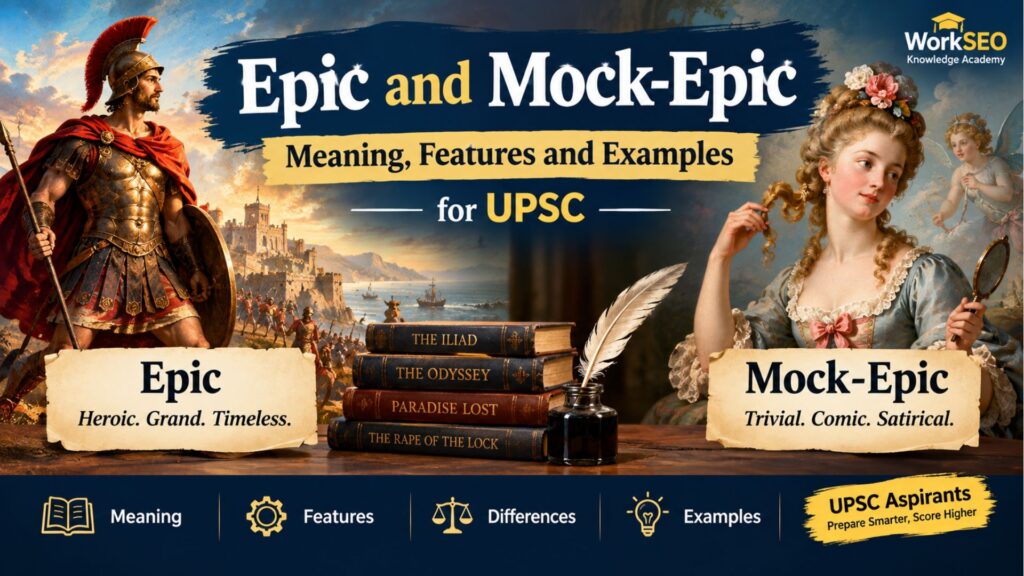
An epic is a long narrative poem that presents the heroic actions of a central figure or a community against a broad historical, cultural, or cosmic background. Homer’s Iliad and Odyssey, Virgil’s Aeneid, and Milton’s Paradise Lost are major examples.
A mock-epic, or mock-heroic, uses the elevated style and conventions of epic poetry to describe a trivial, ordinary, or comic subject. Alexander Pope’s The Rape of the Lock is the most famous English example.
The distinction is important for UPSC because it allows aspirants to connect literary form, historical context, classical influence, satire, social values, and the intellectual character of the Neo-Classical Age.
What Is an Epic?
The word epic comes from the Greek epos, meaning a word, story, or song. In literary studies, an epic is an extended narrative poem dealing with significant events, heroic figures, and issues of collective or universal importance.
Traditional epics often preserve the values, conflicts, beliefs, and ideals of the society from which they emerge.
Major Examples of Epic Poetry
| Epic | Author | Literary Tradition | Central Subject |
|---|---|---|---|
| Iliad | Homer | Greek | Trojan War and Achilles |
| Odyssey | Homer | Greek | Odysseus’s journey home |
| Aeneid | Virgil | Roman | Aeneas and Rome’s legendary origins |
| Paradise Lost | John Milton | English | Fall of humanity |
| Mahabharata | Traditionally attributed to Vyasa | Indian | Conflict of the Kuru dynasty |
| Ramayana | Traditionally attributed to Valmiki | Indian | Rama’s life and exile |
The Indian epics are particularly useful for comparative literary understanding, although their structures and traditions differ from the classical Greek and Roman epic tradition.
Major Features of an Epic
1. Grand Subject Matter
An epic usually deals with events considered important to a community, civilization, or religious tradition.
For example, The Iliad focuses on the Trojan War, while Paradise Lost deals with humanity’s fall from divine grace.
2. Heroic Central Character
The protagonist is generally an exceptional figure whose actions have consequences beyond personal life.
Achilles in The Iliad, Odysseus in The Odyssey, Aeneas in The Aeneid, and Satan and Adam in different ways within Paradise Lost demonstrate the importance of heroic or extraordinary figures in epic narrative.
3. Supernatural Elements
Traditional epics frequently include gods, supernatural forces, prophecies, divine intervention, or extraordinary events.
In Homer’s epics, Greek gods actively influence human affairs. In Paradise Lost, Milton incorporates angels, demons, Heaven, Hell, and divine authority.
4. Invocation of the Muse
Classical epics often begin with an invocation, in which the poet calls upon a divine or supernatural source of inspiration.
Homer’s epics and Virgil’s Aeneid provide important examples of this convention.
5. In Medias Res
Many classical epics begin in medias res, meaning “in the middle of things.”
Instead of narrating events from the absolute beginning, the poet begins at a significant point and later provides the necessary background through narration or flashback.
6. Epic Simile
An epic simile is an extended comparison, often developed over several lines.
Homer is especially famous for elaborate similes comparing warriors and events to natural phenomena, animals, storms, or everyday activities.
7. Elevated Style
The language of an epic is generally formal and dignified. The style reflects the importance of its subject.
Milton’s Paradise Lost, for example, deliberately adopts a grand style influenced by classical epic traditions.
What Is a Mock-Epic?
A mock-epic is a literary work that imitates the conventions, language, structure, and heroic style of an epic but applies them to a comparatively trivial or comic subject.
It is therefore also called mock-heroic.
The technique creates irony: the reader recognizes the enormous difference between the grand style of presentation and the relatively insignificant event being described.
The form became particularly important during the Neo-Classical period, when English writers valued classical models, order, reason, balance, wit, and controlled literary form.
Alexander Pope's The Rape of the Lock
The most important English example of a mock-epic is Alexander Pope’s The Rape of the Lock.
The poem transforms a minor social incident—the cutting of a young woman’s lock of hair—into an apparently grand heroic conflict.
Pope deliberately imitates epic conventions to create comic contrast.
Epic Conventions in The Rape of the Lock
| Epic Convention | Treatment in The Rape of the Lock |
|---|---|
| Invocation | Pope invokes his poetic subject in elevated language |
| Supernatural beings | Sylphs and other supernatural figures participate |
| Heroic conflict | A social dispute is presented as a major conflict |
| Epic machinery | Supernatural beings influence human events |
| Elevated language | Trivial social activities receive grand treatment |
| Battle imagery | A card game and social encounters receive heroic treatment |
| Grand conclusion | The fate of a lock of hair is treated with exaggerated importance |
The comedy emerges because the scale of the language is disproportionate to the scale of the event.
Why Did Neo-Classical Writers Use the Mock-Epic?
The mock-epic was particularly suited to the intellectual environment of eighteenth-century England.
Neo-Classical writers admired the literature of ancient Greece and Rome but also used classical forms to comment on contemporary society.
The mock-epic allowed writers to combine:
- classical literary conventions,
- wit and irony,
- social criticism,
- satire,
- formal poetic structure,
- and commentary on human behaviour.
Thus, the mock-epic is not merely a humorous version of an epic. It can also function as a social and literary critique.
Other Important Mock-Epic Examples
The Dunciad — Alexander Pope
Pope’s The Dunciad uses mock-heroic techniques to satirize what he regarded as intellectual and literary dullness.
The poem demonstrates how epic conventions could be adapted for literary and cultural criticism.
Hudibras — Samuel Butler
Samuel Butler’s Hudibras is another important mock-heroic work. It satirizes political and religious conflicts in seventeenth-century England.
It is particularly significant for understanding how heroic conventions can be combined with satire and political commentary.
Epic vs Mock-Epic: Key Differences
| Basis | Epic | Mock-Epic |
|---|---|---|
| Subject | Grand and serious | Trivial, ordinary or comic |
| Hero | Genuine heroic figure | Ordinary figure treated humorously as heroic |
| Tone | Serious and elevated | Ironic, comic and satirical |
| Purpose | Celebrate, preserve or explore heroic values | Expose absurdity, vanity or social weaknesses |
| Supernatural machinery | Usually significant | Often deliberately imitated or parodied |
| Style | Grand and dignified | Grand style used for comic contrast |
| Scale | Proportionate to subject | Deliberately disproportionate |
| Major example | Iliad | The Rape of the Lock |
| Literary effect | Heroic elevation | Irony and satire |
Similarities Between Epic and Mock-Epic
Despite their differences, the two forms are closely connected.
Both may use:
- Elevated language.
- Heroic imagery.
- Supernatural machinery.
- Formal poetic structures.
- Epic similes.
- Invocations.
- Battle imagery.
- Classical references.
The crucial difference lies in purpose and proportion.
An epic treats its subject as genuinely significant, whereas a mock-epic deliberately gives an insignificant subject the treatment normally reserved for heroic events.
Epic and Mock-Epic in the Neo-Classical Context
The Neo-Classical period placed considerable emphasis on reason, order, decorum, balance, discipline, wit, and classical models.
Writers such as Alexander Pope drew heavily upon the literary traditions of Greece and Rome.
The mock-epic became particularly effective because it allowed writers to imitate classical grandeur while exposing the vanity and artificiality of contemporary social life.
In The Rape of the Lock, for instance, fashionable society is presented through a deliberately exaggerated heroic framework. A small social incident appears to become an epic conflict.
This contrast creates satire without requiring the poet to abandon formal discipline.
Why This Topic Matters for UPSC
This topic has value for both UPSC Prelims and Mains.
For UPSC Prelims
Aspirants should remember the following associations:
- Homer — Iliad and Odyssey
- Virgil — Aeneid
- Milton — Paradise Lost
- Alexander Pope — The Rape of the Lock
- Pope — The Dunciad
- Samuel Butler — Hudibras
- Mock-epic — mock-heroic treatment of a trivial subject
- In medias res — beginning in the middle of the action
- Epic simile — extended comparison associated strongly with epic poetry
These associations can help in questions involving matching authors, works, literary forms, and periods.
For UPSC Mains
The topic can be connected to broader themes such as:
- Classical influence on English literature
- Neo-Classical literary principles
- Development of satire
- Literature and society
- Heroism and its representation
- Reason and order in eighteenth-century literature
- Literary imitation and adaptation
- Social criticism through humour and irony
UPSC Mains Answer Writing Approach
Aspirants should avoid merely defining epic and mock-epic. A good answer should explain their relationship, literary conventions, historical context, and examples.
For a 10-Mark Answer
Use the following structure:
Introduction:
Define epic and mock-epic in two or three sentences.
Body:
- Mention major features of an epic.
- Explain the meaning of mock-epic.
- Give The Rape of the Lock as the central example.
- Mention two or three differences.
Conclusion:
State that mock-epic derives its effect from deliberately applying epic grandeur to a trivial subject.
For a 15-Mark Answer
Use:
Introduction → Definition → Features → Historical context → Comparison → Examples → Conclusion
Include the Neo-Classical emphasis on classical imitation, reason, order, wit and satire.
For a 20-Mark Answer
A more analytical structure can be used:
Introduction
↓
Nature and conventions of epic
↓
Emergence and characteristics of mock-epic
↓
Classical influence
↓
Neo-Classical social context
↓
Comparison of epic and mock-epic
↓
Case study: The Rape of the Lock
↓
Role of satire and irony
↓
Balanced conclusion
A strong answer should demonstrate that the mock-epic is not simply an inferior form of epic. It is a deliberate literary technique that uses the grandeur of epic to create irony, humour and social criticism.
5 Likely UPSC-Style Questions
- What is an epic? Discuss its major characteristics with suitable examples from English literature.
- Explain the meaning and literary significance of the mock-epic. Illustrate your answer with reference to Alexander Pope’s The Rape of the Lock.
- “The mock-epic derives its comic effect from the disproportion between subject and style.” Discuss.
- Compare and contrast the conventions of epic and mock-epic in English literature.
- How did Neo-Classical writers employ classical literary conventions for satire and social criticism? Discuss with suitable examples.
Frequently Asked Questions
1. What is an epic in English literature?
An epic is a long narrative poem dealing with heroic figures, major events, and subjects of cultural, national, religious, or universal significance. Homer’s Iliad and Milton’s Paradise Lost are major examples.
2. What is a mock-epic?
A mock-epic imitates the elevated style and conventions of an epic but applies them to a trivial, ordinary, or comic subject. The contrast produces irony and satire.
3. What is the most famous English mock-epic?
Alexander Pope’s The Rape of the Lock is widely regarded as the most important English mock-epic. It transforms a minor social incident into an apparently heroic conflict.
4. What is the difference between epic and mock-epic?
An epic treats its subject with genuine grandeur and seriousness, whereas a mock-epic deliberately uses epic conventions to exaggerate the importance of a comparatively trivial subject.
5. Why is The Rape of the Lock called a mock-epic?
Pope uses epic devices such as supernatural machinery, elevated language, heroic imagery and battle-like descriptions to present a minor social incident. This deliberate disproportion creates humour and satire.
Conclusion
Epic and mock-epic represent two closely related but fundamentally different uses of literary grandeur. The epic presents heroic action and culturally significant subjects through an elevated narrative form. The mock-epic borrows this grandeur but applies it to trivial or comic situations, creating irony and often social criticism.
For UPSC aspirants, Homer, Virgil, Milton, Alexander Pope, The Rape of the Lock, epic conventions, mock-heroic technique, and Neo-Classical satire are the key areas to remember. The most important analytical point is that the mock-epic gains its effect from the deliberate mismatch between grand form and comparatively small subject.