
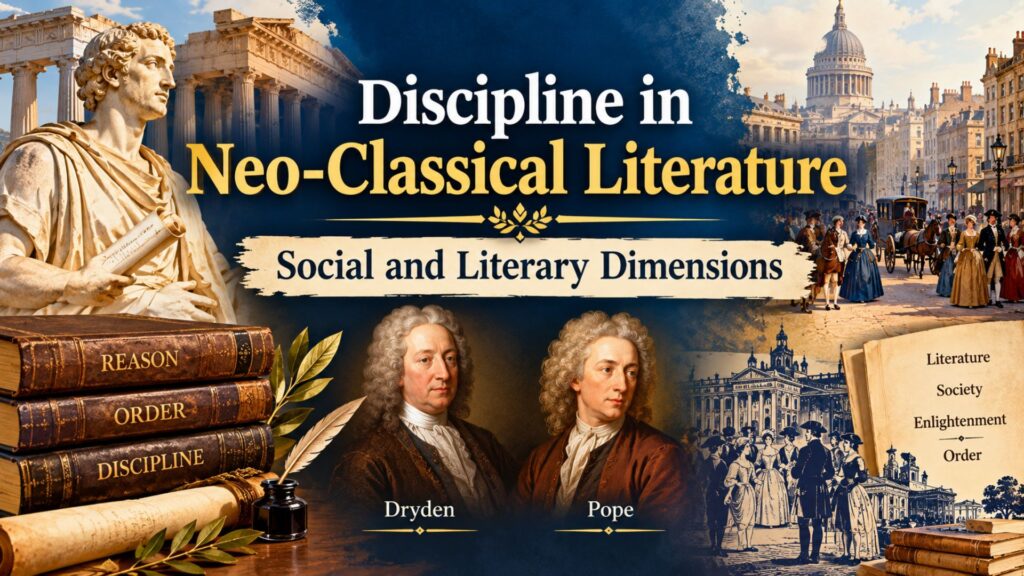
Introduction
Neo-Classical literature is one of the important phases in the history of English literature, particularly associated with the Restoration and the eighteenth century. For UPSC aspirants, studying Neo-Classicism is useful not merely for remembering literary names and works but for understanding how literature reflected the intellectual, social and political climate of its age.
The central idea of discipline in Neo-Classical literature refers to the emphasis on order, reason, restraint, rules, decorum, balance and imitation of classical models. Writers such as John Dryden, Alexander Pope and Samuel Johnson believed that literary creativity could be strengthened by judgment, learning and adherence to established principles.
However, Neo-Classical discipline was not simply a matter of following rigid literary rules. It was connected with broader eighteenth-century concerns about social order, rational conduct, morality and civilized behaviour.
What Is Neo-Classical Literature?
Neo-Classicism literally means a “new classicism.” It refers to the renewed interest in the literature, artistic principles and critical ideas of ancient Greece and Rome.
English Neo-Classicism developed particularly strongly from the Restoration period after 1660 through much of the eighteenth century.
Writers looked to classical authors such as:
- Homer
- Virgil
- Horace
- Aristotle
- Juvenal
They also drew upon Renaissance and French interpretations of classical literary theory.
The movement valued reason over uncontrolled emotion, order over disorder and restraint over excessive ornamentation.
John Dryden played an important role in developing English literary criticism, while Alexander Pope became one of the major representatives of the Augustan literary tradition.
Meaning of Discipline in Neo-Classical Literature
The term discipline can be understood at two interconnected levels:
- Literary discipline – rules governing literary form, style, genre and composition.
- Social discipline – the expectation that individuals should regulate passions and behaviour according to reason, morality and social conventions.
Thus, Neo-Classical literature attempted to establish a relationship between artistic order and social order.
Major Principles of Literary Discipline
| Principle | Meaning | Literary significance |
|---|---|---|
| Reason | Use of judgment and rational thought | Controlled emotion and expression |
| Order | Arrangement and structural balance | Coherent literary composition |
| Decorum | Suitability of style to subject and character | Maintained propriety |
| Restraint | Avoidance of excessive emotion and ornament | Produced controlled expression |
| Rules | Observance of established literary principles | Gave structure to literary works |
| Imitation | Learning from classical models | Connected modern literature with antiquity |
| Wit | Intelligent and controlled expression | Important in satire and poetry |
| Moral purpose | Literature should instruct as well as entertain | Linked literature with social values |
Social Dimensions of Neo-Classical Discipline
Neo-Classical discipline cannot be understood only through literary rules. It developed within a society increasingly interested in reason, manners, social order and civilized conduct.
1. Reason and Self-Control
Neo-Classical writers frequently emphasized the importance of controlling passions through reason.
The ideal individual was expected to demonstrate:
- self-control,
- moderation,
- rational judgment,
- social responsibility and
- proper conduct.
This social ideal was reflected in literature through characters, satire and moral commentary.
2. Order and Social Stability
The eighteenth century was concerned with maintaining political and social stability after the conflicts of the seventeenth century.
Literature often reflected an appreciation of:
order → hierarchy → discipline → stability
This does not mean that every Neo-Classical writer simply supported the existing social system. Satirists frequently exposed hypocrisy, corruption and foolishness within society.
Therefore, Neo-Classical literature could simultaneously value social order and criticize social behaviour.
3. Manners and Politeness
Urban society, particularly London, became an important environment for eighteenth-century literature.
Literature increasingly examined:
- fashionable society,
- manners,
- social ambition,
- courtship,
- reputation,
- vanity and
- intellectual pretension.
The concept of politeness became important because civilized behaviour was increasingly associated with controlled speech and conduct.
Alexander Pope’s poetry provides numerous examples of satire directed at fashionable society. The Rape of the Lock, for example, transforms a trivial social incident into a mock-epic conflict and exposes the values and vanities of elite society.
Literary Dimensions of Neo-Classical Discipline
1. The Importance of Rules
Neo-Classical writers believed that literary composition should not depend entirely on spontaneous inspiration.
Classical models and critical principles could guide writers towards effective composition.
Dryden’s An Essay of Dramatic Poesy discusses questions concerning dramatic structure, classical literature and the famous three unities of:
- time,
- place and
- action.
Dryden’s discussion also demonstrates that Neo-Classical writers did not always accept classical rules mechanically. He compared French, English and ancient dramatic practices and defended certain characteristics of English drama.
This is an important analytical point for UPSC answers: Neo-Classicism emphasized rules, but its writers also debated how those rules should be applied.
2. Decorum
Decorum means appropriateness.
A literary work should maintain an appropriate relationship between:
- character and language,
- subject and style,
- genre and treatment,
- situation and behaviour.
For example, a serious tragic character should not normally speak in a deliberately comic or trivial manner.
Decorum therefore created discipline between content and expression.
3. The Heroic Couplet
The heroic couplet became one of the defining poetic forms of English Neo-Classicism.
It generally consists of two rhyming lines of iambic pentameter.
John Dryden helped establish the form, while Alexander Pope developed it to a particularly polished and controlled form.
The form itself illustrates Neo-Classical discipline because it demands:
- metrical control,
- rhyme,
- balance,
- parallel construction and
- compression of ideas.
Pope frequently used the heroic couplet for satire, moral reflection and philosophical argument.
4. Satire as a Disciplined Literary Weapon
Satire became one of the most important literary forms of the Neo-Classical period.
It used wit, irony and ridicule to expose human weaknesses and social problems.
Rather than merely expressing personal emotion, the satirist observed society, identified deviations from accepted standards and presented them in a controlled literary form.
Important satirists included:
- John Dryden
- Alexander Pope
- Jonathan Swift
- Samuel Johnson
Dryden’s satirical works and Pope’s The Dunciad demonstrate how literary technique could be used to criticize cultural and social shortcomings.
Reason, Nature and the Classical Tradition
Neo-Classical writers frequently connected literary excellence with nature and reason.
However, “nature” did not necessarily mean simply the physical landscape. It could refer to universal human nature and the fundamental principles of human behaviour.
Pope’s An Essay on Criticism emphasizes the importance of judgment, order and learning from ancient writers while also recognizing that literary rules cannot explain every form of artistic excellence.
This provides an important qualification:
Neo-Classical discipline was not necessarily mechanical rule-following; it involved judgment about how rules should serve literary purpose.
Discipline and the Three Unities
The dramatic tradition associated with classical theory emphasized:
Unity of Action
A drama should have one principal action, while subsidiary actions should contribute to it.
Unity of Time
The action should ideally occur within a limited period, traditionally associated with approximately one day.
Unity of Place
The action should ideally remain within a single principal location.
Dryden discusses these principles in An Essay of Dramatic Poesy, while also debating their application to English drama.
Why Were the Unities Important?
They reflected the broader Neo-Classical preference for:
unity → coherence → proportion → discipline
But English drama did not always conform strictly to these principles. Shakespearean drama, for example, frequently used multiple locations, extended periods and subplots.
This created an important literary debate between classical rules and English dramatic practice.
Neo-Classical Literature Compared with Romanticism
The contrast with Romanticism helps UPSC aspirants understand the distinctive nature of Neo-Classicism.
| Feature | Neo-Classicism | Romanticism |
|---|---|---|
| Dominant emphasis | Reason and order | Imagination and emotion |
| Classical influence | Strong | Comparatively weaker |
| Individuality | Controlled by social/literary conventions | Strong emphasis on individual experience |
| Nature | Often linked with universal order | Source of inspiration and spiritual experience |
| Literary form | Structured and disciplined | Greater freedom and experimentation |
| Major tendency | Satire, essays, criticism, heroic couplets | Lyric poetry, nature poetry, imagination |
The contrast should not be treated as absolute. Neo-Classical writers used imagination, while Romantic writers also employed literary discipline.
Major Writers and Their Contribution
| Writer | Major contribution | Neo-Classical significance |
|---|---|---|
| John Dryden | Criticism, poetry, drama | Developed principles of literary criticism |
| Alexander Pope | Poetry and satire | Perfected the heroic couplet and satirical verse |
| Jonathan Swift | Satire and prose | Used irony to criticize society and politics |
| Samuel Johnson | Criticism, essays, biography | Emphasized judgment, morality and literary standards |
Dryden’s critical writings were particularly important in establishing systematic discussion of literary principles in English. Samuel Johnson later contributed significantly to criticism and literary biography.
Why Discipline Was Important in Neo-Classical Literature
The emphasis on discipline served several literary and social purposes.
Literary effects
- encouraged structural coherence;
- strengthened poetic technique;
- promoted controlled diction;
- developed satire;
- encouraged critical study of literature;
- established recognizable standards of composition.
Social effects
- promoted ideals of moderation;
- encouraged self-control;
- reflected concern with civilized manners;
- allowed writers to criticize social excesses;
- connected literature with moral instruction.
Therefore, discipline was not merely a restriction on creativity. It was also a method of organizing literary expression and social criticism.
Limitations of Neo-Classical Discipline
A balanced UPSC answer should also recognize its limitations.
Excessive emphasis on rules could:
- restrict spontaneous expression;
- privilege established literary conventions;
- encourage imitation over originality;
- reduce emotional intensity in some forms of poetry;
- create tension between artistic freedom and formal discipline.
The later rise of Romanticism partly represented a reaction against excessive emphasis on rationality, convention and restraint.
Yet it would be inaccurate to portray Neo-Classicism as completely devoid of creativity. Pope’s satire, Swift’s irony and Dryden’s critical writing demonstrate considerable originality within disciplined forms.
Why This Topic Matters for UPSC
This topic is useful for UPSC because it connects literary history with intellectual and social history.
For Prelims
Remember:
- Neo-Classicism = renewed engagement with Greek and Roman literary traditions.
- Restoration and eighteenth century are central to English Neo-Classical literature.
- Dryden = major critic and poet.
- Pope = major Augustan poet and master of the heroic couplet.
- Johnson = major eighteenth-century critic and biographer.
- Decorum = appropriateness of style, character and subject.
- Three unities = time, place and action.
- Satire = major literary mode of the period.
For Mains
The topic can be used to discuss:
- relationship between literature and society;
- reason versus emotion;
- literary rules and creativity;
- classical influence on European literature;
- eighteenth-century social values;
- transition from Neo-Classicism to Romanticism.
UPSC Mains Answer Writing Approach
For a 10-Mark Answer
Question: Explain the major features of discipline in Neo-Classical literature.
Introduction
Define Neo-Classicism and locate it broadly in the Restoration and eighteenth century.
Body
Discuss:
- reason;
- order;
- decorum;
- classical imitation;
- literary rules;
- heroic couplet;
- satire.
Conclusion
State that discipline provided formal coherence while also reflecting wider eighteenth-century ideals of rational and civilized conduct.
For a 15/20-Mark Answer
For a longer answer, use a multidimensional structure:
Introduction → Historical Context → Literary Discipline → Social Discipline → Major Writers → Limitations → Comparison with Romanticism → Conclusion
A strong answer can include:
Dryden → literary criticism
Pope → heroic couplet and satire
Swift → social criticism
Johnson → criticism and literary standards
The answer should avoid simply listing features. Explain the cause-and-effect relationship between social values and literary form.
5 Likely UPSC-Style Questions
- “Discipline was the defining principle of Neo-Classical literature.” Discuss its literary and social dimensions.
- Examine the role of reason, decorum and classical rules in shaping Neo-Classical literature.
- How did eighteenth-century social values influence the development of Neo-Classical literature?
- Discuss the contribution of John Dryden and Alexander Pope to the development of English Neo-Classicism.
- Neo-Classicism emphasized order and restraint, while Romanticism emphasized imagination and emotion. Compare the two literary traditions.
5 Frequently Asked Questions
1. What is Neo-Classical literature?
Neo-Classical literature refers to a major literary tradition that revived and adapted the principles of ancient Greek and Roman literature, emphasizing reason, order, decorum, restraint and classical models.
2. What does discipline mean in Neo-Classical literature?
Discipline refers to the emphasis on literary rules, structural order, decorum, controlled language, rational judgment and appropriate literary form.
3. Who are the major Neo-Classical writers?
Major English Neo-Classical writers include John Dryden, Alexander Pope, Jonathan Swift and Samuel Johnson.
4. What is the importance of heroic couplet in Neo-Classical literature?
The heroic couplet provided a highly controlled poetic structure. Dryden helped establish its importance, while Pope developed it into a highly polished vehicle for satire, argument and philosophical reflection.
5. How did Neo-Classicism differ from Romanticism?
Neo-Classicism generally emphasized reason, order, classical models and restraint, whereas Romanticism placed greater emphasis on imagination, emotion, individual experience and nature.
Conclusion
Discipline in Neo-Classical literature was both literary and social. At the literary level, it promoted reason, order, decorum, classical imitation, formal structure and controlled expression. At the social level, it reflected eighteenth-century concerns with manners, moderation, rational conduct and social stability.
However, Neo-Classical discipline should not be reduced to rigid rule-following. Writers such as Dryden and Pope used established forms creatively, while satire enabled them to challenge hypocrisy and social excess. The movement therefore represents a productive tension between rules and creativity, order and criticism, tradition and innovation.
For UPSC aspirants, this balanced interpretation is more useful than simply memorizing literary features. It demonstrates how literature can both reflect the values of its society and critically examine them.