National and International Days in January 2026 highlight India’s historical identity, democratic values, social responsibilities and growing role in global affairs. These observances provide important insights into education, youth development, gender equality, international cooperation, human rights and constitutional governance.
For UPSC Civil Services aspirants, important days are more than dates to memorise. They connect historical personalities, national movements, international institutions and contemporary policy issues. Understanding their background and significance helps candidates develop a broader perspective for General Studies, Essay writing and interview preparation.
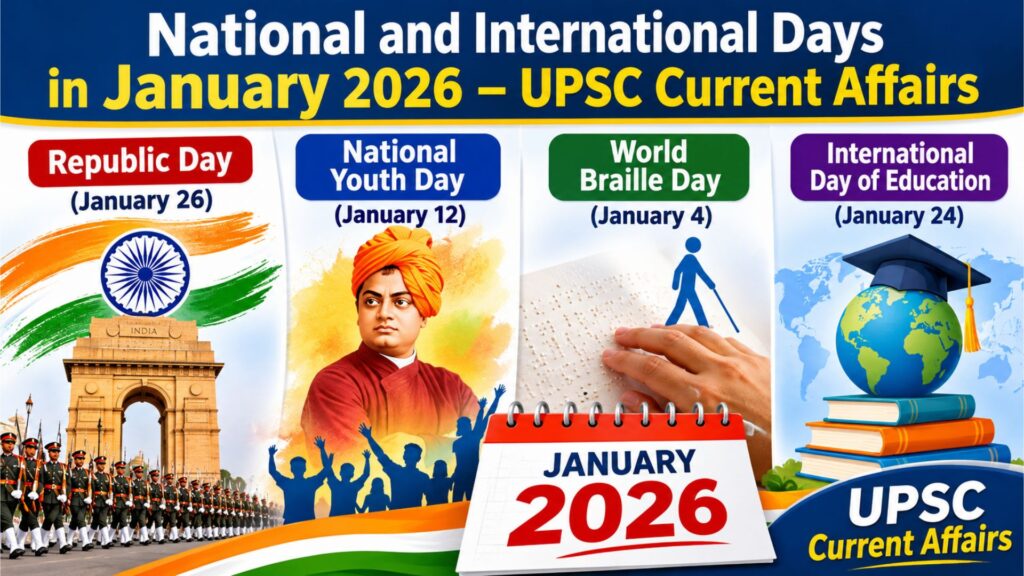
January is particularly important because it includes National Youth Day, Indian Army Day, Parakram Diwas, National Girl Child Day, National Voters’ Day and Republic Day. It also features United Nations observances such as World Braille Day, International Day of Education, International Day of Clean Energy and International Holocaust Remembrance Day.
This article presents the important national and international days in January 2026, their historical backgrounds, themes where officially established, and their relevance to UPSC preparation.
1. Important National Days in January 2026
National observances in January reflect India’s freedom struggle, democratic institutions, social development and cultural identity.
Date | National Day | Significance |
|---|---|---|
9 January | Pravasi Bharatiya Divas | Recognises the contribution of the Indian diaspora |
10 January | World Hindi Day | Promotes Hindi internationally |
12 January | National Youth Day | Commemorates Swami Vivekananda’s birth anniversary |
15 January | Indian Army Day | Honours the Indian Army |
16 January | National Startup Day | Promotes entrepreneurship and innovation |
23 January | Parakram Diwas | Commemorates Netaji Subhas Chandra Bose |
24 January | National Girl Child Day | Promotes girls’ rights and empowerment |
25 January | National Voters’ Day | Encourages electoral participation |
25 January | National Tourism Day | Highlights India’s tourism potential |
26 January | Republic Day | Celebrates the commencement of the Constitution |
30 January | Martyrs’ Day | Remembers Mahatma Gandhi and other martyrs |
1.1 Pravasi Bharatiya Divas – 9 January
Pravasi Bharatiya Divas recognises the contribution of overseas Indians to India’s development. It has been observed annually since 2003.
The date commemorates Mahatma Gandhi’s return to India from South Africa on 9 January 1915. Gandhi’s return marked an important stage in his political journey and his eventual leadership of the Indian freedom movement.
Since 2015, the main Pravasi Bharatiya Divas convention has followed a biennial format, with conferences and other activities during intervening years.
UPSC relevance: Indian diaspora, soft power, migration, remittances and India’s foreign policy.
1.2 World Hindi Day – 10 January
World Hindi Day promotes the international use and recognition of Hindi. The date commemorates the first World Hindi Conference, held in Nagpur in 1975.
It is important to distinguish World Hindi Day from Hindi Diwas, observed on 14 September in India.
The distinction also helps students understand the difference between promoting a language internationally and recognising its constitutional and national significance.
UPSC relevance: Indian languages, linguistic diversity, cultural diplomacy and constitutional provisions concerning official languages.
1.3 National Youth Day – 12 January
National Youth Day marks the birth anniversary of Swami Vivekananda, born on 12 January 1863.
Vivekananda emphasised self-confidence, education, discipline, spiritual development and social service. His address at the Parliament of the World’s Religions in Chicago in 1893 brought international attention to Indian philosophical traditions.
His ideas remain relevant to youth leadership, character formation and nation-building.
UPSC relevance: Youth empowerment, education, skill development, social reform and the role of young citizens in achieving Viksit Bharat.
1.4 Indian Army Day – 15 January
Indian Army Day commemorates the assumption of command of the Indian Army by General K. M. Cariappa on 15 January 1949. He became the first Indian Commander-in-Chief of the Indian Army after independence.
The 78th Army Day was celebrated in Jaipur in 2026. The parade highlighted military preparedness, indigenous defence technology and the modernisation of India’s armed forces.
UPSC relevance: Civil-military relations, national security, defence indigenisation and strategic preparedness.
1.5 National Startup Day – 16 January
National Startup Day recognises entrepreneurship, innovation and the development of India’s startup ecosystem. It is associated with the launch of the Startup India initiative on 16 January 2016.
The observance highlights the role of startups in employment generation, technological development and economic growth.
UPSC relevance: Startup India, innovation, entrepreneurship, MSMEs and economic development.
1.6 Parakram Diwas – 23 January
Parakram Diwas commemorates the birth anniversary of Netaji Subhas Chandra Bose, born on 23 January 1897.
Bose played a significant role in India’s freedom struggle and became closely associated with the Indian National Army (INA). His political approach emphasised organised resistance against British colonial rule.
The day was officially designated Parakram Diwas in 2021.
UPSC relevance: Revolutionary nationalism, INA, India’s freedom struggle and competing strategies of anti-colonial resistance.
1.7 National Girl Child Day – 24 January
National Girl Child Day was initiated in 2008 by the Ministry of Women and Child Development.
Its central concerns include:
Equal access to education.
Protection from gender discrimination.
Better health and nutrition.
Prevention of child marriage.
Women’s participation in social and economic development.
The observance connects with the objectives of Beti Bachao Beti Padhao and other initiatives supporting girls’ welfare.
UPSC relevance: Gender equality, social justice, education, women’s empowerment and inclusive development.
1.8 National Voters’ Day – 25 January
National Voters’ Day commemorates the establishment of the Election Commission of India on 25 January 1950.
The 16th National Voters’ Day in 2026 carried the theme “My India, My Vote”, with the tagline “Citizen at the Heart of Indian Democracy”.
The observance encourages voter registration, informed electoral participation and democratic responsibility.
UPSC relevance: Election Commission, electoral reforms, universal adult suffrage and democratic participation.
1.9 National Tourism Day – 25 January
National Tourism Day highlights tourism’s contribution to India’s economy, employment, cultural heritage and international image.
Tourism also supports local communities through hospitality, transport, handicrafts and other service industries.
UPSC relevance: Sustainable tourism, cultural heritage, employment generation and regional economic development.
1.10 Republic Day – 26 January
India celebrates Republic Day on 26 January because the Constitution of India came into force on this date in 1950.
The Constituent Assembly adopted the Constitution on 26 November 1949. Its commencement on 26 January honoured the historical significance of the Purna Swaraj declaration adopted in 1930.
India celebrated its 77th Republic Day in 2026 under the central theme “150 Years of Vande Mataram”. The celebrations highlighted the national song, India’s cultural diversity, military strength and self-reliance.
Literary significance: Bankim Chandra Chattopadhyay composed Vande Mataram, which appeared in his novel Anandamath (1882). The song became an influential expression of Indian nationalism.
For English Literature students, this provides an opportunity to examine how literature, symbolism and patriotic expression influence political consciousness.
1.11 Martyrs’ Day – 30 January
Martyrs’ Day, also known as Shaheed Diwas, commemorates Mahatma Gandhi’s assassination on 30 January 1948.
The day encourages reflection on non-violence, national unity, sacrifice and the values associated with India’s freedom struggle.
It also provides an opportunity to study Gandhi’s political philosophy and its relationship with ethical leadership.
2. Important International Days in January 2026
International observances highlight global cooperation, human rights, education, accessibility, peace and sustainable development.
Date | International Day | Main significance |
|---|---|---|
4 January | World Braille Day | Accessibility and the rights of visually impaired people |
24 January | International Day of Education | Education as a human right |
25 January | World Leprosy Day | Ending discrimination against people affected by leprosy |
26 January | International Day of Clean Energy | Clean energy transition |
26 January | International Customs Day | International customs cooperation |
27 January | International Holocaust Remembrance Day | Remembering Holocaust victims |
28 January | International Day of Peaceful Coexistence | Peace, tolerance and mutual understanding |
2.1 World Braille Day – 4 January
World Braille Day commemorates Louis Braille, born on 4 January 1809.
Braille developed a tactile reading and writing system that enables visually impaired people to access written information independently.
The system uses combinations of raised dots to represent letters, numbers and symbols.
Significance: Inclusive education, accessibility, disability rights and equal opportunities.
2.2 International Day of Education – 24 January
The United Nations General Assembly proclaimed 24 January as the International Day of Education in 2018.
Education is recognised as a human right and an essential foundation for peace, equality and sustainable development.
The 2026 observance focused on young people as co-creators of education, highlighting their participation in shaping learning systems and educational opportunities.
UPSC relevance: Sustainable Development Goal 4 (SDG 4), educational inequality, digital learning and human resource development.
2.3 World Leprosy Day – 25 January 2026
World Leprosy Day is observed internationally on the last Sunday of January. In 2026, it fell on 25 January.
The WHO announced the theme “Leprosy is curable, the real challenge is stigma”.
The campaign focuses on reducing discrimination and improving the social inclusion of people affected by leprosy.
In India, World Leprosy Day is observed on 30 January, linking the occasion with Mahatma Gandhi’s concern for people affected by the disease.
UPSC relevance: Public health, neglected tropical diseases, social stigma and inclusive healthcare.
2.4 International Day of Clean Energy – 26 January
The United Nations established this observance through General Assembly Resolution 77/327 in 2023.
It promotes awareness and international cooperation for a fair and inclusive transition towards clean energy.
Important areas include:
Solar and wind energy.
Energy efficiency.
Green hydrogen.
Renewable energy infrastructure.
Affordable and sustainable electricity.
UPSC relevance: Climate change, energy security, renewable energy and Sustainable Development Goal 7.
2.5 International Customs Day – 26 January
International Customs Day is observed by the World Customs Organization (WCO).
It recognises the work of customs administrations in facilitating international trade, collecting revenue and preventing illegal cross-border activities.
Its importance extends to trade security, supply-chain management and international economic cooperation.
2.6 International Holocaust Remembrance Day – 27 January
The United Nations observes this day to remember the victims of the Holocaust, during which Nazi Germany and its collaborators systematically murdered approximately six million Jews, alongside other victims of Nazi persecution.
The date marks the liberation of Auschwitz-Birkenau concentration and extermination camp by Soviet forces on 27 January 1945.
The 2026 theme was “Holocaust Remembrance for Dignity and Human Rights”.
UPSC relevance: Human rights, genocide, historical memory, international law and the importance of preventing mass atrocities.
2.7 International Day of Peaceful Coexistence – 28 January
The United Nations recognises 28 January as the International Day of Peaceful Coexistence.
It emphasises mutual respect, dialogue, tolerance and peaceful relationships among individuals and communities.
The observance is particularly relevant to multicultural societies and international relations.
UPSC relevance: Secularism, communal harmony, pluralism, peacebuilding and global cooperation.
3. Understanding the Themes Behind January Observances
The observances of January 2026 can be grouped into five broader academic and policy themes.
Major theme | Related observances | Wider significance |
|---|---|---|
Democracy and citizenship | Republic Day, National Voters’ Day | Constitutional values and political participation |
Youth and education | National Youth Day, International Day of Education | Human capital and inclusive development |
Gender equality | National Girl Child Day | Equal opportunities and social justice |
Peace and human rights | Holocaust Remembrance Day, Peaceful Coexistence Day | Tolerance and protection of human dignity |
Sustainable development | International Day of Clean Energy, World Leprosy Day | Environmental responsibility and public health |
Why are annual themes important?
Themes provide a central message for an observance. They connect the historical purpose of a day with contemporary social and political challenges.
For example, the 2026 National Voters’ Day theme, “My India, My Vote”, connects electoral participation with democratic citizenship. Similarly, the International Day of Clean Energy connects environmental sustainability with energy security.
Important examination point: Not every national or international day has a separately announced annual theme. Aspirants should distinguish officially announced themes from the general objectives of an observance rather than memorising unverified slogans.
Why This Topic Matters for UPSC
National and International Days are useful for UPSC preparation because they connect static knowledge with contemporary issues.
1. UPSC English Literature
Understand the relationship between literature, nationalism and cultural identity.
Study Bankim Chandra Chattopadhyay’s Anandamath and its historical significance.
Examine how literary expression influences social reform and political consciousness.
2. UPSC Prelims and General Studies
Important areas include constitutional history, international organisations, important personalities, social development and global observances.
3. UPSC Mains
These topics provide examples for questions on democracy, education, gender equality, human rights, sustainable development and India’s international relations.
4. Essay writing
Observances offer useful examples for essays on:
Education as an instrument of social transformation.
Youth as agents of nation-building.
Democracy and responsible citizenship.
Literature and national identity.
Human dignity and social inclusion.
5. Language and analytical skills
Reading about these observances improves vocabulary, comprehension and the ability to connect historical events with contemporary developments.
UPSC Mains Answer Writing Approach
UPSC answers should present factual information alongside analysis. Merely listing important dates is insufficient when a question demands evaluation.
10-mark answer framework
Suggested structure: approximately 150 words.
Introduction: Define the observances and establish their importance.
Major points: Discuss democracy, education and social equality.
Example: National Voters’ Day 2026 and its theme, “My India, My Vote”.
Conclusion: Explain how public observances strengthen democratic awareness.
15-mark answer framework
Suggested structure: approximately 250 words.
Introduction: Explain the historical and international background of important days.
Context: Differentiate national observances from UN-recognised international days.
Analytical dimensions:
Democratic participation.
Youth development and education.
Gender equality.
Human rights and peaceful coexistence.
Environmental sustainability.
Examples: Republic Day, International Day of Education and International Day of Clean Energy.
Conclusion: Emphasise the relationship between awareness, public participation and sustainable development.
20-mark answer framework
Suggested structure: approximately 300 words.
Introduction: Introduce the historical and international significance of January observances.
Historical context: Discuss India’s constitutional development and the evolution of international awareness days.
Multiple dimensions: Analyse political, social, economic, environmental and cultural significance.
Comparison: Compare India’s national observances with United Nations international observances.
Literary perspective: Examine the relationship between Vande Mataram, nationalism and collective identity.
Critical interpretation: Discuss whether symbolic observances translate into meaningful social change.
Conclusion: Recommend connecting awareness campaigns with institutional action and public participation.
Topic-specific model answer framework
Question: Discuss the significance of National and International Days in promoting democratic values and social awareness.
Introduction: National and International Days provide opportunities to recognise historical events, promote social responsibilities and strengthen collective awareness.
Main body:
Republic Day reinforces constitutional values and national identity.
National Voters’ Day encourages democratic participation.
National Girl Child Day highlights gender equality.
International Day of Education promotes inclusive learning.
Holocaust Remembrance Day reinforces human dignity and the protection of human rights.
Conclusion: These observances become meaningful when their messages are translated into public awareness, effective policies and responsible citizenship.
UPSC Prelims Quick Revision
Date | Important fact to remember |
|---|---|
4 January | World Braille Day – Louis Braille |
9 January | Pravasi Bharatiya Divas – Gandhi returned to India in 1915 |
10 January | World Hindi Day – First World Hindi Conference, 1975 |
12 January | National Youth Day – Swami Vivekananda |
15 January | Army Day – K. M. Cariappa assumed command in 1949 |
16 January | National Startup Day – Startup India |
23 January | Parakram Diwas – Subhas Chandra Bose |
24 January | National Girl Child Day and International Day of Education |
25 January | National Voters’ Day and National Tourism Day |
25 January | World Leprosy Day in 2026 |
26 January | Republic Day and International Day of Clean Energy |
26 January | International Customs Day |
27 January | International Holocaust Remembrance Day |
28 January | International Day of Peaceful Coexistence |
30 January | Martyrs’ Day in India |
Additional facts for revision:
Indian Constitution adopted: 26 November 1949.
Indian Constitution came into force: 26 January 1950.
First Indian Commander-in-Chief: General K. M. Cariappa.
Vande Mataram: Written by Bankim Chandra Chattopadhyay.
Anandamath: Published in 1882.
Election Commission of India: Established on 25 January 1950.
SDG 4: Quality Education.
SDG 7: Affordable and Clean Energy.
World Customs Organization: Established in 1952 as the Customs Co-operation Council.
Likely UPSC-Style Questions
1. Definition: What is the significance of Pravasi Bharatiya Divas? Explain why 9 January was selected for its observance.
2. Explanation: Examine the contribution of Swami Vivekananda’s ideas to youth development and nation-building in contemporary India.
3. Analysis: Discuss how National Voters’ Day strengthens democratic participation and electoral awareness in India.
4. Comparison: Differentiate between National Girl Child Day and International Day of Education in terms of their objectives and significance.
5. Critical evaluation: “National and International Days should move beyond symbolic celebrations towards meaningful social transformation.” Critically examine this statement with suitable examples from January 2026.
Frequently Asked Questions (FAQs)
1. What are the most important national days in January 2026 for UPSC?
National Youth Day, Indian Army Day, Parakram Diwas, National Girl Child Day, National Voters’ Day, Republic Day and Martyrs’ Day are particularly important for UPSC preparation.
2. What is the theme of Republic Day 2026?
The central theme of the 77th Republic Day celebrations was “150 Years of Vande Mataram”, highlighting the historical and cultural significance of India’s national song.
3. What is the difference between World Hindi Day and Hindi Diwas?
World Hindi Day is observed on 10 January to promote Hindi internationally. Hindi Diwas is observed on 14 September to commemorate the Constituent Assembly’s adoption of Hindi in Devanagari script as the official language of the Union in 1949.
4. Which international days are observed in January 2026?
Important UN-recognised observances include World Braille Day, International Day of Education, International Day of Clean Energy, International Holocaust Remembrance Day and International Day of Peaceful Coexistence.
5. How should UPSC aspirants prepare important days and their themes?
Aspirants should prepare each observance through four aspects: date, historical background, official annual theme where applicable, and its connection with contemporary national or international issues. Linking these facts with General Studies topics improves retention and answer writing.
Conclusion
National and International Days in January 2026 reflect important dimensions of India’s history, democracy, social development and international responsibilities. Their significance extends beyond ceremonial celebrations to questions of citizenship, equality, education, human rights and sustainability.
For UPSC aspirants, understanding the historical background and wider implications of these observances is more valuable than memorising dates alone. A combination of factual revision, historical understanding and analytical interpretation will help students use these topics effectively in Prelims, Mains and Essay preparation.