
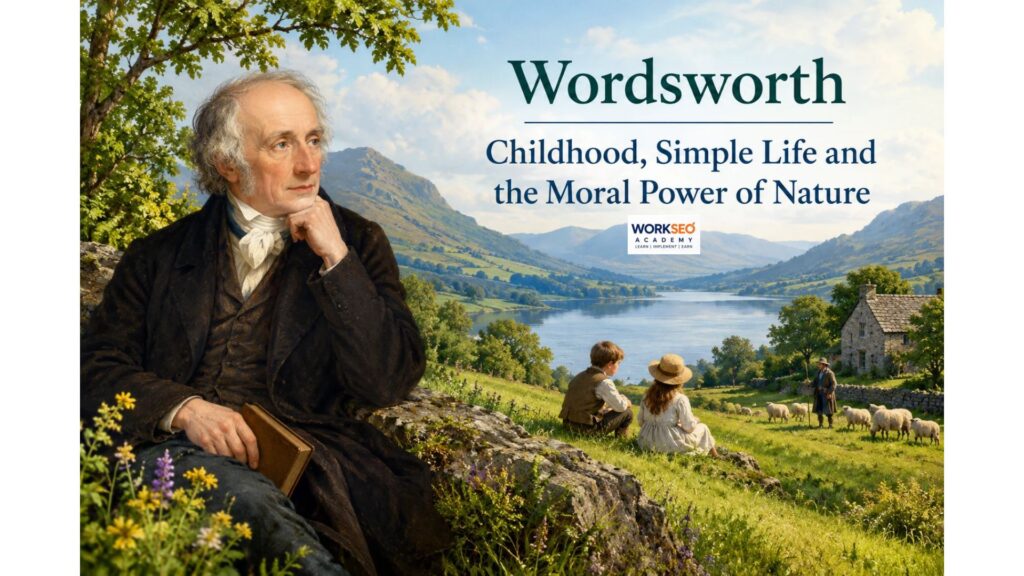
William Wordsworth is one of the most influential poets of English Romanticism. His poetry explores the relationship between human beings and nature, the innocence of childhood, the dignity of ordinary life, and the moral influence of natural surroundings. Unlike poets who emphasised classical rules, aristocratic culture, or elaborate poetic language, Wordsworth found profound meaning in everyday experiences and the lives of ordinary people.
For Wordsworth, nature is more than a beautiful landscape. It is a source of emotional comfort, spiritual insight, moral development, and lasting wisdom. Childhood also occupies a central position in his poetry because children possess a freshness of perception and an imaginative relationship with the world that adults often lose.
These ideas are especially important for UPSC English Literature aspirants studying Romantic poetry, poetic themes, literary devices, and the historical development of English literature. This article examines Wordsworth’s treatment of childhood, simple life, and the moral power of nature, with examples from his major works and a framework for UPSC Mains answer writing.
1. William Wordsworth and the Romantic Movement
William Wordsworth (1770–1850) was a major English Romantic poet. His literary partnership with Samuel Taylor Coleridge helped establish Romanticism as an important movement in English literature.
Their collection Lyrical Ballads, first published in 1798, is widely regarded as a landmark in the development of English Romantic poetry. Its 1800 edition included Wordsworth’s influential Preface, which explained his ideas about poetic language, emotion, and ordinary human experience.
Wordsworth challenged the excessive artificiality of earlier poetic conventions. He believed poetry could discover extraordinary significance in ordinary events and familiar surroundings.
Major Characteristics of Wordsworth’s Poetry
Nature: The natural world shapes human emotions and understanding.
Childhood: Early experiences preserve imagination, wonder, and spiritual sensitivity.
Simple life: Rural people and everyday experiences provide meaningful subjects for poetry.
Emotion and memory: Past experiences can nourish present reflection.
Accessible language: Poetry can draw on the language of ordinary people.
Moral development: Experiences of nature and human life can cultivate sympathy, humility, and self-awareness.
These characteristics connect Wordsworth closely with the broader Romantic emphasis on imagination, individual experience, and a renewed appreciation of nature.
2. Wordsworth’s View of Childhood
Childhood is one of Wordsworth’s most distinctive subjects. He presents it as a period of wonder, imaginative freedom, and heightened awareness. Children often experience the world with an immediacy that becomes less accessible through the habits and pressures of adulthood.
However, Wordsworth does not treat childhood merely as a happy stage of life. It also has philosophical and spiritual significance.
Childhood and Spiritual Awareness
In Ode: Intimations of Immortality from Recollections of Early Childhood, Wordsworth explores the difference between childhood perception and adult experience. The poem reflects on the fading intensity of childhood vision and the difficulty of recovering its original freshness.
The poem’s philosophical suggestion is that early life possesses a special imaginative and spiritual richness. Although this intensity diminishes with age, memory, reflection, and emotional attachment can preserve part of its influence.
Wordsworth therefore presents childhood as both a source of loss and a foundation for mature understanding.
Important Example: My Heart Leaps Up
In the short poem My Heart Leaps Up, Wordsworth expresses continuity between childhood and adulthood through his response to a rainbow. His famous statement, “The Child is father of the Man,” suggests that childhood experiences help shape adult identity.
The paradox reverses the usual relationship between parent and child. The adult personality grows from the experiences and sensitivities formed during childhood.
UPSC analytical point: Wordsworth’s treatment of childhood links personal development with imagination, memory, and the continuity of human experience.
3. The Simple Life and the Dignity of Ordinary People
Wordsworth believed that ordinary life offered rich material for poetry. In the Preface to Lyrical Ballads, he defended the use of relatively simple language and subjects drawn from common human experience.
Rural life particularly interested him because it often revealed fundamental emotions and relationships without the artificial conventions associated with fashionable society.
Why Does Wordsworth Prefer Ordinary Life?
Wordsworth does not suggest that every rural experience is automatically virtuous or that urban life has no value. Rather, he finds that ordinary experiences can reveal universal truths about love, suffering, memory, loneliness, and human dignity.
His poetic focus challenges the assumption that literature must concentrate on heroic figures, aristocratic society, or extraordinary events.
Examples from His Poetry
1. Michael
This poem tells the story of an elderly shepherd whose hopes for his son are shaped by family duty, labour, and rural life. Through Michael’s relationship with Luke, Wordsworth explores parental affection, responsibility, and the painful consequences of separation.
2. The Solitary Reaper
The speaker encounters a young woman singing while working in the fields. Although he does not understand the words of her song, its emotional power remains with him.
The poem demonstrates how ordinary labour can become an experience of beauty and lasting memory.
3. The Old Cumberland Beggar
Wordsworth presents an elderly beggar as part of the moral life of a community. The poem considers the social and emotional effects of charity, habit, and human interdependence.
Together, these works show that simple life is not merely a background in Wordsworth’s poetry. It is a means of examining universal human concerns.
4. The Moral Power of Nature
Nature is central to Wordsworth’s poetic imagination. Mountains, rivers, trees, fields, and changing landscapes offer more than visual pleasure. They can influence character, restore emotional balance, and encourage moral reflection.
His understanding of nature develops across his poetry, moving from immediate sensory pleasure towards deeper reflection on memory, consciousness, and human relationships.
Nature as a Teacher
In Lines Composed a Few Miles above Tintern Abbey, Wordsworth reflects on his changing relationship with the natural world.
The landscape that once produced youthful excitement now provides deeper consolation and reflective understanding. Remembered encounters with nature influence his behaviour and help him respond more thoughtfully to human suffering.
This is a crucial distinction: nature’s moral influence is not presented simply as a direct lesson. It operates through experience, memory, imagination, and reflection.
Nature and Human Conduct
Wordsworth often associates nature with qualities such as sympathy, humility, patience, and emotional balance. Contact with the natural world can help individuals look beyond immediate anxieties and recognise their connection with a wider reality.
In The Prelude, his autobiographical poem, he examines how encounters with landscapes shape the growth of his mind. Nature can encourage freedom and joy, but it can also inspire awe and reveal human limitations.
His representation of nature is therefore complex. The natural world does not always comfort the individual; sometimes it challenges assumptions and transforms perception.
Nature and Spiritual Understanding
Wordsworth’s poetry frequently gives nature a spiritual dimension. In Tintern Abbey, he describes a profound awareness connecting human consciousness with the world around it.
Readers may interpret this as a pantheistic tendency, but this label requires care. Wordsworth’s religious and philosophical ideas developed over time, and his poetry does not always present one consistent theological system.
The central point is that nature provides a means of exploring the relationship between the individual mind, the external world, and spiritual experience.
5. The Relationship Between Childhood, Simple Life, and Nature
These three themes reinforce one another throughout Wordsworth’s poetry.
| Theme | Main idea | Representative work |
|---|---|---|
| Childhood | Imagination and early experience shape adult identity | Ode: Intimations of Immortality |
| Simple life | Ordinary people and experiences reveal universal truths | Michael |
| Nature | The natural world influences emotion and moral understanding | Tintern Abbey |
| Memory | Past experiences continue to shape present consciousness | The Prelude |
| Human dignity | Everyday life deserves serious poetic attention | The Old Cumberland Beggar |
Childhood provides an early form of wonder; simple life offers opportunities to observe genuine human experience; and nature creates conditions for emotional and moral development.
Memory connects all three. The adult poet repeatedly returns to earlier experiences and discovers that their meaning changes with time.
This relationship helps explain why Wordsworth’s poetry is both personal and philosophical. His recollections become a way of examining how human beings develop through their encounters with the world.
6. Literary Techniques in Wordsworth’s Poetry
Wordsworth’s themes become clearer when examined through his poetic methods.
Simple and Conversational Language
His preference for accessible language challenged the artificial diction associated with some earlier poetry. However, his poetry is carefully shaped rather than merely conversational.
Imagery and Symbolism
Natural images often carry meanings beyond their physical appearance. The rainbow in My Heart Leaps Up, for example, represents continuity between childhood and adulthood.
Memory and Reflection
Wordsworth frequently combines an earlier experience with the adult speaker’s later interpretation. This structure allows readers to observe the development of consciousness.
Personification
Nature may appear as a companion, guide, or teacher. Such representations communicate the emotional relationship between the poet and the natural world.
Lyric and Blank Verse
Wordsworth uses lyric forms to express personal feeling and reflective blank verse in works such as Tintern Abbey and The Prelude. Blank verse consists of unrhymed lines, usually written in iambic pentameter.
These techniques make his poetry particularly suitable for analysing the relationship between literary form and philosophical meaning.
Why This Topic Matters for UPSC
Wordsworth’s poetry offers several useful areas of study for UPSC candidates.
UPSC English Literature: It supports the study of Romanticism, poetic form, imagery, symbolism, and close textual analysis.
UPSC Mains and Essay: His ideas can help develop arguments about childhood, education, environmental responsibility, memory, and human values.
Reading comprehension: His reflective poetry encourages careful interpretation of figurative language and abstract ideas.
Vocabulary and language development: Studying his poetry introduces terms such as Romanticism, pastoral, lyric, blank verse, and personification.
Analytical answer writing: Comparing childhood, nature, and memory helps students organise literary arguments around themes rather than simply summarising poems.
For English Literature optional preparation, candidates should prioritise prescribed texts and the official syllabus. This topic should be used to strengthen relevant literary understanding, not as a substitute for syllabus-based preparation.
UPSC Mains Answer Writing Approach
A strong answer should define the central argument, refer to specific poems, explain literary techniques, and conclude with a balanced interpretation.
10-Mark Answer
Suggested structure:
Introduction: Introduce Wordsworth as a major Romantic poet.
Point 1: Explain childhood through My Heart Leaps Up.
Point 2: Discuss nature as a source of reflection through Tintern Abbey.
Point 3: Connect ordinary life with poetic dignity through Michael.
Conclusion: Explain how these themes contribute to Wordsworth’s view of human development.
Aim for focused analysis rather than lengthy biographical details.
15-Mark Answer
Include a brief historical context, followed by three to five analytical dimensions:
Romanticism and the rejection of artificial poetic conventions.
Childhood as a source of imagination and continuity.
Rural life and the dignity of ordinary people.
Nature, memory, and moral development.
Relevant poetic techniques and textual examples.
Conclude by acknowledging that Wordsworth’s poetry presents nature and childhood as powerful influences, rather than simple guarantees of moral goodness.
20-Mark Answer
A longer answer should develop a connected argument:
Introduce Wordsworth’s Romantic philosophy and literary background.
Explain his ideas about poetic language and ordinary experience.
Analyse childhood through Ode: Intimations of Immortality and My Heart Leaps Up.
Examine nature and memory in Tintern Abbey and The Prelude.
Discuss rural life through Michael and The Old Cumberland Beggar.
Evaluate the relationship between personal experience, spirituality, and moral growth.
Conclude by assessing the continuing literary significance of these themes.
A comparative perspective may also distinguish Wordsworth’s reflective treatment of nature from the more varied approaches adopted by other Romantic poets.
Model Answer Framework
Question: Discuss the moral significance of nature in Wordsworth’s poetry.
Introduction: Wordsworth, a leading Romantic poet, presents nature as an active influence on human consciousness rather than merely a scenic background.
Main argument: In Tintern Abbey, remembered encounters with nature provide emotional consolation and encourage sympathetic reflection. In The Prelude, natural experiences shape the poet’s developing mind, sometimes through joy and sometimes through awe. These works demonstrate how memory and imagination mediate nature’s influence.
Critical perspective: Nature does not always offer immediate comfort. Its power may also challenge the individual and reveal the limits of human understanding.
Conclusion: Wordsworth’s treatment of nature combines emotional, psychological, and moral dimensions, making the natural world central to his understanding of human development.
UPSC Prelims Quick Revision
Author: William Wordsworth (1770–1850).
Literary movement: English Romanticism.
Important publication: Lyrical Ballads, first published in 1798 with Samuel Taylor Coleridge.
Critical document: Wordsworth’s Preface to Lyrical Ballads, published in the 1800 edition.
Childhood: Explored in Ode: Intimations of Immortality and My Heart Leaps Up.
Nature and memory: Central to Tintern Abbey and The Prelude.
Ordinary life: Examined in Michael, The Solitary Reaper, and The Old Cumberland Beggar.
Blank verse: Unrhymed verse commonly using iambic pentameter.
Pastoral: A literary mode concerned with rural life and landscapes.
Major concepts: Imagination, recollection, emotional experience, childhood, and the moral influence of nature.
5 Likely UPSC-Style Questions
Explain Wordsworth’s conception of childhood with reference to Ode: Intimations of Immortality and My Heart Leaps Up.
Critically examine the moral and psychological significance of nature in Wordsworth’s poetry.
Discuss Wordsworth’s treatment of ordinary people and rural life as a challenge to established poetic conventions.
Analyse the relationship between memory, imagination, and nature in Lines Composed a Few Miles above Tintern Abbey.
“Childhood, simple life, and nature are interconnected elements of Wordsworth’s poetic philosophy.” Critically evaluate this statement with suitable textual examples.
5 Frequently Asked Questions
1. What is Wordsworth’s view of nature?
Wordsworth views nature as a source of emotional consolation, imaginative experience, and moral reflection. Its influence develops through direct encounters, memory, and the individual’s changing understanding of the world.
2. Why is childhood important in Wordsworth’s poetry?
Childhood represents wonder, imagination, and an intense relationship with the world. In poems such as My Heart Leaps Up, early experience also shapes adult identity.
3. How does Wordsworth represent simple life?
He explores the lives of rural people and ordinary individuals to reveal universal emotions and moral concerns. Works such as Michael and The Solitary Reaper demonstrate the poetic significance of everyday experience.
4. Which Wordsworth poems are important for studying nature and childhood?
Tintern Abbey, The Prelude, My Heart Leaps Up, and Ode: Intimations of Immortality are particularly useful. Michael and The Solitary Reaper also help students examine rural life and human experience.
5. How should UPSC English Literature students analyse Wordsworth’s poetry?
Students should combine historical context with close reading. They should identify themes, explain poetic devices, analyse specific passages, and support interpretations with accurate references to the prescribed poems.
Conclusion
Wordsworth’s poetry connects childhood, simple life, and the moral power of nature through a sustained interest in human development. Childhood provides imagination and wonder, ordinary life reveals universal human experiences, and nature offers opportunities for emotional and moral reflection. Memory links these elements by allowing past experiences to shape present understanding.
For UPSC aspirants, Wordsworth is an important figure for studying Romanticism, poetic techniques, and the relationship between literary form and philosophical ideas. A strong examination answer should combine accurate textual references with critical analysis, recognising both the transformative potential and the complexity of his poetic vision.