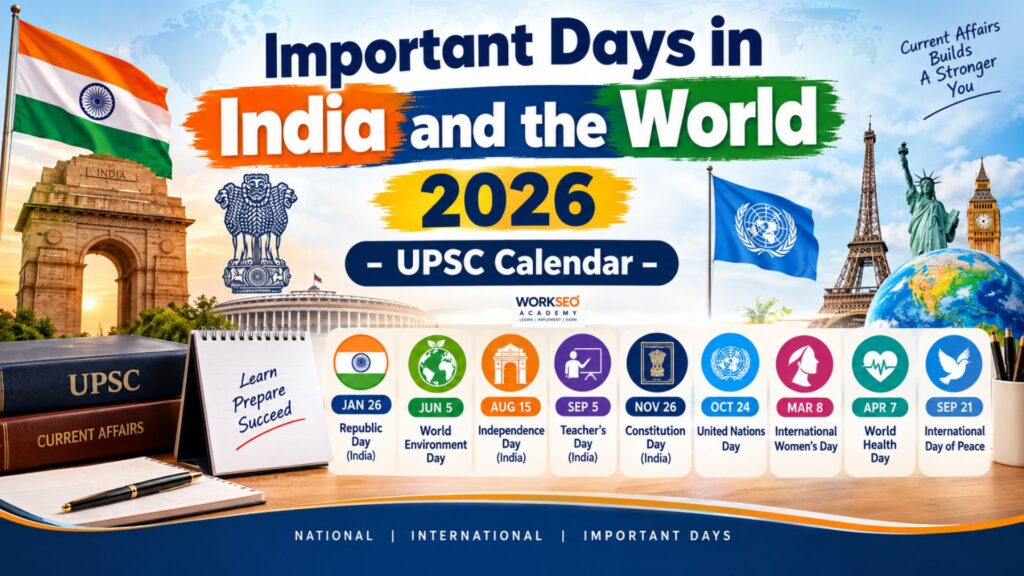
The dates below focus on widely recognised international observances and important Indian national days relevant to General Studies, current affairs, and essay writing. The list is a practical revision guide rather than an exhaustive calendar of every national, religious, and professional observance. International observances are cross-checked against the United Nations calendar of international days.

January 2026
Date | Important day | Significance |
|---|---|---|
4 January | World Braille Day | Accessibility and inclusion of persons with visual disabilities |
12 January | National Youth Day (India) | Birth anniversary of Swami Vivekananda |
24 January | International Day of Education | Education as a human right and a foundation for development |
24 January | National Girl Child Day (India) | Girl-child rights, education and empowerment |
25 January | National Voters’ Day (India) | Electoral participation and democratic awareness |
26 January | Republic Day (India) | Constitution came into force in 1950 |
26 January | International Day of Clean Energy | Transition towards sustainable energy |
30 January | Martyrs’ Day (India) | Remembrance of Mahatma Gandhi and other freedom-struggle martyrs |
February 2026
Date | Important day | Significance |
|---|---|---|
2 February | World Wetlands Day | Wetland conservation and biodiversity |
4 February | World Cancer Day | Cancer awareness, prevention and care |
10 February | World Pulses Day | Nutrition, food security and sustainable agriculture |
11 February | International Day of Women and Girls in Science | Gender equality in science and research |
13 February | World Radio Day | Radio as a medium of communication |
20 February | World Day of Social Justice | Equality, labour rights and social inclusion |
21 February | International Mother Language Day | Linguistic and cultural diversity |
28 February | National Science Day (India) | Discovery of the Raman Effect |
National Science Day commemorates C. V. Raman’s discovery of the Raman Effect in 1928. The day also promotes scientific awareness and a scientific temper.
March 2026
Date | Important day | Significance |
|---|---|---|
3 March | World Wildlife Day | Wildlife conservation and biodiversity |
8 March | International Women’s Day | Women’s rights and gender equality |
15 March | World Consumer Rights Day | Consumer protection and awareness |
20 March | International Day of Happiness | Well-being and quality of life |
21 March | International Day of Forests | Forest conservation and sustainable management |
21 March | World Poetry Day | Poetry and cultural expression |
22 March | World Water Day | Water conservation and access to safe water |
23 March | World Meteorological Day | Weather, climate and meteorological services |
24 March | World Tuberculosis Day | TB prevention, diagnosis and treatment |
April 2026
Date | Important day | Significance |
|---|---|---|
2 April | World Autism Awareness Day | Inclusion and awareness of autism |
7 April | World Health Day | Global public health |
14 April | Dr. B. R. Ambedkar Jayanti (India) | Social justice and constitutional values |
18 April | World Heritage Day | Protection of cultural heritage |
22 April | Earth Day | Environmental protection and sustainability |
23 April | World Book and Copyright Day | Reading, literature and copyright |
25 April | World Malaria Day | Malaria prevention and control |
May 2026
Date | Important day | Significance |
|---|---|---|
1 May | International Labour Day | Workers’ rights and labour welfare |
3 May | World Press Freedom Day | Media freedom and freedom of expression |
8 May | World Red Cross and Red Crescent Day | Humanitarian service |
11 May | National Technology Day (India) | Technological advancement and innovation |
12 May | International Nurses Day | Nursing and healthcare |
15 May | International Day of Families | Family welfare and social development |
17 May | World Telecommunication and Information Society Day | Digital connectivity and ICT |
22 May | International Day for Biological Diversity | Conservation of biodiversity |
31 May | World No Tobacco Day | Tobacco control and public health |
June 2026
Date | Important day | Significance |
|---|---|---|
5 June | World Environment Day | Environmental protection |
8 June | World Oceans Day | Marine conservation |
12 June | World Day Against Child Labour | Elimination of child labour |
14 June | World Blood Donor Day | Voluntary blood donation |
17 June | World Day to Combat Desertification and Drought | Land restoration and drought resilience |
21 June | International Day of Yoga | Yoga and physical and mental well-being |
21 June | World Music Day (Fête de la Musique) | Music and cultural participation |
26 June | International Day Against Drug Abuse and Illicit Trafficking | Prevention of drug abuse and illicit drug trade |
July 2026
Date | Important day | Significance |
|---|---|---|
1 July | National Doctors’ Day (India) | Contributions of doctors to healthcare |
11 July | World Population Day | Population dynamics and reproductive health |
15 July | World Youth Skills Day | Skills development and employment |
18 July | Nelson Mandela International Day | Human rights, equality and public service |
28 July | World Hepatitis Day | Prevention and treatment of viral hepatitis |
29 July | International Tiger Day | Tiger conservation and habitat protection |
30 July | World Day Against Trafficking in Persons | Prevention of human trafficking |
August 2026
Date | Important day | Significance |
|---|---|---|
6 August | Hiroshima Day | Remembrance and nuclear disarmament awareness |
9 August | International Day of the World’s Indigenous Peoples | Indigenous rights and cultural heritage |
12 August | International Youth Day | Youth participation and development |
15 August | Independence Day (India) | Independence from British rule in 1947 |
19 August | World Humanitarian Day | Humanitarian assistance and aid workers |
20 August | World Mosquito Day | Awareness of mosquito-borne diseases |
29 August | National Sports Day (India) | Birth anniversary of Major Dhyan Chand |
September 2026
Date | Important day | Significance |
|---|---|---|
5 September | Teachers’ Day (India) | Birth anniversary of Dr. Sarvepalli Radhakrishnan |
8 September | International Literacy Day | Literacy and lifelong learning |
14 September | Hindi Diwas (India) | Hindi and its constitutional status |
15 September | Engineers’ Day (India) | Birth anniversary of M. Visvesvaraya |
16 September | World Ozone Day | Protection of the ozone layer |
21 September | International Day of Peace | Peace and non-violence |
27 September | World Tourism Day | Sustainable tourism and cultural exchange |
29 September | World Heart Day | Cardiovascular health |
October 2026
Date | Important day | Significance |
|---|---|---|
1 October | International Day of Older Persons | Rights and welfare of older people |
2 October | Gandhi Jayanti (India) | Birth anniversary of Mahatma Gandhi |
2 October | International Day of Non-Violence | Gandhian principles of non-violence |
5 October | World Teachers’ Day | Teachers and education |
10 October | World Mental Health Day | Mental health awareness |
11 October | International Day of the Girl Child | Girls’ rights and opportunities |
16 October | World Food Day | Food security and nutrition |
24 October | United Nations Day | Establishment of the UN in 1945 |
31 October | National Unity Day (India) | Birth anniversary of Sardar Vallabhbhai Patel |
November 2026
Date | Important day | Significance |
|---|---|---|
7 November | National Cancer Awareness Day (India) | Cancer awareness and early detection |
10 November | World Science Day for Peace and Development | Science in society and sustainable development |
11 November | National Education Day (India) | Birth anniversary of Maulana Abul Kalam Azad |
14 November | Children’s Day (India) | Birth anniversary of Jawaharlal Nehru |
16 November | International Day for Tolerance | Mutual respect and peaceful coexistence |
19 November | World Toilet Day | Sanitation and public health |
20 November | World Children’s Day | Children’s rights and welfare |
26 November | Constitution Day (India) | Adoption of the Constitution in 1949 |
Constitution Day is particularly relevant to UPSC aspirants because it provides an opportunity to revise the Constituent Assembly, the Preamble, fundamental rights, and constitutional values.
December 2026
Date | Important day | Significance |
|---|---|---|
1 December | World AIDS Day | HIV/AIDS awareness and prevention |
2 December | National Pollution Control Day (India) | Pollution awareness and environmental protection |
3 December | International Day of Persons with Disabilities | Accessibility, inclusion and equal rights |
4 December | Indian Navy Day | Role of the Indian Navy |
7 December | Armed Forces Flag Day (India) | Welfare of armed forces personnel |
9 December | International Anti-Corruption Day | Integrity and accountable governance |
10 December | Human Rights Day | Universal human rights |
11 December | International Mountain Day | Mountain ecosystems and sustainable development |
14 December | National Energy Conservation Day (India) | Energy efficiency and conservation |
16 December | Vijay Diwas (India) | India’s victory in the 1971 war |
18 December | International Migrants Day | Migrants’ rights and welfare |
22 December | National Mathematics Day (India) | Birth anniversary of Srinivasa Ramanujan |
23 December | National Farmers’ Day (India) | Birth anniversary of Chaudhary Charan Singh |
24 December | National Consumer Day (India) | Consumer rights and protection |
Note: Some observances may have additional or different names in particular countries. Religious festivals and lunar-calendar observances can change dates and should be checked against the relevant official calendar. This list focuses on commonly recognised fixed-date observances.