
Introduction
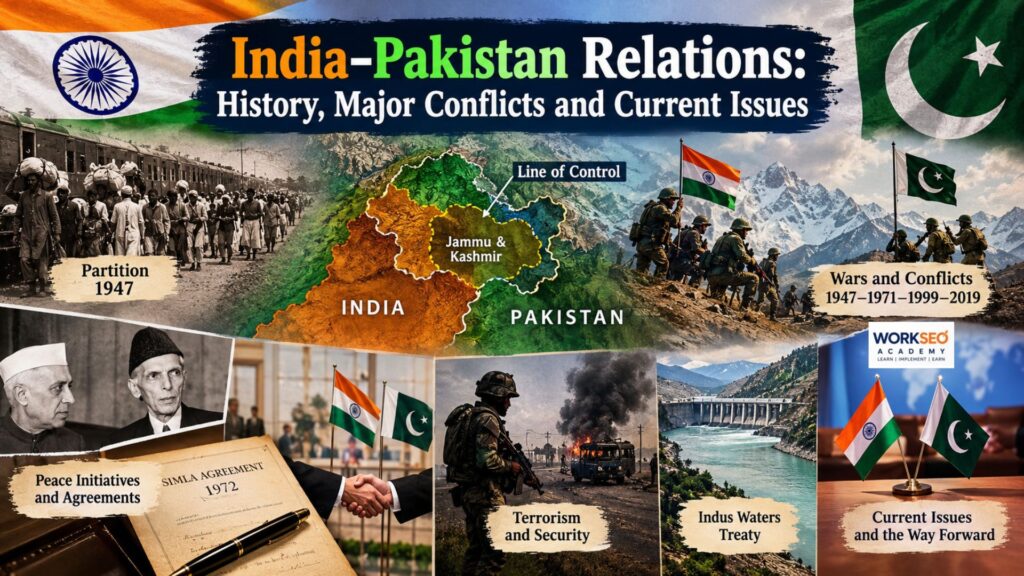
India–Pakistan relations are among the most significant and complex subjects in modern South Asian history. Since the Partition of British India in 1947, the two countries have experienced wars, territorial disputes, diplomatic negotiations, periods of cooperation and recurring security challenges. Their relationship has been shaped by the circumstances of Partition, the Kashmir dispute, competing national identities, cross-border terrorism, nuclear weapons and wider regional geopolitics.
For UPSC Civil Services aspirants, this topic connects several important areas: the Indian National Movement, the Partition of India, post-independence consolidation, international relations, national security and India’s neighbourhood policy. It is relevant to History and International Relations in GS Paper I, GS Paper II and GS Paper III, as well as Prelims questions on treaties, wars and historical events.
A proper understanding of India–Pakistan relations requires more than memorising the dates of conflicts. Aspirants must examine their historical causes, the consequences of political decisions, the role of diplomacy and the possibilities for lasting peace.
1. Historical Background: From British India to Partition
The roots of Partition
The origins of India–Pakistan relations lie in the political developments of British India. During the colonial period, religious identities, constitutional arrangements, political competition and debates over representation influenced the development of Indian nationalism.
The formation of the All-India Muslim League in 1906 and the introduction of separate electorates for Muslims under the Indian Councils Act of 1909 institutionalised separate political representation. However, Partition was not an inevitable outcome of these developments; it resulted from a complex interaction of political choices, constitutional disagreements, communal tensions and the circumstances of British withdrawal.
The Lahore Resolution of March 1940, adopted by the Muslim League, called for independent political arrangements in Muslim-majority areas of north-western and eastern India. It later became central to the demand for Pakistan.
During the final years of British rule, disagreements between the Indian National Congress, the Muslim League and the British government over power-sharing and the transfer of authority intensified.
Partition in 1947
The Indian Independence Act of 1947 created the independent Dominions of India and Pakistan. Partition divided British India’s provinces of Punjab and Bengal and triggered one of the largest and most traumatic migrations in modern history.
Development | Historical significance |
|---|---|
Formation of the Muslim League, 1906 | Established a major platform for Muslim political representation |
Lahore Resolution, 1940 | Strengthened the demand for separate political arrangements |
Cabinet Mission Plan, 1946 | Attempted to preserve a united India through a federal arrangement |
Indian Independence Act, 1947 | Provided the legal framework for independence and Partition |
Partition, August 1947 | Created India and Pakistan amid mass migration and communal violence |
Partition left unresolved questions concerning minority protection, the division of assets, river waters, territorial boundaries and the accession of princely states. These issues shaped the relationship between the two new countries from the beginning.
2. The Kashmir Dispute: A Central Issue
Accession of Jammu and Kashmir
Jammu and Kashmir was a princely state ruled by Maharaja Hari Singh in 1947. Its ruler initially sought to maintain independence while considering the state’s future.
In October 1947, armed tribal forces entered the state from the direction of Pakistan. Facing the invasion, the Maharaja signed the Instrument of Accession to India on 26 October 1947; India accepted it on 27 October. Indian troops were subsequently airlifted to Srinagar.
Pakistan disputed the accession, and the conflict developed into the First Indo-Pakistani War. The dispute subsequently became a central source of military confrontation and diplomatic disagreement.
United Nations involvement
India brought the Kashmir issue to the United Nations in January 1948. The UN Security Council adopted Resolution 47 on 21 April 1948, recommending measures involving a ceasefire, a truce and a proposed plebiscite subject to specified conditions.
The proposed process was never implemented. Disagreement over the sequence and fulfilment of the required conditions prevented agreement on the framework.
A ceasefire took effect on 1 January 1949. The Karachi Agreement of July 1949 established a ceasefire line under UN supervision. This line was later replaced by the Line of Control under the Simla Agreement of 1972.
Why Kashmir remains disputed
The dispute involves several interconnected dimensions:
Territorial control: India and Pakistan administer different parts of the former princely state.
National identity: Kashmir has occupied an important place in both countries’ political narratives.
Security concerns: Military deployments and armed violence have repeatedly heightened tensions.
Political aspirations: The preferences and rights of people living in the region are central to any durable settlement.
External involvement: The United Nations and other international actors have played roles at different stages.
An analytical UPSC answer should distinguish the historical origins of the dispute from the present constitutional and diplomatic positions of the two countries.
3. Major India–Pakistan Wars and Conflicts
India and Pakistan have fought several major wars and experienced serious military crises. Their causes and outcomes illustrate the relationship between territorial disputes, military strategy and diplomacy.
Year | Conflict or event | Major outcome |
|---|---|---|
1947–1949 | First Kashmir War | Ceasefire and division of the former princely state between areas administered by India and Pakistan |
1965 | Second Indo-Pakistani War | Ended with a ceasefire; the Tashkent Declaration followed in January 1966 |
1971 | India–Pakistan War | Pakistan’s eastern wing became independent Bangladesh |
1984 onward | Siachen conflict | Military confrontation over control of the Siachen Glacier region |
1999 | Kargil conflict | Indian forces regained positions occupied by Pakistani soldiers and infiltrators on the Indian side of the Line of Control |
2001–2002 | Military standoff | Large-scale mobilisation followed the attack on the Indian Parliament in December 2001 |
2016 | Uri attack and surgical strikes | India announced cross-Line of Control surgical strikes following the Uri attack |
2019 | Pulwama attack and Balakot airstrike | A major escalation involving an Indian airstrike in Pakistan and subsequent aerial confrontation |
The 1965 War and the Tashkent Declaration
The 1965 war developed amid tensions in the Rann of Kutch and Jammu and Kashmir. Pakistan’s Operation Gibraltar sought to infiltrate forces into Indian-administered Kashmir and encourage an uprising. Fighting escalated into a broader war.
The Soviet Union facilitated negotiations between Indian Prime Minister Lal Bahadur Shastri and Pakistani President Ayub Khan. They signed the Tashkent Declaration on 10 January 1966, agreeing to withdraw forces to their pre-conflict positions and restore peaceful relations.
The declaration reduced immediate tensions but did not resolve the Kashmir dispute.
The 1971 War and the birth of Bangladesh
The 1971 conflict had a distinct historical background. Political tensions in Pakistan intensified after the Awami League won a majority in Pakistan’s 1970 general election, but the transfer of power did not take place. The Pakistani military’s crackdown in East Pakistan in March 1971 triggered a humanitarian crisis and a massive refugee influx into India.
India supported the Bengali liberation movement. War formally broke out in December 1971, and Pakistani forces in the eastern theatre surrendered on 16 December.
The emergence of Bangladesh transformed South Asian geopolitics. The war also demonstrated that internal political crises, refugee flows and military intervention could combine to produce major regional change.
The 1999 Kargil conflict
The Kargil conflict occurred after Pakistani soldiers and armed personnel occupied positions on the Indian side of the Line of Control in the Kargil sector. India launched military operations to recapture the positions.
The conflict was significant because it occurred after both countries conducted nuclear tests in 1998. It exposed the danger that limited conventional conflict could escalate even between nuclear-armed neighbours.
The episode also showed that diplomatic engagement alone cannot guarantee peace without restraint, credible communication and respect for established military arrangements.
4. Major Peace Initiatives and Agreements
Despite recurring conflict, India and Pakistan have repeatedly attempted to improve bilateral relations.
Key agreements for UPSC Prelims and Mains
Agreement or initiative | Year | Importance |
|---|---|---|
Liaquat–Nehru Pact | 1950 | Addressed the protection of minorities and refugee-related concerns |
Tashkent Declaration | 1966 | Sought normalisation after the 1965 war |
Simla Agreement | 1972 | Committed both countries to peaceful settlement and respect for the Line of Control |
Indus Waters Treaty | 1960 | Established a framework for sharing the waters of the Indus river system |
Lahore Declaration | 1999 | Promoted dialogue, peace and nuclear risk reduction |
Agra Summit | 2001 | Attempted to advance dialogue but ended without a joint declaration |
Composite Dialogue Process | 2004 onward | Addressed Kashmir, terrorism, trade and other bilateral issues |
Ceasefire understanding | 2003, reaffirmed in 2021 | Sought to reduce firing along the Line of Control |
The Simla Agreement, 1972
Signed by Prime Minister Indira Gandhi and President Zulfikar Ali Bhutto on 2 July 1972, the Simla Agreement is a foundational document in bilateral relations.
Its major principles include:
Resolving differences through peaceful means and bilateral negotiations, or other peaceful means mutually agreed upon.
Respecting each other’s sovereignty and territorial integrity.
Observing the Line of Control in Jammu and Kashmir without seeking to alter it unilaterally.
Taking steps towards normalising relations and restoring communications.
The agreement is especially important because India relies on its bilateral framework when addressing outstanding disputes.
The Indus Waters Treaty, 1960
Brokered with the assistance of the World Bank, the Indus Waters Treaty regulates the use of the Indus river system.
It allocates the waters of the eastern rivers—Ravi, Beas and Sutlej—primarily to India, while the western rivers—Indus, Jhelum and Chenab—are allocated primarily to Pakistan, subject to specified provisions for permitted uses by India.
The treaty is historically important because it established a technical framework for water sharing despite continuing political hostility. Its dispute-resolution mechanisms also illustrate the role of institutions in managing disagreements.
Current affairs note: Following the Pahalgam terrorist attack in April 2025, India announced that the treaty would be held in abeyance. The resulting dispute over the treaty’s status and implementation became a major bilateral issue. Aspirants should distinguish the original treaty provisions from subsequent political announcements and competing legal positions.
5. Current Issues in India–Pakistan Relations
Cross-border terrorism and national security
Terrorism remains one of India’s principal concerns in its relations with Pakistan. Major attacks, including the 2001 Parliament attack, the 2008 Mumbai attacks, the 2016 Uri attack and the 2019 Pulwama attack, severely damaged prospects for dialogue.
The terrorist attack at Pahalgam in April 2025 further escalated tensions. India announced measures against Pakistan, including placing the Indus Waters Treaty in abeyance, while the two countries entered another serious period of confrontation.
The central challenge is to prevent attacks from triggering wider military escalation while ensuring accountability and protecting civilians. India maintains that meaningful progress in bilateral relations requires action against terrorism directed at it.
Kashmir and the Line of Control
The Kashmir dispute remains unresolved. Ceasefire arrangements can reduce violence, but they do not settle the underlying political and territorial disagreements.
The Line of Control is a military control line, not an internationally agreed final boundary. The 2021 reaffirmation of the 2003 ceasefire understanding demonstrated that military communication can reduce immediate risks even when broader negotiations remain stalled.
Nuclear deterrence
Both countries possess nuclear weapons. Nuclear deterrence may discourage an all-out war, but it does not eliminate the possibility of limited conflict, miscalculation or escalation.
The 1999 Kargil conflict and the 2001–2002 military standoff illustrate the risks of crises between nuclear-armed states. Confidence-building measures, communication channels and clear crisis-management procedures are therefore important for regional stability.
Water security and the Indus river system
The Indus Waters Treaty has long served as a framework for managing a shared natural resource. Changes in its status following the 2025 crisis raised concerns about water security, treaty obligations and regional cooperation.
For UPSC, the issue connects international relations with environmental security, transboundary rivers, international law and food security.
Trade, connectivity and people-to-people relations
Trade and transport links remain vulnerable to political tensions. Restrictions on commerce, visas and cross-border movement limit economic opportunities and reduce ordinary contact between citizens.
India and Pakistan share linguistic, cultural and historical connections. Religious pilgrimage, family ties, cultural exchange and regional trade can contribute to confidence-building when security conditions permit.
However, these initiatives depend on a stable political environment and cannot substitute for addressing serious security concerns.
China’s role and wider regional geopolitics
China’s close strategic and economic relationship with Pakistan influences India’s regional security calculations. China–Pakistan cooperation, including the China–Pakistan Economic Corridor, has implications for regional connectivity and India’s concerns over sovereignty and territory.
The relationship also has implications for Afghanistan, Central Asian connectivity, the security of the Arabian Sea and wider South Asian stability.
India–Pakistan relations therefore cannot be examined in isolation from the regional balance of power.
6. Why Has Lasting Peace Been Difficult?
Several structural factors have prevented the normalisation of relations.
Unresolved historical disputes
Partition left territorial questions and competing national narratives that continue to influence political decisions.
Security dilemma
One country’s military or security measures may be perceived as threatening by the other, prompting countermeasures and increasing mistrust.
Weak continuity of dialogue
Negotiations have repeatedly been interrupted by terrorist attacks, military crises and changes in political priorities.
Regional and international factors
External partnerships, strategic competition and domestic political pressures affect the scope for compromise.
The central lesson is that bilateral relations cannot improve through declarations alone. Durable progress requires credible security arrangements, sustained diplomacy, responsible political leadership and mechanisms to prevent local incidents from escalating into wider conflict.
7. The Way Forward
A balanced approach should combine national security with practical diplomacy.
1. Counterterrorism cooperation: Prevent terrorist organisations from using territory under state control to organise or support attacks, and strengthen credible mechanisms for accountability.
2. Crisis communication: Maintain military hotlines and other communication channels to reduce the risk of miscalculation during periods of tension.
3. Sustained diplomatic engagement: Use appropriate bilateral channels to discuss outstanding issues, even when progress on the most contentious disputes is limited.
4. Water and environmental dialogue: Address shared river systems through technically informed discussions, applicable legal frameworks and transparent dispute-management mechanisms.
5. Humanitarian measures: Facilitate legitimate religious pilgrimages, family reunions, prisoner-related matters and other humanitarian exchanges wherever security conditions allow.
6. Regional cooperation: Explore practical cooperation in trade, public health, climate resilience and disaster management when political conditions permit.
The objective is not to ignore historical grievances or security threats. It is to prevent recurring crises from undermining long-term regional stability.
8. Why This Topic Matters for UPSC
This topic offers direct preparation value across the Civil Services Examination.
UPSC component | What to prepare |
|---|---|
Prelims | Dates, wars, treaties, declarations, Line of Control and Indus river system |
GS Paper I | Partition, post-independence consolidation and the historical background of Kashmir |
GS Paper II | Bilateral relations, neighbourhood policy, international agreements and regional organisations |
GS Paper III | Nuclear security, terrorism, border management and strategic stability |
Essay | Peace and security, historical memory, nationalism and regional cooperation |
Interview | Balanced assessment of security interests, diplomacy and peaceful coexistence |
High-value revision points
Distinguish the Tashkent Declaration (1966) from the Simla Agreement (1972).
Remember that the Lahore Declaration was signed in February 1999, before the Kargil conflict later that year.
Understand the difference between the international border and the Line of Control.
Connect the 1971 war with the creation of Bangladesh.
Separate historical facts from the competing political claims of India and Pakistan.
For current affairs, verify the latest official developments concerning the Indus Waters Treaty, security incidents and diplomatic engagement before the examination.
9. UPSC Mains Answer Writing Approach
A good answer should move beyond chronology to explain causes, consequences and the significance of diplomacy.
For a 10-mark question
Suggested length: approximately 150 words
Example question: Explain the historical origins of India–Pakistan tensions.
Introduction: Connect Partition in 1947 with the emergence of bilateral disputes.
Body: Discuss Kashmir, the division of assets, wars and mistrust.
Conclusion: Explain why sustained diplomacy and peaceful dispute management remain important.
For a 15-mark question
Suggested length: approximately 250 words
Example question: Examine the major conflicts and peace initiatives in India–Pakistan relations since independence.
Introduction: Establish the historical context.
Conflict chronology: Briefly analyse the wars of 1947–1949, 1965 and 1971, along with Kargil in 1999.
Diplomatic initiatives: Evaluate the Tashkent Declaration, Simla Agreement and Lahore Declaration.
Critical analysis: Explain why agreements have not produced lasting normalisation.
Conclusion: Recommend credible security arrangements and sustained dialogue.
For a 20-mark question
Suggested length: approximately 300–350 words, depending on the examination instructions
Example question: Critically analyse the evolution of India–Pakistan relations and suggest a framework for durable peace in South Asia.
Use this model structure:
Introduction: Partition and the formation of the two states.
Historical evolution: Kashmir, major wars and changing regional dynamics.
Diplomatic framework: Bilateral agreements, water sharing and ceasefire arrangements.
Contemporary challenges: Terrorism, nuclear deterrence, water security and China’s role.
Critical evaluation: Explain why earlier peace efforts achieved limited or temporary results.
Way forward: Combine security measures, crisis communication, diplomacy and humanitarian engagement.
Conclusion: Emphasise peace with security, accountability and respect for applicable agreements.
Answer-writing tip: Include a short chronology or treaty table when useful. Use precise dates and distinguish established historical facts from disputed interpretations. Avoid presenting either country’s official narrative as an uncontested historical conclusion.
10. Five Likely UPSC-Style Questions
1. GS Paper I: Examine how the circumstances of Partition shaped India–Pakistan relations after independence.
2. GS Paper I / II: Discuss the historical origins of the Kashmir dispute and its impact on bilateral relations.
3. GS Paper II: Evaluate the role of the Simla Agreement and the Lahore Declaration in efforts to normalise India–Pakistan relations.
4. GS Paper II / III: How do cross-border terrorism and nuclear deterrence affect India’s security policy towards Pakistan?
5. Essay / GS Paper II: “Sustainable peace in South Asia requires both security preparedness and diplomatic engagement.” Critically discuss with reference to India–Pakistan relations.
11. Frequently Asked Questions (FAQs)
1. Why did India and Pakistan separate in 1947?
Partition resulted from constitutional disagreements, competing political demands, communal tensions and the circumstances of British withdrawal. The Indian Independence Act of 1947 created the independent states of India and Pakistan.
2. What is the main cause of conflict between India and Pakistan?
The Kashmir dispute has been a central source of conflict, but tensions also involve cross-border terrorism, security competition, territorial disagreements and mistrust arising from earlier wars.
3. What was the purpose of the Simla Agreement of 1972?
The agreement sought to normalise bilateral relations after the 1971 war. It committed both countries to peaceful settlement of differences and respect for the Line of Control in Jammu and Kashmir.
4. Why is the Indus Waters Treaty important?
The treaty established a framework for sharing the waters of the Indus river system. It is important for agriculture, water security, regional stability and the management of transboundary natural resources.
5. What is the relevance of India–Pakistan relations for UPSC?
It is relevant to modern Indian history, Partition, post-independence consolidation, international relations, border security, terrorism and nuclear deterrence. It is useful for both factual Prelims preparation and analytical Mains answers.

Conclusion
India–Pakistan relations have evolved through Partition, territorial disputes, wars, diplomatic agreements and recurring security crises. The 1971 war transformed South Asia through the creation of Bangladesh, while the Simla Agreement and Lahore Declaration demonstrated that both countries have pursued peaceful engagement at different points in their history.
Yet lasting normalisation remains difficult because of unresolved disputes, terrorism, strategic mistrust and competing national priorities. A balanced historical assessment recognises both the importance of protecting national security and the value of preventing further conflict. Sustainable peace will require credible security measures, accountability, diplomatic engagement and practical cooperation wherever conditions permit.
