
Introduction
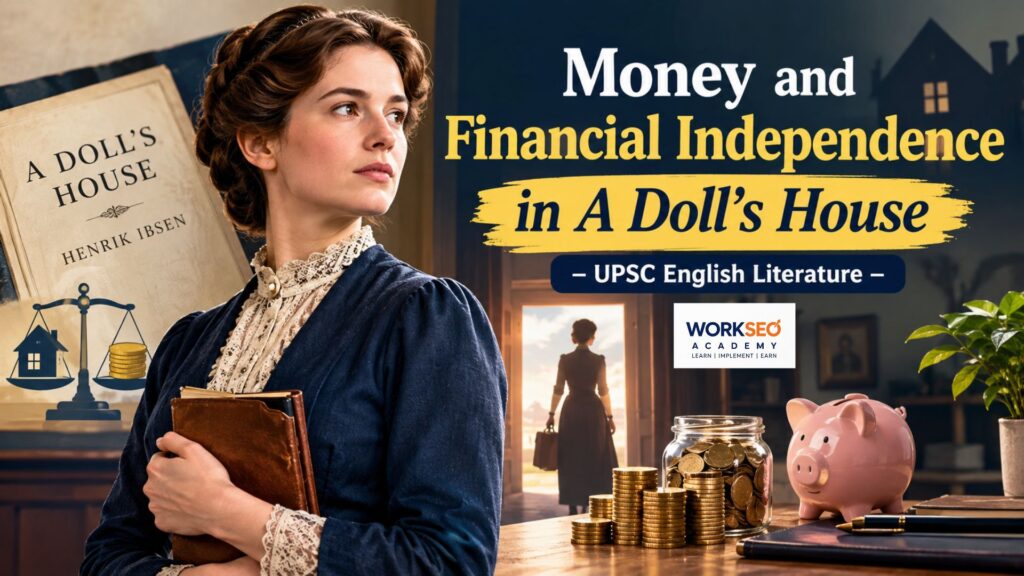
Henrik Ibsen’s A Doll’s House (1879) is a landmark modern European drama that examines marriage, gender roles, individual freedom, morality, and social expectations. Among its most important concerns is the relationship between money and financial independence. Ibsen uses domestic finances not merely as a background detail but as a dramatic force that reveals the unequal power structure within Nora and Torvald Helmer’s marriage.
Money determines who makes decisions, who depends on whom, and who possesses authority. Nora’s secret loan, her repayment efforts, Torvald’s attitude towards expenditure, and Krogstad’s financial insecurity all demonstrate how economic dependence can become a form of social and personal control.
For UPSC English Literature aspirants, this theme is particularly important because it connects characterisation, symbolism, dramatic conflict, gender relations, realism, and nineteenth-century social context. A critical study of money in A Doll’s House therefore goes beyond the question of finance: it examines the relationship between economic power and individual freedom.
Money and Financial Independence in A Doll's House
Historical and Literary Context
A Doll’s House was written by Norwegian playwright Henrik Ibsen and first performed in 1879. It belongs to the development of modern European drama and is commonly associated with realism, particularly its examination of ordinary social life and contemporary moral problems.
The play challenges conventional assumptions about the Victorian-era family, although Norway had its own distinctive social and legal context. Women had limited economic and legal independence in many areas of nineteenth-century Europe. Within such a society, marriage could provide economic security while simultaneously restricting female autonomy.
Ibsen transforms these social conditions into dramatic conflict. Nora appears to be financially dependent on Torvald, yet the revelation that she secretly borrowed money to save his life complicates this apparent dependence.
Nora’s Secret Loan: Money as an Act of Independence
The central financial event in the play is Nora’s secret borrowing of money to finance Torvald’s recovery from illness.
Nora initially appears to be a financially irresponsible wife because she enjoys spending money. Torvald repeatedly treats her as someone who needs financial supervision. However, the audience gradually learns that Nora has demonstrated considerable determination and responsibility.
She borrowed money without Torvald’s knowledge and has been secretly repaying the debt.
This creates an important contradiction:
- Socially, Nora appears dependent.
- Economically, she has acted independently.
- Morally, she believes her action was justified because she wanted to save her husband’s life.
- Legally, however, the means she used involve forgery and place her in danger.
The loan therefore becomes a symbol of the gap between social morality and personal morality.
Nora’s financial action is motivated by love and necessity, but the society around her judges the legality and respectability of the act rather than fully recognising the circumstances behind it.
Money and Power in Nora and Torvald’s Marriage
Money is closely connected with authority in the Helmer household.
Torvald controls the family’s financial decisions. He discusses expenditure with Nora in a patronising manner and treats her spending habits as evidence of childishness. His language and behaviour establish an unequal relationship in which financial authority belongs primarily to the husband.
This is significant because economic control becomes a form of domestic power.
Nora may have access to money, but she does not possess genuine financial autonomy. Torvald’s income gives him social authority, while Nora’s dependence reinforces the role he expects her to perform.
The irony is that Nora has secretly managed a serious financial obligation without his knowledge. The person whom Torvald considers financially incapable has actually demonstrated considerable resourcefulness.
The Loan and the Theme of Sacrifice
The financial plot also develops the theme of sacrifice.
Nora believes that her sacrifice for Torvald should have moral value. She has taken financial and personal risks because she wanted to protect him. Her understanding of marriage is based on affection, loyalty, and mutual sacrifice.
However, Torvald’s reaction to the crisis exposes a fundamental weakness in their relationship.
When he fears that Nora’s actions may damage his reputation, his primary concern becomes his own social position. His response reveals that he does not understand Nora’s sacrifice in the way she expected.
The financial crisis therefore becomes a test of marriage.
Ibsen uses money to reveal character rather than simply to create a plot complication.
Krogstad: Financial Insecurity and Social Reputation
Nils Krogstad provides another perspective on financial dependence.
Krogstad is not simply a villain seeking revenge. He is a man concerned about employment, reputation, and social survival. His position at the bank makes him vulnerable, and his attempt to preserve his employment drives much of the conflict.
His connection with Nora demonstrates how economic insecurity can influence moral decisions.
Krogstad’s actions are therefore connected to a broader social world in which employment and reputation determine a person’s status.
The play consequently presents money at several levels:
| Aspect | Significance |
|---|---|
| Nora’s loan | Financial independence and moral conflict |
| Torvald’s income | Economic authority within marriage |
| Krogstad’s employment | Economic survival and social reputation |
| Debt | Dependence, secrecy and anxiety |
| Bank | Institutional economic power |
| Nora’s repayment | Personal responsibility and sacrifice |
Financial Independence and Female Identity
Nora’s development is one of the central reasons why financial independence matters in the play.
At the beginning, Nora participates in the role expected of her. She appears playful, dependent and concerned with pleasing Torvald. Money reinforces this image because she depends upon his income.
Yet her secret financial actions reveal another identity: she is capable of making decisions, accepting responsibility and enduring hardship.
The crisis forces her to reconsider the identity imposed upon her.
Her final decision to leave the household is therefore not simply a rejection of marriage. It represents a demand for self-education, self-knowledge and personal autonomy.
Her movement towards independence is intellectual and ethical as well as economic.
The Christmas Setting and Financial Anxiety
The play begins around Christmas, a season conventionally associated with generosity, family and celebration. Yet financial concerns are present from the beginning.
This creates dramatic irony. The apparently comfortable household is built upon hidden anxiety.
The contrast between festive domestic appearance and financial secrecy supports one of the play’s major ideas: social appearances can conceal serious personal conflicts.
Ibsen repeatedly exposes the difference between what the household appears to be and what it actually is.
Money as a Symbol of Dependency
Money functions symbolically throughout the drama.
It represents:
- dependence
- authority
- security
- social status
- secrecy
- responsibility
- freedom
Nora’s relationship with money changes during the play. Initially, money is associated with comfort and pleasure. Later, it becomes associated with fear, responsibility and moral conflict. By the end, the deeper issue is not simply whether Nora has money but whether she can make decisions for herself.
Thus, financial independence becomes part of the larger search for personal independence.
Dramatic Irony and the Financial Plot
Ibsen makes effective use of dramatic irony.
The audience gradually understands the significance of Nora’s financial secret while Torvald remains unaware of its full implications.
This produces tension because the audience knows that apparently ordinary conversations about money have much greater consequences.
The financial plot also allows Ibsen to delay the revelation of the marriage’s underlying weakness. The crisis involving Krogstad ultimately exposes the emotional and moral limitations of the relationship.
Critical Interpretation
The theme of money should not be reduced to a simple argument that women merely need independent income. Ibsen’s treatment is broader.
The play questions a social structure in which legal authority, economic power, marriage and respectability are interconnected.
A feminist reading emphasises Nora’s restricted autonomy and her movement towards self-determination. A social-realistic reading highlights the institutions that shape individual behaviour. A psychological reading focuses on Nora’s transformation from a performed identity towards self-awareness.
These interpretations can coexist. The financial conflict is powerful precisely because it connects private emotion with larger social structures.
Money, Marriage and the Transformation of Nora
The financial crisis becomes the catalyst for Nora’s transformation.
At first, she believes that Torvald will respond to the revelation by protecting her and accepting responsibility for her actions. Instead, his reaction reveals that his conception of marriage is strongly influenced by reputation, authority and social expectations.
Nora consequently recognises that the marriage has not provided the mutual understanding she believed existed.
Her final departure represents a radical assertion of individuality.
The play therefore moves from:
financial dependence → secret economic action → crisis → revelation → self-awareness → demand for independence
This progression makes money an essential part of the dramatic structure rather than a secondary theme.
Why This Topic Matters for UPSC
1. UPSC English Literature
The theme provides material for analysing:
- characterisation of Nora and Torvald
- realism in modern drama
- dramatic irony
- symbolism
- social criticism
- gender and power
- conflict between individual and society
2. Mains Answer Writing
A strong answer should not merely state that Nora wants financial freedom. It should explain how economic dependence reflects unequal power within marriage and how the financial crisis contributes to Nora’s psychological transformation.
3. Essay and General Analytical Skills
The theme connects literature with broader questions about:
- economic autonomy
- gender equality
- individual freedom
- social institutions
- morality versus law
- the relationship between economic power and personal identity
4. Vocabulary and Literary Analysis
Important terms include realism, dramatic irony, symbolism, autonomy, patriarchy, economic dependence, social respectability, characterisation, and dramatic conflict.
UPSC Mains Answer Writing Approach
For a 10-Mark Answer
Introduction: Identify Ibsen’s A Doll’s House as a realist modern drama and introduce money as a mechanism of power.
Major points:
- Torvald’s financial control reflects marital inequality.
- Nora’s secret loan demonstrates hidden agency and responsibility.
- The financial crisis exposes the weakness of their marriage.
Example: Nora’s borrowing and repayment of the loan.
Conclusion: Financial independence becomes an important stage in Nora’s search for individual autonomy.
For a 15-Mark Answer
Begin with the nineteenth-century social context.
Develop three to five dimensions:
- economic dependence within marriage
- Nora’s secret financial agency
- Krogstad and economic insecurity
- money and social reputation
- financial crisis as a catalyst for Nora’s transformation
Use the financial plot as evidence and conclude by connecting economic autonomy with personal freedom.
For a 20-Mark Answer
A higher-value answer can introduce multiple critical perspectives.
Discuss:
- nineteenth-century social and economic context
- money as domestic power
- Nora’s financial agency
- Krogstad’s economic insecurity
- law versus morality
- reputation and social respectability
- symbolism of debt
- Nora’s final movement towards autonomy
A comparative or critical perspective can distinguish economic independence from complete personal freedom. Nora’s departure suggests that financial autonomy alone is insufficient without intellectual and emotional self-determination.
Short Model Answer Framework
Question: Discuss the significance of money and financial independence in Henrik Ibsen’s A Doll’s House.
Framework:
Introduction → nineteenth-century gender and economic context → Torvald’s financial authority → Nora’s secret loan → debt as symbol → Krogstad’s insecurity → dramatic irony → revelation of marital inequality → Nora’s movement towards autonomy → balanced conclusion.
UPSC Prelims Quick Revision
- Author: Henrik Ibsen
- Work: A Doll’s House
- First performed: 1879
- Genre: Drama / modern realist drama
- Central protagonist: Nora Helmer
- Husband: Torvald Helmer
- Important financial conflict: Nora’s secret loan
- Creditor: Nils Krogstad
- Major themes: marriage, gender roles, individual freedom, money, morality, social reputation and identity
- Important literary concepts: realism, dramatic irony, symbolism and social criticism
- Central financial idea: Economic dependence can reinforce social and domestic power.
5 Likely UPSC-Style Questions
- Define economic dependence as represented in Henrik Ibsen’s A Doll’s House. Discuss its significance in the play.
- How does Ibsen use money and debt to reveal the unequal power relationship between Nora and Torvald?
- “The financial crisis in A Doll’s House is ultimately a crisis of marriage and identity.” Critically examine.
- Compare Nora’s relationship with money with Krogstad’s economic insecurity. What does this comparison reveal about Ibsen’s social criticism?
- Discuss the relationship between financial independence and individual freedom in A Doll’s House. To what extent does Nora’s final decision represent liberation?
5 Frequently Asked Questions
1. What is the significance of money in A Doll’s House?
Money represents economic dependence, domestic authority, social status and personal freedom. Nora’s secret loan becomes the central financial conflict that exposes the unequal nature of her marriage.
2. How does Nora achieve financial independence in A Doll’s House?
Nora does not initially possess formal financial independence. Instead, she secretly borrows money and works to repay the debt. This hidden economic activity demonstrates her capacity for responsibility despite her socially dependent position.
3. Why is Nora’s loan important to the plot?
The loan creates the central conflict involving Krogstad and Torvald. Its eventual exposure forces Nora and Torvald to confront the true nature of their marriage.
4. What does Torvald’s attitude towards money reveal about his character?
Torvald treats money as a source of authority and social security. His attitude also reflects his desire to control the household and maintain social respectability.
5. Is A Doll’s House only about women’s financial independence?
No. Financial independence is one part of a wider argument about individual autonomy. The play also examines marriage, identity, morality, social expectations, reputation and the individual’s right to develop an independent sense of self.
Conclusion
Money in A Doll’s House is much more than a practical element of the plot. It is a dramatic instrument through which Ibsen examines power, dependence, responsibility and freedom. Nora’s secret loan demonstrates both her vulnerability within a restrictive social system and her capacity for independent action. Torvald’s response to the crisis exposes the limitations of a marriage built around unequal economic and social power.
For UPSC English Literature preparation, the theme is especially valuable because it connects realism, characterisation, symbolism, dramatic irony and social criticism. A strong interpretation therefore sees Nora’s financial struggle not as an isolated domestic problem but as part of her larger movement from dependence towards self-awareness and individual autonomy.