
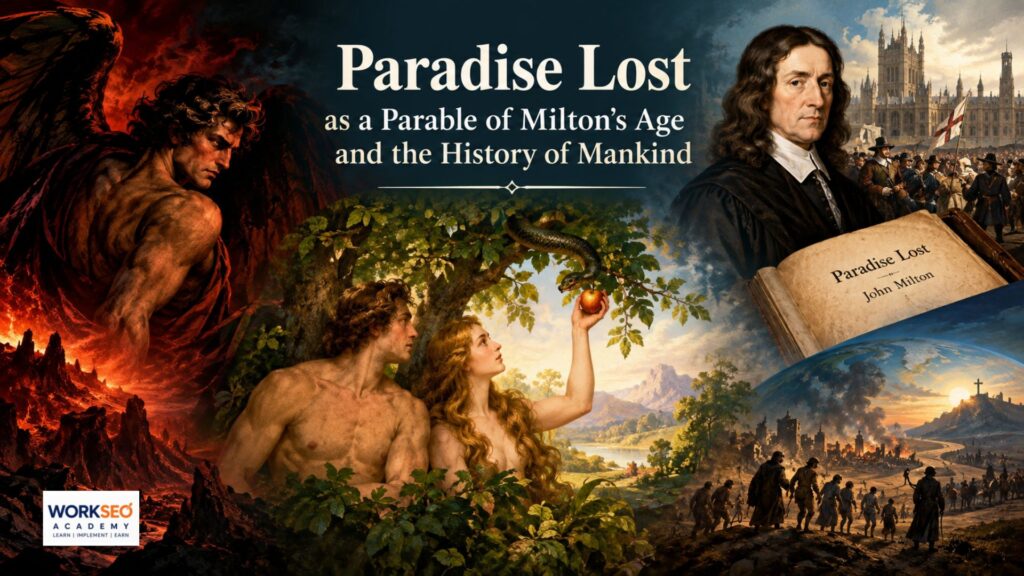
John Milton’s Paradise Lost (1667) is one of the major achievements of English epic poetry. At one level, it narrates the biblical story of the Fall of Man: Satan’s rebellion against God, the temptation of Adam and Eve, their disobedience, and their expulsion from Paradise. At another level, however, the poem reflects the political, religious, intellectual, and moral conflicts of seventeenth-century England.
The idea of Paradise Lost as a parable of Milton’s age and the history of mankind is therefore important to literary study. Milton does not simply retell the Book of Genesis. He transforms the biblical narrative into a large meditation on freedom, authority, rebellion, obedience, temptation, knowledge, justice, and human responsibility.
The poem can consequently be read on two interconnected levels. Historically, it reflects the tensions of Milton’s own age, including the English Civil War, the conflict between monarchy and republicanism, and religious controversy. Universally, it presents the human condition through the Fall and its consequences.
For UPSC English Literature aspirants, this topic is especially useful because it connects textual interpretation with historical context, political thought, religious ideas, symbolism, and epic technique.
Meaning of the “Parable” of Milton’s Age
A parable is a narrative that conveys a broader moral, intellectual, or philosophical meaning through particular events and characters. Calling Paradise Lost a parable of Milton’s age does not mean that every character or event corresponds mechanically to a particular historical person or event.
Rather, the poem reflects the intellectual and political tensions of seventeenth-century England.
Milton lived through one of the most turbulent periods in English history. The English Civil Wars, the execution of Charles I in 1649, the Commonwealth, the Restoration of Charles II in 1660, and continuing religious conflicts formed the historical background of his life.
Milton himself supported republican government and opposed absolute monarchy. His political writings demonstrate his commitment to ideas concerning liberty, conscience, and resistance to tyranny. Therefore, questions of authority and obedience in Paradise Lost inevitably acquire a historical resonance.
Historical Context: Seventeenth-Century England
Milton’s age was characterised by intense disputes concerning:
- monarchy and republican government
- political authority and resistance
- Protestantism and religious conformity
- individual conscience
- freedom and obedience
- the relationship between church and state
- human reason and divine authority
These tensions provide an important context for reading Paradise Lost.
However, the poem should not be reduced to a political allegory. Satan is not simply a representation of one historical political group, nor is God a direct representation of a particular English monarch. The poem operates at a much broader philosophical level.
Its historical significance emerges because Milton’s own political and religious concerns shaped the questions the poem asks.
The Fall of Man as a Universal History
The second dimension of the poem is its representation of the history of mankind.
The Fall of Adam and Eve becomes the central event through which Milton explores human nature. Before the Fall, humanity possesses innocence and lives in harmony with God and creation. The act of disobedience introduces sin, suffering, shame, mortality, and separation from divine grace.
The movement can be understood as:
Creation → Innocence → Temptation → Disobedience → Fall → Suffering → Hope of Redemption
Thus, the biblical story becomes a framework for understanding the human condition.
Milton does not present Adam and Eve as purely evil figures. Their tragedy arises from the misuse of freedom. They possess the ability to choose, and their choice has consequences.
This makes the Fall both a religious event and a philosophical investigation into free will and moral responsibility.
Free Will, Obedience and Human Responsibility
One of the central ideas in Paradise Lost is the relationship between freedom and obedience.
Milton gives Adam and Eve genuine moral agency. Their obedience has value precisely because disobedience is possible.
The Fall therefore raises an important question:
Can moral goodness exist without freedom of choice?
Milton’s answer is closely connected with the poem’s Christian framework. God does not create human beings as machines incapable of choice. Their freedom makes moral responsibility possible.
This idea also becomes important when examining Satan. Satan repeatedly presents himself as a defender of freedom, but his rebellion gradually reveals the destructive side of self-centred freedom.
The poem consequently distinguishes between liberty governed by reason and freedom transformed into self-will.
Satan and the Problem of Rebellion
Satan is one of the most complex figures in the poem. He rebels against divine authority, refuses submission, and seeks revenge by attacking humanity.
His rhetoric often gives rebellion the appearance of heroic independence. His famous declaration, “Better to reign in Hell, than serve in Heav’n,” expresses his preference for sovereignty over obedience.
Yet Milton gradually exposes the limitations of Satan’s position.
Satan claims freedom but becomes increasingly enslaved by pride, hatred, and revenge. His external rebellion therefore contrasts with his internal loss of freedom.
For a modern reader, Satan’s speeches may initially appear politically or psychologically attractive. But Milton’s larger narrative does not simply celebrate rebellion. Instead, it examines the difference between legitimate liberty and destructive pride.
Milton’s Age Reflected in Satanic Rebellion
Satan’s rebellion has sometimes encouraged political readings of the poem because Milton himself participated in the political struggles of seventeenth-century England.
The historical parallel should, however, be treated carefully.
Milton had defended resistance to tyranny in his political writings, while Satan rebels against God. Therefore, it would be simplistic to equate Milton’s republican politics with Satan’s rebellion.
The more useful connection is thematic. Milton’s age forced writers to confront questions such as:
- When is resistance to authority justified?
- What makes authority legitimate?
- What happens when political liberty becomes personal ambition?
- Can freedom exist without moral responsibility?
These questions resonate throughout Paradise Lost.
Adam and Eve as Representatives of Humanity
Adam and Eve are not merely biblical characters. They become representatives of the human race.
Adam
Adam represents rational understanding, affection, responsibility, and human vulnerability. His decision to follow Eve into disobedience demonstrates the tension between reason and emotional attachment.
His tragedy is therefore also the tragedy of human beings who recognise the consequences of wrongdoing but nevertheless choose to act against better judgment.
Eve
Eve represents independence, curiosity, ambition, and susceptibility to temptation. Her desire for knowledge becomes dangerous when separated from obedience and rational judgment.
Importantly, Milton’s characterisation of Eve should be studied critically rather than reduced to the idea that she is simply responsible for the Fall. Adam knowingly participates in the act, and both characters experience the consequences.
Together, Adam and Eve represent the complexity of human choice.
Knowledge, Curiosity and Temptation
The temptation narrative also explores the problem of knowledge.
The forbidden fruit becomes a symbol of knowledge sought beyond legitimate limits. Satan exploits Eve’s desire for greater understanding by suggesting that knowledge can make her godlike.
Milton therefore distinguishes between knowledge guided by wisdom and knowledge pursued through pride.
The issue is particularly relevant to the intellectual culture of the seventeenth century, an age marked by scientific inquiry, religious debate, and changing conceptions of human knowledge.
The poem does not reject knowledge itself. Instead, it questions the moral conditions under which knowledge is pursued.
Epic Form and Milton’s Historical Purpose
Paradise Lost adopts the scale and techniques of classical epic poetry while giving them a Christian subject.
Milton draws upon traditions associated with Homer and Virgil but changes the purpose of epic.
The poem contains:
- invocation of the Muse
- supernatural machinery
- epic similes
- heroic conflict
- extensive descriptions
- elevated diction
- journeys across cosmic spaces
- speeches and debates
- prophetic visions
Yet the central conflict is not simply between military armies. It concerns God, Satan, humanity, sin, free will, and salvation.
Milton therefore transforms the classical epic into a Christian philosophical epic.
The Poem as a Reflection of Human History
The poem’s historical scope extends beyond the Fall itself.
Through Raphael’s account and Michael’s prophecy, Milton connects the biblical beginning of humanity with later human history.
Michael reveals the consequences of the Fall, including violence, political conflict, suffering, and moral corruption. In this way, the poem moves from the story of two individuals toward the history of the human race.
Human history becomes a repeated struggle involving:
desire → conflict → power → violence → suffering → moral choice
This gives Paradise Lost a universal historical dimension.
Important Themes and Their Significance
| Theme | Meaning in Paradise Lost | UPSC Analytical Value |
|---|---|---|
| Free will | Human beings possess moral choice | Connects liberty with responsibility |
| Rebellion | Resistance can become destructive when driven by pride | Useful for analysing Satan |
| Obedience | Moral order requires responsible submission to legitimate authority | Central to the Fall |
| Knowledge | Knowledge requires wisdom and moral discipline | Connects temptation with intellectual ambition |
| Pride | Excessive self-assertion produces moral destruction | Central to Satan and the Fall |
| Justice | Divine justice operates alongside mercy | Important theological dimension |
| Human history | The Fall becomes the starting point for humanity’s suffering and hope | Gives the poem universal significance |
| Redemption | The Fall does not represent the final destiny of humanity | Completes the Christian framework |
Critical Interpretation
The poem has generated different interpretations because of its extraordinary complexity.
One important approach examines Paradise Lost as a Christian epic concerned with the relationship between divine justice and human freedom. Another focuses on Milton’s political and historical circumstances and considers how questions of authority and rebellion reflect seventeenth-century concerns.
A further approach studies Satan’s powerful rhetoric and the poem’s treatment of heroism. Readers may initially be attracted to Satan’s language of independence, but the narrative increasingly exposes the psychological and moral consequences of his pride.
The most balanced interpretation recognises that Paradise Lost operates simultaneously as biblical narrative, Christian epic, philosophical poem, political meditation, and universal account of human experience.
Why This Topic Matters for UPSC
UPSC English Literature Preparation
This topic helps candidates connect:
- Milton’s biography and historical context
- Puritan and republican ideas
- epic conventions
- Christian theology
- characterisation
- symbolism
- free will
- political authority
- human history
It is particularly useful for analytical questions on Paradise Lost, Satan, Adam and Eve, Milton’s epic technique, and the relationship between literature and history.
Mains and Essay Writing
The themes of liberty, authority, responsibility, knowledge, temptation, and human conflict can also strengthen analytical writing when relevant to broader literary or philosophical questions.
Vocabulary and Language Development
Milton’s elevated diction and complex syntax expose students to important literary vocabulary such as epic, invocation, allegory, symbolism, free will, providence, rhetoric, heroic convention, and theological interpretation.
UPSC Mains Answer Writing Approach
10-Mark Answer
Introduction: Define Paradise Lost as Milton’s Christian epic and introduce its dual historical and universal dimensions.
Point 1: Explain its reflection of seventeenth-century concerns about authority, liberty, and rebellion.
Point 2: Discuss the Fall as a representation of human freedom and moral responsibility.
Example: Use Satan’s rebellion and Adam and Eve’s disobedience.
Conclusion: State that Milton transforms biblical history into a meditation on both his age and humanity.
Short Model Framework
Paradise Lost reflects Milton’s age through its concern with authority, rebellion, liberty and religious conflict, while the Fall gives these concerns a universal human significance. Satan’s rebellion, Adam’s choice and Eve’s temptation together explore the relationship between freedom and responsibility.
15-Mark Answer
Introduction: Introduce the poem as a Christian epic published after the political upheavals of seventeenth-century England.
Context: Mention Milton’s republican commitments and the historical tensions surrounding monarchy, religion and political authority.
Analytical dimensions:
- Satan and rebellion
- Adam and Eve and moral responsibility
- Free will and obedience
- Knowledge and temptation
- Michael’s vision of human history
Evidence: Refer to the Fall, Satan’s speeches, and Michael’s historical prophecy.
Conclusion: Emphasise the combination of historical resonance and universal significance.
20-Mark Answer
A high-value answer should move beyond simple biography and demonstrate that the poem cannot be reduced to political allegory.
A strong structure would include:
- Introduction – Paradise Lost as Christian epic and meditation on the Fall.
- Historical context – Civil War, Commonwealth, Restoration, religious and political conflict.
- Political dimension – authority, liberty, rebellion and legitimate obedience.
- Theological dimension – free will, providence, justice and redemption.
- Characterisation – Satan, Adam and Eve as embodiments of different forms of choice.
- Historical dimension – Michael’s account of humanity after the Fall.
- Critical perspective – distinction between Milton’s republicanism and Satan’s self-centred rebellion.
- Conclusion – the poem transcends its historical moment while remaining deeply marked by it.
A balanced answer should avoid treating every element of the poem as a direct political allegory.
UPSC Prelims Quick Revision
- Author: John Milton
- Work: Paradise Lost
- First published: 1667
- Form: English epic poem
- Subject: The Fall of Man
- Central characters: God, Satan, Adam and Eve
- Literary background: Classical epic tradition transformed into Christian epic
- Major concerns: Free will, obedience, rebellion, temptation, knowledge, justice and redemption
- Historical context: Seventeenth-century England, including Civil War, Commonwealth and Restoration
- Important concept: The poem links the biblical Fall with the larger history of humanity
- Key literary features: Epic simile, invocation, elevated diction, blank verse, supernatural action and prophetic narrative
- Important distinction: Satan’s rebellion should not be treated as a simple equivalent of Milton’s republican politics
5 Likely UPSC-Style Questions
- Explain the significance of the Fall of Man in John Milton’s Paradise Lost.
- “Paradise Lost reflects the political and religious tensions of seventeenth-century England.” Discuss.
- Analyse Satan’s character in Paradise Lost with particular reference to rebellion, freedom and pride.
- How does Milton transform the biblical story of the Fall into a universal account of human history?
- “Paradise Lost is simultaneously a Christian epic and a poem deeply rooted in Milton’s historical circumstances.” Critically examine.
5 FAQs
1. What is Paradise Lost mainly about?
Paradise Lost narrates the biblical Fall of Man, focusing on Satan’s rebellion, the temptation of Adam and Eve, their disobedience, and the consequences of the Fall.
2. Why is Paradise Lost called a reflection of Milton’s age?
The poem explores authority, rebellion, liberty, obedience, religious conflict and political power—issues that were particularly important in seventeenth-century England, the period in which Milton lived.
3. How is Paradise Lost connected with the history of mankind?
The Fall becomes the starting point for a larger account of human suffering, conflict, sin, political violence and the possibility of redemption. Michael’s prophetic vision expands the poem’s scope from individual experience to human history.
4. Is Satan in Paradise Lost a symbol of Milton’s political opponents?
It is too simplistic to identify Satan directly with a particular political group or historical figure. Satan’s rebellion can, however, be examined alongside the poem’s broader concerns with authority, liberty, rebellion and self-rule.
5. What is the main significance of free will in Paradise Lost?
Free will makes moral responsibility possible. Adam and Eve are capable of choosing obedience or disobedience, and their choices produce consequences. Milton therefore connects freedom with responsibility rather than treating freedom as unlimited self-assertion.
Conclusion
Paradise Lost is both a product of Milton’s historical moment and a work of universal human significance. Its treatment of rebellion, authority, liberty, knowledge, temptation, free will and responsibility reflects the intellectual and political concerns of seventeenth-century England. At the same time, the Fall becomes Milton’s framework for examining the history and condition of humanity.
The poem should therefore not be reduced either to a simple biblical retelling or to a direct political allegory. Its enduring importance lies in the way it combines Christian theology, epic tradition, historical consciousness and philosophical reflection. For UPSC aspirants, this makes Paradise Lost an especially valuable text for developing contextual, comparative and analytical literary answers.