
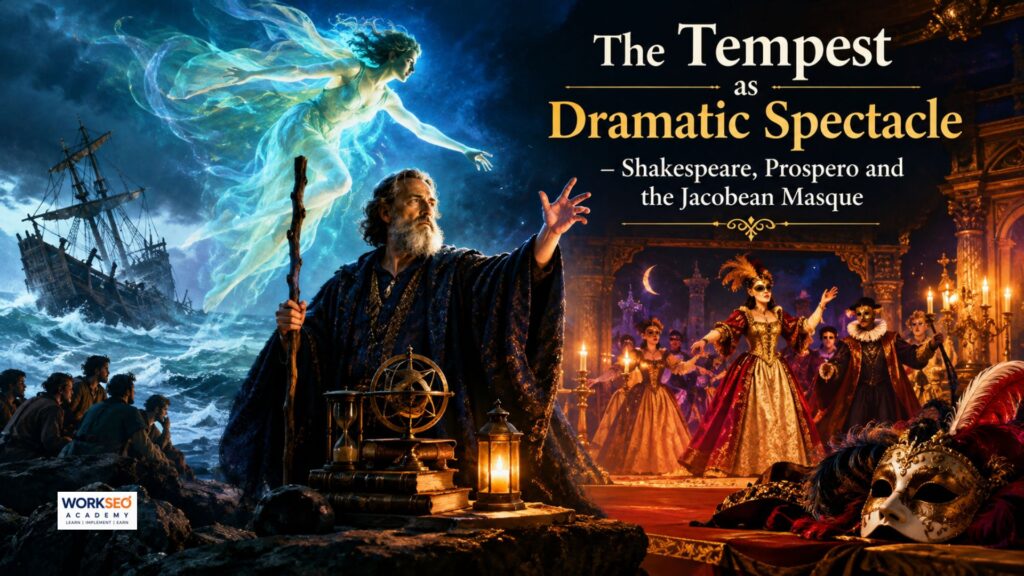
William Shakespeare’s The Tempest is one of the most unusual plays in the Shakespearean canon. Written around 1610–1611 and first recorded in performance at the Jacobean court on 1 November 1611, the play combines romance, comedy, political conflict, magic, music, masque, spectacle and philosophical reflection. It was first printed in the 1623 First Folio.
The description of The Tempest as “dramatic spectacle rather than drama proper” draws attention to its extraordinary dependence on visual effects, music, magical transformations, symbolic pageantry and theatrical illusion. The opening storm, Ariel’s supernatural appearances, the disappearing banquet, the harpy scene and the masque in Act IV all make spectacle central to the play’s dramatic method.
Yet this description should not be taken to mean that The Tempest lacks dramatic structure. On the contrary, Shakespeare carefully organizes its conflicts around Prospero’s loss of political power, his control of the island, the relationship between Miranda and Ferdinand, the conspiracies of Antonio and Sebastian, and the eventual movement from revenge towards reconciliation.
Thus, the most productive critical approach is to see The Tempest as a drama that deliberately incorporates the techniques of spectacle and masque into its dramatic structure.
The Tempest as Dramatic Spectacle Rather Than Drama Proper
What Does “Dramatic Spectacle” Mean?
In literary criticism, spectacle refers to the visual and theatrical dimension of drama: scenery, costumes, music, movement, special effects, supernatural appearances and stage pictures.
“Drama proper,” in contrast, may be understood primarily through:
- conflict between characters,
- dialogue,
- action,
- character development,
- psychological tension,
- causality and plot.
The Tempest contains all these elements, but spectacle is unusually prominent.
The Royal Shakespeare Company notes that the play requires music, appropriate costumes, props and visual effects. Its opening stage direction famously calls for “a tempestuous noise of thunder and lightning.”
Therefore, Shakespeare’s dramatic world is constructed not merely through speech but through sound, movement, illusion and visual transformation.
Historical Background: The Jacobean Theatre and Court Spectacle
The play belongs to the early Jacobean period. Its probable composition around 1610–1611 coincided with a theatrical culture increasingly interested in courtly spectacle and masque. The play’s first recorded performance took place before King James I at Whitehall in 1611.
The masque was a form of court entertainment combining:
- music,
- dance,
- poetry,
- elaborate costumes,
- scenery,
- allegorical figures,
- visual effects.
Ben Jonson was a major practitioner of the Jacobean masque, while designers such as Inigo Jones developed increasingly elaborate theatrical environments.
This cultural context is important because The Tempest incorporates several features associated with the masque tradition. Scholarship has therefore examined the relationship between Shakespeare’s play and the Jacobean court masque.
Major Features That Make The Tempest a Dramatic Spectacle
1. The Opening Tempest
The first scene immediately establishes spectacle.
The audience encounters:
- thunder,
- lightning,
- a ship in danger,
- sailors shouting,
- aristocratic passengers in panic,
- apparent destruction.
The play begins not with a conventional exposition but with an extraordinary theatrical event.
This is significant because the storm is simultaneously physical and symbolic. It creates the circumstances that bring Prospero’s enemies onto the island.
Thus, spectacle performs a narrative function.
2. Prospero as Director and Magician
Prospero is perhaps the clearest link between drama and spectacle.
He controls:
- Ariel,
- music,
- supernatural spirits,
- visual illusions,
- the movements of the shipwrecked characters,
- the masque,
- the final revelation.
In this sense, Prospero resembles a stage director within the play.
His magical art enables him to create experiences for other characters just as a playwright or director creates experiences for an audience.
This produces an important metatheatrical dimension: the play becomes partly about the power of performance itself.
Modern scholarship has consequently connected Prospero’s magic with questions about theatrical power, artistic control and the relationship between performer and audience.
Ariel, Music and the Theatre of Enchantment
Ariel is central to the spectacular character of the play.
Ariel appears in different forms and performs supernatural tasks for Prospero. Music is particularly important because it repeatedly influences the characters’ perceptions and movements.
The island is therefore experienced through:
- strange sounds,
- songs,
- supernatural voices,
- invisible music,
- magical transformations.
The effect is not merely decorative. Music becomes a method of dramatic control.
Ariel’s songs also create an atmosphere of mystery and uncertainty. The audience, like the characters, is encouraged to question the boundary between reality and illusion.
The Harpy Scene and the Disappearing Banquet
Act III provides one of the clearest examples of Shakespeare’s use of spectacle.
Alonso and his companions encounter a banquet. The food suddenly disappears, and Ariel appears as a harpy who confronts them with their past crime against Prospero.
Barbara Mowat of the Folger Shakespeare Library identifies the scene as a major theatrical fantasy involving dancing figures, a disappearing banquet and the appearance of a supernatural monster.
The spectacle has a moral purpose.
It transforms Prospero’s desire for revenge into a theatrical trial.
The characters are forced to confront guilt through an experience that resembles a supernatural vision.
Act IV: The Masque as the Height of Spectacle
The most important evidence for the argument that The Tempest is a dramatic spectacle is the masque in Act IV.
Prospero arranges an elaborate performance to celebrate the betrothal of Ferdinand and Miranda.
Ariel and other spirits assume mythological roles, including:
- Iris,
- Ceres,
- Juno.
The scene combines:
- poetry,
- music,
- dance,
- mythology,
- costumes,
- supernatural figures,
- visual pageantry.
The masque is therefore almost a complete theatrical performance within the larger play.
Scholarship has particularly emphasized the connection between The Tempest and the Jacobean masque tradition.
Why Does Shakespeare Use a Masque?
The masque is not simply entertainment.
It represents harmony, fertility, marriage and social order.
Ferdinand and Miranda’s union symbolically offers the possibility of reconciliation between political communities.
However, Prospero abruptly interrupts the performance when he remembers Caliban’s conspiracy.
This interruption is critically important.
It reminds the audience that illusion cannot permanently replace reality.
The beautiful spectacle of the masque is interrupted by the practical problem of political disorder.
Theatrical Illusion and Reality
One of the central ideas of The Tempest is the unstable boundary between appearance and reality.
Prospero creates illusions, but he also eventually recognizes their temporary nature.
The play repeatedly asks:
What is real, and what is theatrical illusion?
The shipwreck itself is a spectacle created through Prospero’s art.
The banquet is an illusion.
The harpy is an illusion.
The masque is an illusion.
The spirits are theatrical performers.
Consequently, The Tempest can be read as a play about theatre itself.
Stephen Orgel’s scholarship, discussed by the Folger Shakespeare Library, connects Prospero’s masque with Renaissance ideas about political power and the ruler who creates the spectacle.
Does Spectacle Weaken the Drama?
The argument that The Tempest is “spectacle rather than drama proper” can be interpreted as a criticism.
A traditional drama may depend heavily upon sustained psychological conflict and realistic character development. The Tempest, however, often moves rapidly from one symbolic event to another.
Its characters can sometimes appear less psychologically elaborate than characters such as Hamlet, Macbeth or King Lear.
For example:
- Prospero is primarily constructed around power, memory, magic and forgiveness.
- Ariel functions partly as a supernatural theatrical agent.
- Caliban has both dramatic and symbolic dimensions.
- Miranda represents innocence and renewal.
- Ferdinand participates in the romance structure.
This does not necessarily make the play dramatically weak. Rather, Shakespeare uses symbolic and theatrical characterization instead of relying entirely on psychological realism.
The Unity of Time, Place and Action
Another important point is that The Tempest is unusually concentrated in structure.
The action takes place on one island and unfolds within roughly a single day. The different plots are interconnected around Prospero’s plan. Oxford Bibliographies notes the play’s unusually close relationship to the classical dramatic unities of time, place and action.
This structural concentration actually strengthens its theatrical quality.
Instead of presenting a large historical world, Shakespeare creates a controlled theatrical universe.
The island becomes almost like a stage.
Prospero controls the action as a director controls performers.
Major Themes Connected with Spectacle
| Theme | Connection with Spectacle |
|---|---|
| Magic | Produces illusions and supernatural performances |
| Power | Prospero controls both people and theatrical events |
| Revenge | Characters are confronted through staged experiences |
| Forgiveness | Spectacle eventually leads towards reconciliation |
| Appearance and reality | Illusions constantly challenge perception |
| Colonial power | Prospero’s control of the island raises questions about authority and possession |
| Art and theatre | Prospero’s magic resembles theatrical creation |
| Love | Ferdinand and Miranda’s relationship is celebrated through the masque |
| Mortality | The temporary nature of spectacle reflects the transience of human experience |
The Tempest as Metatheatre
Metatheatre means drama that draws attention to its own theatrical nature.
The Tempest is strongly metatheatrical because Prospero behaves like a playwright, director and stage magician.
He:
- creates a situation,
- controls performers,
- manipulates spectators,
- produces illusions,
- stages moral confrontations,
- ends the performance by giving up his magical art.
This makes the play a reflection on the nature and limits of artistic power.
Recent scholarship has also examined The Tempest as an exploration of anxieties about theatrical power, music and the ability of artists to influence audiences.
Spectacle and the Final Renunciation of Magic
The ending gives the spectacle a philosophical meaning.
Prospero eventually decides to abandon his magical powers.
This can be interpreted as a movement:
Magic → Theatre → Illusion → Recognition → Renunciation
The artist who has controlled everyone through spectacle ultimately chooses to relinquish that control.
This is why the spectacular quality of The Tempest cannot be separated from its moral structure.
The spectacle is not an end in itself. It becomes a means of exploring power, art, illusion, forgiveness and human freedom.
Critical Interpretation: Spectacle and Drama Are Not Opposites
The phrase “dramatic spectacle rather than drama proper” is useful if treated critically rather than literally.
The Tempest certainly contains spectacular elements, but these elements perform dramatic functions.
| Spectacular Element | Dramatic Function |
|---|---|
| Storm | Brings characters together |
| Music | Controls mood and movement |
| Ariel’s appearances | Creates supernatural tension |
| Banquet | Confronts characters with guilt |
| Harpy | Converts moral conflict into theatrical vision |
| Masque | Represents harmony and marriage |
| Magical disappearance | Reinforces illusion/reality theme |
| Prospero’s art | Structures the entire dramatic action |
Therefore, spectacle and drama are integrated rather than mutually exclusive.
Why This Topic Matters for UPSC
This topic is particularly useful for UPSC English Literature because it connects textual analysis with dramatic theory, Renaissance theatre and Shakespearean criticism.
For UPSC preparation, students should understand:
- Shakespeare’s dramatic technique.
- The Jacobean masque tradition.
- The role of spectacle in Renaissance theatre.
- Prospero as magician and theatrical controller.
- The relationship between magic and art.
- Metatheatre and self-conscious drama.
- Symbolism of the island.
- The significance of music and supernatural performance.
- The masque as a structural and thematic device.
- The movement from revenge towards forgiveness.
It also develops skills useful for Mains answer writing and Essay preparation, particularly the ability to connect literary form with meaning.
UPSC Mains Answer Writing Approach
10-Mark Answer
Introduction: Define the idea of dramatic spectacle and introduce The Tempest.
Main points:
- Opening storm and theatrical effects.
- Prospero’s magical control.
- Ariel, music and supernatural spectacle.
- The masque and visual pageantry.
Example: Act IV masque.
Conclusion: Spectacle strengthens rather than completely replaces dramatic action.
Model Framework
Question: “The Tempest is more remarkable for spectacle than conventional dramatic action.” Discuss.
A strong answer can argue that Shakespeare gives unusual prominence to magic, music, supernatural effects and masque. However, these spectacles advance the plot and reveal themes such as power, guilt, forgiveness and illusion. Therefore, the play is better understood as a drama that deliberately incorporates spectacular theatrical forms.
15-Mark Answer
Structure the answer through:
- Renaissance/Jacobean theatrical context.
- Opening tempest.
- Prospero as theatrical controller.
- Ariel and music.
- Harpy and disappearing banquet.
- Act IV masque.
- Metatheatre.
- Relationship between spectacle and plot.
- Balanced critical conclusion.
Use textual examples rather than merely describing the plot.
20-Mark Answer
A comprehensive answer should examine The Tempest through several dimensions:
- Historical: Jacobean theatre and court masque.
- Dramatic: concentrated action and unity.
- Theatrical: music, costumes and visual effects.
- Symbolic: spectacle as representation of power and illusion.
- Metatheatrical: Prospero as dramatist/director.
- Political: spectacle and authority.
- Philosophical: illusion, mortality and renunciation.
- Critical: whether spectacle supplements or displaces conventional dramatic action.
The conclusion should avoid treating “spectacle” and “drama” as mutually exclusive categories.
UPSC Prelims Quick Revision
- Author: William Shakespeare
- Work: The Tempest
- Probable composition: 1610–1611
- First recorded performance: 1 November 1611
- First printed: First Folio, 1623
- Company: King’s Men
- Central character: Prospero
- Island spirit: Ariel
- Important figure: Caliban
- Major device: Masque
- Major themes: Magic, power, revenge, forgiveness, illusion and reconciliation
- Important dramatic feature: Unity of time, place and action
- Key literary concept: Metatheatre
- Important theatrical feature: Music and spectacle
- Act IV: Famous masque celebrating Ferdinand and Miranda’s betrothal
5 Likely UPSC-Style Questions
- What is meant by dramatic spectacle? Examine its significance in Shakespeare’s The Tempest.
- “Prospero is both a character and a theatrical director within The Tempest.” Discuss.
- Analyse the role of the masque in Act IV of The Tempest. How does it contribute to the play’s themes?
- Discuss the relationship between illusion and reality in Shakespeare’s The Tempest.
- “The spectacular elements of The Tempest are integral to its dramatic structure rather than merely decorative.” Critically examine.
Frequently Asked Questions
1. What is meant by The Tempest as dramatic spectacle?
It means that the play gives exceptional importance to visual effects, music, supernatural appearances, magic, masque, costumes and theatrical illusion. These elements are central to its dramatic structure.
2. Why is The Tempest associated with the Jacobean masque?
The play incorporates music, dance, mythological figures, spectacle and ceremonial celebration, particularly in the Act IV masque. These features connect it with the theatrical culture of the Jacobean court.
3. How is Prospero connected with the idea of theatre?
Prospero controls performers, creates illusions, stages experiences for other characters and ultimately ends his magical performance. His role therefore resembles that of a playwright or director.
4. What is the importance of the masque in The Tempest?
The masque celebrates Ferdinand and Miranda’s union and symbolises harmony, fertility and social reconciliation. Its interruption also reminds the audience that theatrical illusion cannot permanently eliminate real-world conflict.
5. Is The Tempest really more spectacle than drama?
It contains an unusually high level of spectacle, but spectacle does not replace dramatic action. Storms, music, supernatural performances and the masque all contribute to plot, characterization and themes. It is therefore more accurate to regard The Tempest as a drama deeply shaped by spectacle.
Conclusion
The Tempest occupies a distinctive position in Shakespeare’s dramatic achievement because it brings drama, spectacle, masque, music and magic into a highly concentrated theatrical structure. Its storms, supernatural appearances, disappearing banquet and Act IV masque make visual and aural experience central to the play.
However, calling it merely “spectacle rather than drama proper” can be misleading. The spectacle advances the plot, exposes guilt, expresses political power, creates emotional transformation and develops the central opposition between illusion and reality.
For UPSC English Literature students, the most effective interpretation is therefore to understand The Tempest as a self-conscious drama in which spectacle becomes one of Shakespeare’s principal dramatic instruments.