
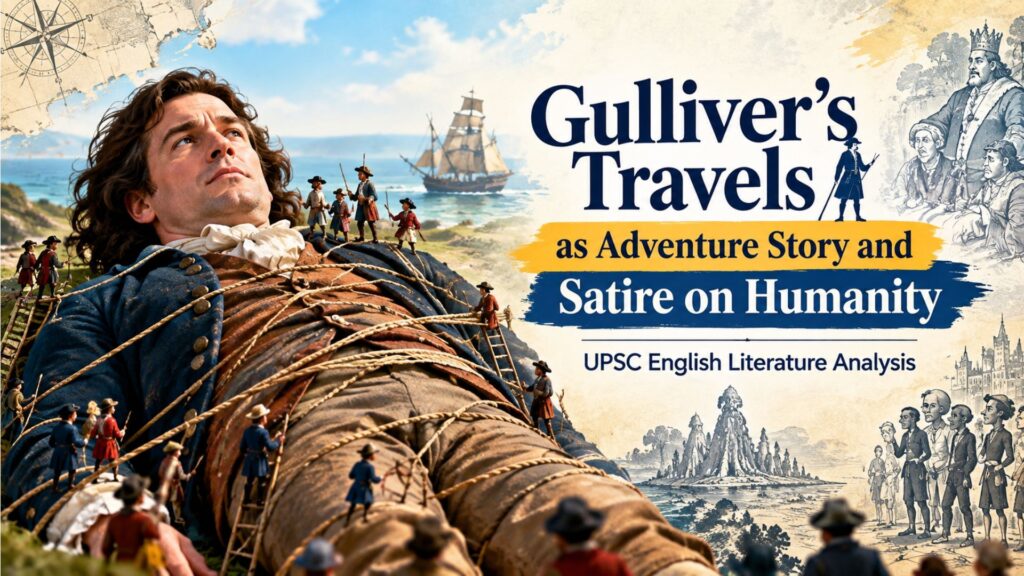
Jonathan Swift’s Gulliver’s Travels (1726) is one of the most complex works of English prose fiction because it can be read at several levels. At the surface level, it is an imaginative adventure narrative involving strange lands, unusual inhabitants, giants, miniature people, flying islands, and intelligent horses. These fantastic elements make the work attractive to young readers.
At a deeper level, however, Swift uses Gulliver’s journeys as a powerful instrument of satire. Through imaginary societies, he exposes political corruption, human pride, war, greed, irrationality, false ideas of progress, and the limitations of human reason.
The statement that Gulliver’s Travels is “a very attractive adventure story for children and a pungent critique of humanity addressed to the adult” therefore captures the fundamental duality of the work. Its fantasy attracts the child, while its satire challenges the adult reader.
The Dual Nature of Gulliver’s Travels
The most important feature of Swift’s work is its double structure.
As an adventure story, the novel offers:
- voyages to unknown lands,
- encounters with strange civilizations,
- giants and miniature people,
- dangerous situations,
- humour and fantasy,
- geographical discovery and exploration.
As a satire, however, these imaginary experiences become a means of examining human civilization.
Swift does not simply invent strange societies for entertainment. He uses them as mirrors through which readers can examine their own society.
Thus, the novel’s fantasy is not separate from its satire. Adventure becomes the method through which Swift delivers social and moral criticism.
Lilliput: Satire Through Miniature Humanity
The first voyage to Lilliput is probably the most immediately attractive part of the novel for younger readers. Gulliver finds himself among people who are only a few inches tall. The reversal of normal human proportions creates humour and wonder.
For an adult reader, however, Lilliput becomes a political satire.
The Lilliputians are physically tiny, but their ambitions, rivalries and political passions are enormous. Swift deliberately creates this contrast to expose human pride.
Their political disputes often concern trivial matters. The conflict between the Big-Endians and Little-Endians, for example, originates in a disagreement over which end of an egg should be broken.
The absurdity of this conflict reflects Swift’s criticism of political and religious disputes that become serious despite having seemingly insignificant origins.
The Lilliputian court also contains rivalry, ambition and competition for royal favour. Political advancement depends not necessarily on wisdom or moral virtue but on pleasing those in power.
Therefore, the miniature world provides entertainment for the child while offering the adult a satirical representation of political society.
Brobdingnag: Human Civilization Seen from Another Perspective
In the second voyage, Swift reverses the situation. Gulliver, who appeared enormous in Lilliput, becomes tiny among the giants of Brobdingnag.
This change of physical scale produces an important change in perspective.
Gulliver proudly describes European civilization to the King of Brobdingnag, including its political institutions, military power and weapons. Instead of admiring these achievements, the King views many of them with moral suspicion.
The episode forces readers to reconsider what Europeans call civilization.
Swift particularly questions the glorification of warfare. The development of powerful weapons may demonstrate technological ability, but it does not necessarily demonstrate moral progress.
The contrast between Gulliver’s admiration for European power and the King’s response creates irony. The reader is encouraged to ask whether human beings are truly civilized simply because they possess advanced political and military institutions.
Laputa: Criticism of Knowledge Without Practical Wisdom
The third voyage introduces another dimension of Swift’s satire.
Gulliver encounters Laputa, a floating island inhabited by people deeply interested in mathematics, music, science and abstract intellectual pursuits.
Swift’s target here is not knowledge itself. Rather, he questions intellectual activity that becomes disconnected from practical human needs.
Some of the experiments and projects described in the voyage are absurd because their creators fail to consider ordinary reality.
This creates another important theme: knowledge without judgment can become useless or even ridiculous.
For young readers, Laputa provides another strange and imaginative world. For adult readers, it raises questions about the relationship between scientific knowledge, practical wisdom and human welfare.
The Houyhnhnms and the Yahoos: The Deepest Critique of Humanity
The fourth voyage provides the most serious and disturbing part of the novel.
Gulliver encounters the Houyhnhnms, intelligent horses who appear to live according to reason. In contrast, the Yahoos are human-like creatures dominated by greed, violence, jealousy and selfish desire.
The contrast forces Gulliver to reconsider his understanding of humanity.
Human beings generally consider themselves rational and superior to animals. Swift reverses this assumption. The supposedly rational human being is represented through the Yahoos, while the horses display qualities associated with reason and order.
The question becomes uncomfortable:
Are human beings genuinely rational, or do they merely use reason to justify their desires and ambitions?
This is where the novel moves far beyond children’s adventure literature. Swift is questioning the very idea of human superiority.
The fourth voyage therefore represents the strongest expression of the work’s critique of humanity.
Satire on Human Pride
Human pride is one of the central themes running throughout Gulliver’s Travels.
Swift repeatedly changes Gulliver’s physical position to challenge his sense of superiority.
In Lilliput, Gulliver is a giant.
In Brobdingnag, he becomes a tiny creature.
Among the Houyhnhnms, he is forced to confront the possibility that human beings may possess serious moral weaknesses.
These changes of scale are not merely imaginative tricks. They create a shifting perspective from which human pride can be examined.
Swift suggests that people often consider themselves powerful, rational and important because they judge the world only from their own limited perspective.
Satire on War and Political Conflict
War is another major target of Swift’s criticism.
The novel repeatedly shows how political institutions can transform relatively minor disagreements into serious conflicts.
The absurd disputes of Lilliput demonstrate the irrationality of political rivalry. The discussion of military weapons in Brobdingnag further questions the idea that military strength is necessarily a sign of civilization.
Swift’s treatment of war is therefore ironic. Humans claim to be rational creatures, yet they repeatedly use their intelligence to develop more effective ways of destroying one another.
The satire becomes especially powerful because Swift does not simply preach against war. He makes the reader see its absurdity through fictional situations.
Swift’s Use of Irony and Inversion
Swift’s satire depends heavily on literary techniques.
Irony
Swift frequently says or presents something in a way that encourages the reader to recognize a deeper meaning. Gulliver’s admiration for certain aspects of European society can become ironic because the reader gradually sees their weaknesses.
Inversion
Swift reverses familiar relationships.
The tiny Lilliputians possess enormous political ambitions. Gulliver becomes a tiny person in Brobdingnag. Horses appear more rational than humans.
These reversals force the reader to look at ordinary human assumptions from a new perspective.
Exaggeration
Swift exaggerates physical size, political disputes, scientific experiments and human behaviour. The exaggeration produces humour but also reveals the underlying weakness.
Contrast
The contrast between Lilliput and Brobdingnag, and especially between Houyhnhnms and Yahoos, provides the novel with much of its intellectual power.
Why Is It Attractive to Children?
Despite its serious satire, Gulliver’s Travels remains attractive to young readers because its imaginative elements can be enjoyed independently of the deeper meaning.
Children can enjoy:
- Gulliver becoming a giant among tiny people.
- Gulliver becoming tiny among giants.
- Strange islands and unfamiliar civilizations.
- Fantastic creatures.
- Dangerous voyages and unexpected discoveries.
- Humorous situations created by differences in size and culture.
The narrative therefore works successfully as an adventure story even when the reader does not fully understand Swift’s political and philosophical criticism.
This accessibility is one reason the work has remained popular across generations.
Why Is It a Critique Addressed to Adults?
The adult reader encounters a very different book.
The imaginary worlds become political and social mirrors.
Lilliput raises questions about political ambition and trivial disputes.
Brobdingnag challenges assumptions about European civilization and warfare.
Laputa questions intellectual activity without practical wisdom.
The Houyhnhnms and Yahoos challenge the assumption that humans are naturally rational and morally superior.
The adult reader therefore has to move beyond the literal events of the voyages and interpret their symbolic and satirical significance.
Gulliver as an Unreliable Observer
Gulliver’s role is also significant to the interpretation of the novel.
He presents himself as a rational observer who reports what he sees. However, his judgments are not always completely reliable.
His experiences gradually alter his understanding of humanity. By the end of the fourth voyage, his attitude toward humans becomes extremely negative.
This development creates an important interpretive question: Is Swift presenting Gulliver’s final view as completely correct, or is he also showing the dangers of adopting an extreme perspective?
This ambiguity contributes to the complexity of the novel and prevents it from being reduced to a simple moral lesson.
The Significance of the Title and the Travel Form
The travel narrative itself is central to Swift’s method.
A traveller encounters unfamiliar cultures and compares them with his own. Swift uses this structure to make European society appear strange when viewed from outside.
The technique creates defamiliarization: ordinary institutions and behaviours become strange because they are examined from an unfamiliar perspective.
Consequently, the reader is encouraged to question things that are normally accepted without thought.
The travel form therefore serves both the adventure dimension and the satirical dimension of the novel.
Conclusion
Gulliver’s Travels succeeds because it combines two apparently different literary functions within a single work. Its fantastic voyages, strange societies and extraordinary characters make it an engaging adventure story that can attract children. At the same time, its irony, exaggeration, inversion and social criticism make it a sophisticated satire aimed at mature readers.
Swift uses Lilliput to expose political pettiness and human pride, Brobdingnag to question European civilization and warfare, Laputa to examine knowledge without practical wisdom, and the Houyhnhnms and Yahoos to challenge the assumption of human rationality and superiority.
Thus, the adventure is not merely decorative. It is the vehicle of the satire.
The child can read Gulliver’s Travels as a story of extraordinary journeys; the adult is invited to see those journeys as a disturbing examination of human civilization. This duality explains the enduring significance of Swift’s work and makes the novel an important example of how fantasy can be used to deliver serious social, political and philosophical criticism.