
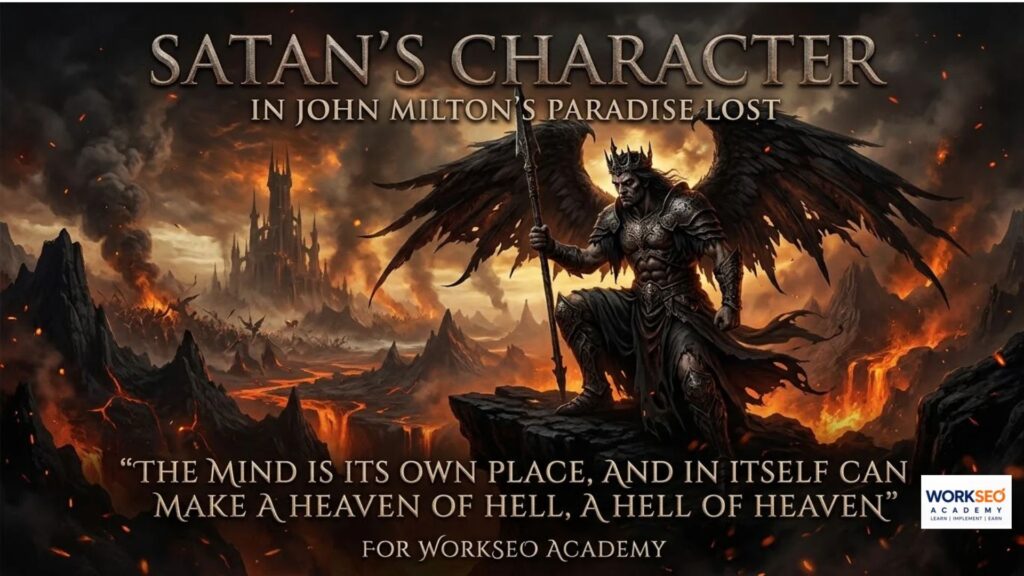
John Milton’s Paradise Lost is one of the greatest works of English epic poetry. Published in 1667, the poem explores the biblical story of the Fall of Man, the rebellion of Satan, and the loss of Paradise. Among its many literary achievements, Milton’s portrayal of Satan remains one of the most debated subjects in English literature.
The famous statement, “The mind is its own place, and in itself / Can make a Heav’n of Hell, a Hell of Heav’n,” appears in Book I. Through these words, Satan presents himself as a powerful individual who believes that the human-like mind can determine its own experience regardless of external circumstances.
However, Milton’s Satan is more complex than a straightforward symbol of rebellion. He displays ambition, pride, courage, persuasive ability, self-deception and moral corruption. His character raises important questions about free will, authority, ambition and the consequences of excessive pride.
For UPSC English Literature aspirants, understanding Satan is essential for analysing Milton’s epic structure, characterisation, imagery, political and religious ideas, and poetic techniques. This article examines Satan’s character through important episodes, literary interpretations and an examination-oriented approach.
Satan's Character in Paradise Lost
1. Historical and Literary Background
John Milton (1608–1674) was an English poet, political thinker and prose writer associated with the seventeenth-century Puritan intellectual tradition.
Paradise Lost was first published in 1667 in ten books. Its revised edition appeared in 1674 in twelve books.
Milton draws upon the biblical account of the Fall in Genesis, classical epic traditions and Christian theological ideas.
The central purpose of the poem is expressed in its opening lines: Milton seeks to justify the ways of God to humanity.
Satan’s rebellion provides the background for the poem’s exploration of obedience, free will, temptation and moral responsibility.
2. Meaning of "The Mind Is Its Own Place"
The statement appears in Book I, when Satan speaks to Beelzebub after their defeat and expulsion from Heaven.
Satan argues that the mind possesses the power to transform its surroundings psychologically. According to his claim, even Hell can become like Heaven if an individual maintains independence and determination.
The statement reveals three important aspects of his character:
Mental independence: Satan refuses to accept defeat as the end of his existence.
Pride and ambition: He believes that ruling in Hell is preferable to serving in Heaven.
Self-deception: He attempts to convince himself that his punishment has not destroyed his freedom.
The statement initially sounds inspiring because it emphasises mental strength. However, its deeper meaning becomes problematic when considered alongside Satan’s selfish ambition and refusal to accept moral responsibility.
Milton therefore creates a distinction between genuine freedom and the false freedom produced by pride.
3. Major Characteristics of Satan
A. Pride and Ambition
Pride is the fundamental weakness behind Satan’s rebellion.
Satan refuses to accept the authority of God and attempts to establish himself as an independent ruler. His ambition eventually results in his expulsion from Heaven.
His famous declaration, “Better to reign in Hell, than serve in Heav’n,” expresses his preference for personal authority over obedience.
However, his ambition is not a demonstration of genuine freedom. It becomes an obsession with power and superiority.
B. Courage and Leadership
At the beginning of Book I, Satan appears physically and psychologically powerful despite his defeat.
He encourages the fallen angels, organises their forces and inspires them to continue their resistance.
His leadership qualities include:
Confidence in difficult circumstances.
Ability to influence followers.
Strategic thinking.
Powerful public speaking.
Determination to continue struggling.
Nevertheless, Milton presents these qualities with moral complexity. Leadership and courage do not automatically make an individual virtuous.
C. Persuasive Speech and Rhetorical Ability
Satan is an exceptionally persuasive speaker.
His speeches in Books I and II demonstrate his ability to influence the fallen angels. He presents rebellion as a struggle for independence and attempts to transform defeat into an opportunity for renewed action.
His rhetorical ability is important because he frequently uses language to conceal selfish motives.
This introduces the theme of political manipulation: a leader can use attractive language to justify morally questionable actions.
D. Self-Deception and Internal Conflict
Satan’s character becomes more psychologically complex in Book IV.
While observing the beauty of Paradise, he experiences regret and recognises the possibility of repentance. However, his pride prevents him from accepting responsibility.
His internal conflict reveals that he understands the difference between good and evil but deliberately continues choosing evil.
This is an important development in his character. He is not simply an ignorant opponent of divine authority; he is conscious of his moral condition.
E. Jealousy and Revenge
Satan’s hostility increases when he learns about humanity and God’s favour towards Adam and Eve.
Instead of accepting the existence of a new creation, he develops jealousy and seeks revenge.
His decision to corrupt humanity demonstrates how personal resentment can become destructive when combined with ambition and hatred.
F. Moral Corruption
In Book IX, Satan enters the Garden of Eden in the form of a serpent and tempts Eve.
This episode reveals the transformation of Satan from a rebellious leader into a deceiver.
His earlier claims of courage and independence are contrasted with his use of disguise and manipulation.
His character therefore demonstrates how pride can gradually develop into dishonesty, cruelty and moral degradation.
4. Satan's Character Development Across the Epic
Satan’s character does not remain static throughout Paradise Lost.
| Book | Character development |
|---|---|
| Book I | Appears as a powerful rebel and leader of fallen angels. |
| Book II | Uses persuasive speeches and political strategy to organise rebellion. |
| Book III | Continues his journey towards humanity’s new world. |
| Book IV | Experiences internal conflict, regret and renewed determination to resist God. |
| Book IX | Tempts Eve through deception and contributes to humanity’s Fall. |
| Book X | Faces the consequences of his actions and undergoes degradation. |
This development is important because the reader gradually discovers the difference between Satan’s impressive public personality and his inner moral condition.
5. Important Literary Themes Associated with Satan
Free Will and Responsibility
Milton’s poem explores the relationship between freedom and moral responsibility.
Satan exercises his freedom by choosing rebellion. However, his choices bring destructive consequences.
Milton suggests that freedom without moral understanding can become self-destruction.
Pride and the Abuse of Power
Satan’s rebellion demonstrates the destructive effects of excessive pride.
His desire for equality with divine authority reflects an ambition that cannot recognise legitimate limits.
Good and Evil
The contrast between Heaven and Hell provides the poem’s central moral framework.
Satan’s actions demonstrate that evil may initially appear attractive through persuasive language, confidence and apparent strength.
Appearance and Reality
Satan frequently presents himself as a defender of freedom. However, his actual behaviour reveals manipulation and selfishness.
This difference between appearance and reality is central to understanding his character.
6. Literary Techniques Used in Satan's Characterisation
Milton uses several poetic techniques to develop Satan’s personality.
Epic Simile: Extended comparisons give Satan an extraordinary physical and imaginative presence. For example, his enormous size is compared to legendary sea creatures in Book I.
Blank Verse: Milton uses unrhymed iambic pentameter, giving the epic flexibility, dignity and dramatic force.
Soliloquy: Satan’s speech in Book IV reveals his internal conflict and allows readers to examine his psychological condition.
Irony: Satan believes that he can achieve freedom through rebellion, but his actions increasingly make him a prisoner of his own hatred and ambition.
Imagery: Images of darkness, fire, chains and the infernal landscape reinforce the moral and psychological atmosphere surrounding Satan.
7. Is Satan the Hero of Paradise Lost?
One of the most important critical debates surrounding Paradise Lost concerns Satan’s heroic status.
Some readers find Satan heroic because of his courage, determination, leadership and resistance to authority.
The Romantic writers William Blake and Percy Bysshe Shelley contributed to the influential tradition of interpreting Milton’s Satan as a powerful figure of rebellion. Their responses, however, should not be treated as proof that Milton intended Satan to be the poem’s moral hero.
An opposing interpretation considers Satan a false hero. His pride, deception, jealousy and destructive actions undermine his apparent greatness.
A balanced reading recognises that Milton gives Satan considerable dramatic power while also exposing the moral weakness behind his rebellion.
The character’s complexity is precisely what makes him an enduring subject of literary criticism.
Why This Topic Matters for UPSC
Understanding Satan’s character develops several important skills for UPSC aspirants.
UPSC English Literature: The topic supports the study of Milton’s epic poetry, characterisation, blank verse, Christian humanism, symbolism and literary criticism.
UPSC Mains: The themes of ambition, leadership, freedom, responsibility and moral choices can provide useful perspectives for analytical discussions.
Essay Writing: Satan’s character offers literary examples for essays concerning power, individual freedom, ego, leadership and the consequences of uncontrolled ambition.
Reading Comprehension: Analysing Milton’s language helps students understand complex sentences, metaphors, irony and rhetorical techniques.
Vocabulary Development: Important literary terms such as soliloquy, epic simile, blank verse, allegory and characterisation improve academic expression.
The greatest examination benefit comes from learning to distinguish a character’s words from the author’s larger moral and literary design.
UPSC Mains Answer Writing Approach
A good answer on Satan’s character should combine textual evidence, literary analysis and a balanced critical interpretation.
10-Mark Answer Framework
Introduction: Introduce Milton’s Paradise Lost and Satan as its central dramatic character.
Major points:
Satan’s pride and ambition.
His leadership and persuasive speeches.
His psychological conflict and moral decline.
Example: Refer to the statement “Better to reign in Hell, than serve in Heav’n” from Book I.
Conclusion: Explain that Satan’s apparent heroism is complicated by his moral corruption.
15-Mark Answer Framework
Introduction: Explain the significance of Satan in Milton’s Christian epic.
Context: Briefly discuss the biblical background and seventeenth-century religious context.
Analytical dimensions:
Rebellion against divine authority.
Pride and the desire for power.
Rhetorical skill and leadership.
Internal conflict in Book IV.
Deception and moral degradation in Book IX.
Literary evidence: Include short, accurate references to relevant episodes and speeches.
Conclusion: Present Satan as a psychologically complex but morally flawed character.
20-Mark Answer Framework
For a longer answer, develop the following dimensions:
Historical and theological background of Paradise Lost.
Satan’s development as a tragic and rebellious figure.
The relationship between free will, pride and responsibility.
Milton’s use of blank verse, epic similes and soliloquies.
Romantic interpretations and the false-hero debate.
The distinction between Satan’s self-presentation and his actual moral condition.
Balanced conclusion: Satan’s dramatic power makes him fascinating, but his progressive moral degradation challenges the interpretation of him as a genuine epic hero.
Model Answer Framework
Question: Discuss the character of Satan in Milton’s Paradise Lost.
John Milton’s Paradise Lost presents Satan as a complex character whose rebellion against divine authority forms an important part of the epic’s narrative. In Book I, Satan emerges as a confident leader who refuses to accept defeat. His declaration, “Better to reign in Hell, than serve in Heav’n,” expresses his pride and ambition.
His leadership, courage and rhetorical ability initially create an impression of heroism. However, Book IV reveals his internal conflict, while Book IX demonstrates his transformation into a deceptive tempter. His character exposes the destructive consequences of pride, jealousy and the misuse of free will.
Although Romantic interpretations have emphasised Satan’s rebellious energy, a balanced reading must consider his moral decline. Milton therefore creates a character whose dramatic greatness is inseparable from his ethical failure.
UPSC Prelims Quick Revision
| Important fact | Answer |
|---|---|
| Author | John Milton |
| Birth and death | 1608–1674 |
| Major work | Paradise Lost |
| First publication | 1667 |
| Revised edition | 1674 |
| First edition structure | 10 books |
| Revised structure | 12 books |
| Literary form | Epic poem |
| Verse form | Blank verse |
| Central subject | The Fall of Man |
| Main biblical source | Book of Genesis |
| Famous statement | “The mind is its own place” |
| Satan’s major weakness | Pride |
| Important literary debate | Satan as hero or false hero |
| Romantic writers associated with the debate | William Blake and Percy Bysshe Shelley |
Important terminology:
Epic: A long narrative poem dealing with significant events and heroic or supernatural characters.
Blank verse: Unrhymed iambic pentameter.
Soliloquy: A speech in which a character expresses private thoughts, usually while alone.
Epic simile: An extended comparison used in epic poetry.
Hamartia: A tragic error or flaw contributing to a character’s downfall.
Rhetoric: The art of persuasive speaking or writing.
5 Likely UPSC-Style Questions
Explain the meaning and literary significance of the statement, “The mind is its own place,” in Milton’s Paradise Lost.
Examine the role of pride and ambition in the characterisation of Satan in Paradise Lost.
Discuss Satan as a complex literary character, with reference to his leadership, rhetoric and psychological conflict.
Critically evaluate the argument that Satan is the true hero of Paradise Lost.
Analyse how Milton uses blank verse, epic similes and soliloquies to develop Satan’s character.
Frequently Asked Questions
1. What does “The mind is its own place” mean in Paradise Lost?
The statement means that the mind can shape its perception of circumstances. Satan believes that he can transform Hell into Heaven through his mental attitude. However, the statement also reveals his pride and self-deception.
2. Why is Satan considered an important character in Paradise Lost?
Satan dominates the opening books and drives much of the poem’s conflict. His character allows Milton to explore rebellion, free will, pride, temptation and moral responsibility.
3. Is Satan the hero or villain of Paradise Lost?
Satan has certain heroic qualities, including courage, leadership and determination. However, his pride, deception and destructive actions make him a morally flawed character. His heroic status remains an important critical debate.
4. What is the significance of Satan’s soliloquy in Book IV?
The soliloquy reveals Satan’s internal conflict. He experiences regret and recognises the possibility of repentance, but his pride prevents him from changing his course.
5. What literary techniques does Milton use to portray Satan?
Milton uses blank verse, epic similes, imagery, irony, persuasive speeches and soliloquies. These techniques reveal Satan’s external power as well as his psychological and moral weaknesses.
Conclusion
Satan is one of the most complex and memorable characters in English epic poetry. In Paradise Lost, Milton presents him as a rebellious leader with extraordinary rhetorical ability, ambition and determination. However, his pride, jealousy and refusal to accept moral responsibility gradually expose his weaknesses.
The statement “The mind is its own place” captures the central contradiction in Satan’s personality: his desire for independence becomes a form of psychological imprisonment.
For UPSC English Literature aspirants, Satan’s character offers an excellent opportunity to study epic conventions, character development, poetic techniques and competing critical interpretations. A balanced understanding requires examining both his apparent heroism and his moral decline.