
Introduction
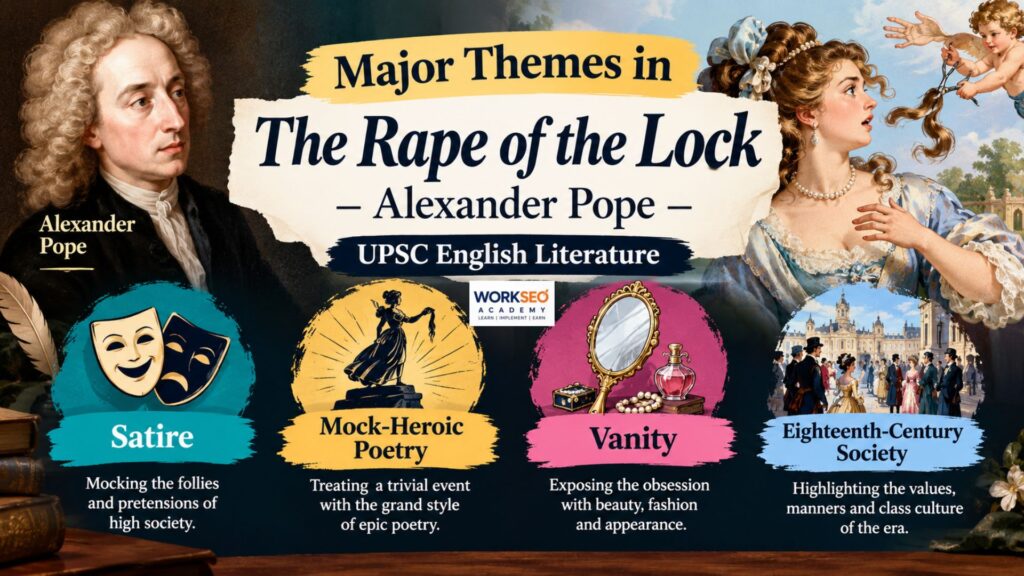
Alexander Pope’s The Rape of the Lock is one of the most important examples of mock-heroic poetry in English literature. Written in the early eighteenth century, the poem transforms a minor social incident—the cutting of a young woman’s lock of hair—into an elaborate epic-like conflict involving aristocratic characters, supernatural beings, battles, rituals, and heroic language.
For UPSC English Literature aspirants, the poem is important not simply because of its story, but because it demonstrates how satire, irony, parody, epic conventions, social criticism, and neoclassical literary principles can operate together in a single poem.
The central theme is not merely the stolen lock. Pope uses the trivial incident to expose the values, vanity, manners, gender relations, and social priorities of eighteenth-century fashionable society. Understanding these themes also helps students analyse Pope as a Neoclassical poet and master of satire.
This article examines the major themes in The Rape of the Lock, along with its historical background, literary techniques, critical significance, and relevance to UPSC preparation.
Historical and Literary Background
Alexander Pope and the Neoclassical Age
Alexander Pope (1688–1744) was one of the leading poets of the English Neoclassical period. Neoclassical writers valued:
- Reason and order
- Balance and proportion
- Classical models
- Wit and intellectual control
- Moral and social criticism
- Clarity and precision of expression
Pope drew heavily upon classical writers such as Homer and Virgil. In The Rape of the Lock, he deliberately imitates the conventions of epic poetry while applying them to an insignificant social quarrel.
The Real Incident Behind the Poem
The poem originated in a real dispute between two aristocratic families after Robert, Lord Petre, cut a lock of hair from Arabella Fermor without her permission.
John Caryll, a friend of both families, asked Pope to write something humorous that might reconcile them. Pope transformed the incident into a sophisticated mock-heroic poem.
The first version appeared in 1712, while the substantially expanded five-canto version was published in 1714.
The historical incident is important because it explains Pope’s central artistic strategy: a trivial social event is treated with the seriousness and grandeur normally associated with epic warfare.
Major Themes in The Rape of the Lock
1. Mock-Heroic Treatment of Triviality
The most important theme is the contrast between serious epic style and trivial subject matter.
Traditional epics deal with subjects such as war, national destiny, heroic struggle, and the fate of civilizations. Pope instead focuses on:
- Fashion
- Beauty
- Social visits
- Card games
- Cosmetics
- Parties
- A lock of hair
The poem deliberately gives these activities epic importance.
The cutting of Belinda’s lock becomes comparable to a heroic conflict. The result is comic, but the comedy also carries criticism: fashionable society appears to have lost its sense of proportion.
Why it matters
The mock-heroic method allows Pope to ask an important social question:
Why does an insignificant personal injury receive the emotional seriousness of a national catastrophe?
Thus, humour becomes a method of social criticism.
2. Satire on Eighteenth-Century High Society
The Rape of the Lock is fundamentally a satirical poem.
Pope does not attack his characters through direct moral preaching. Instead, he exaggerates their behaviour and allows the contrast between their actions and the epic style to expose their superficiality.
The fashionable world of the poem is obsessed with:
- Appearance
- Reputation
- Courtship
- Social status
- Beauty
- Gambling
- Fashion
- Romantic conquest
The poem therefore presents a society in which external appearance often becomes more important than deeper moral values.
Social satire
Pope’s satire is particularly effective because he does not simply say that aristocratic society is foolish. He dramatises its values and allows readers to recognise the absurdity themselves.
3. Vanity and Self-Importance
Belinda represents the culture of fashionable beauty and social display.
Her elaborate preparation before appearing in public is described almost like a religious or heroic ritual. Her dressing table becomes a kind of sacred space, while cosmetics and beauty accessories assume extraordinary importance.
This exaggeration creates comic irony.
Belinda is not simply a vain individual. She represents a larger culture in which appearance, reputation, and social admiration dominate personal identity.
The stolen lock becomes disastrous because it threatens her carefully constructed public image.
4. Appearance versus Reality
Another important theme is the difference between what things appear to be and what they actually are.
The poem’s characters treat social appearances as extremely important. Honour, beauty, reputation, and romantic behaviour are frequently shaped by performance.
Pope’s satire works by exposing the gap between:
Epic appearance → trivial reality
For example, an apparently heroic battle may actually be a quarrel between fashionable young people.
This contrast is central to the poem’s mock-heroic effect.
5. Gender, Courtship and Sexual Politics
The poem also explores the complicated relationship between men and women in aristocratic society.
Belinda’s beauty gives her social power, but the male characters also participate in a culture where women are treated as objects of admiration and conquest.
The “rape” in the title does not refer to sexual assault in the modern meaning of the word. In the poem’s context, it refers to the forcible taking or theft of the lock of hair.
Nevertheless, the poem raises questions about:
- Female autonomy
- Male entitlement
- Courtship
- Reputation
- Sexual politics
- The social value placed upon female beauty
A modern reader should therefore distinguish the historical meaning of the word from its contemporary meaning while still recognising the gender dynamics represented in the poem.
6. Beauty and the Culture of Fashion
Fashion is almost a character in its own right.
Belinda’s beauty is supported by an entire material culture of:
- Cosmetics
- Clothing
- Jewellery
- Hair styling
- Mirrors
- Accessories
Pope presents these objects with exaggerated seriousness.
The theme becomes more than simple criticism of cosmetics. It concerns a society where identity is increasingly constructed through consumption and appearance.
This makes the poem surprisingly useful for discussions of social performance and material culture.
7. Supernatural Machinery
One of Pope’s most distinctive techniques is his use of supernatural beings called sylphs, gnomes, nymphs, and salamanders.
The sylphs especially protect Belinda’s beauty and social reputation.
This supernatural machinery parodies the gods and divine interventions of classical epic poetry.
In Homer and Virgil, gods influence wars and heroic destinies. In Pope, supernatural beings become involved in:
- Hair
- Beauty
- Clothing
- Social behaviour
- Romantic situations
This produces one of the poem’s central comic contrasts:
Grand epic supernatural machinery + trivial social concerns = mock-heroic satire.
8. Religion and Secular Ritual
Pope repeatedly presents ordinary fashionable activities as if they were religious or sacred ceremonies.
Belinda’s dressing ritual, for example, receives almost religious seriousness.
This does not necessarily mean that Pope is simply attacking Christianity. Rather, he creates an ironic contrast between true spiritual seriousness and fashionable society’s exaggerated attention to worldly objects.
The poem therefore contains a recurring theme of false values and misplaced devotion.
9. Conflict and Honour
The poem’s conflict resembles a miniature version of an epic war.
Yet the causes of conflict are remarkably small:
- A lock of hair
- Personal pride
- Social reputation
- Romantic rivalry
The characters behave as though their honour has been catastrophically violated.
Pope uses this disproportion to criticise a culture in which personal pride and social reputation become exaggerated forms of honour.
10. Materialism and Consumer Culture
The poem provides a vivid picture of aristocratic consumption.
Objects associated with luxury and fashion occupy considerable imaginative space. Material possessions contribute to social identity and status.
Pope therefore exposes a society in which people can become emotionally attached to objects, appearance, and social prestige.
This theme connects naturally with the broader Neoclassical concern for reason and moral proportion.
Major Literary Techniques in The Rape of the Lock
| Technique | Function in the Poem |
|---|---|
| Mock-heroic | Treats a trivial event in epic style |
| Satire | Criticises fashionable society |
| Parody | Imitates epic conventions for comic effect |
| Irony | Creates a contrast between appearance and reality |
| Hyperbole | Exaggerates ordinary events |
| Supernatural machinery | Parodies classical epic gods |
| Epic conventions | Gives grandeur to trivial actions |
| Heroic couplets | Provides order, balance and wit |
| Imagery | Creates vivid pictures of fashion and society |
| Bathos | Moves from grandeur to triviality |
Heroic Couplets
The poem is written primarily in heroic couplets—rhymed pairs of iambic pentameter lines.
The form reflects the Neoclassical preference for:
- Order
- Balance
- Symmetry
- Precision
- Controlled expression
Pope’s polished couplets also contribute to the poem’s wit and satirical force.
Important Symbols and Images
The Lock of Hair
The lock is both a literal object and a symbol of:
- Beauty
- Female identity
- Social reputation
- Vanity
- Romantic possession
- Conflict
Its transformation into a supposedly heroic object is central to Pope’s satire.
The Toilet or Dressing Table
Belinda’s dressing space symbolises the importance of appearance and fashionable self-presentation.
The Card Game
The card game represents the miniature world of fashionable conflict. A trivial social activity is presented with the intensity of military warfare.
Critical Interpretation
A useful way to understand The Rape of the Lock is to see it as a poem of proportion and disproportion.
Pope does not merely laugh at individual characters. He exposes a society whose emotional scale is distorted.
A minor social event becomes a major crisis because the characters live in a culture where:
appearance → reputation → honour → identity
are closely connected.
At the same time, Pope’s satire is playful rather than purely destructive. He transforms social criticism into elegant entertainment. This combination of wit, irony, classical form and social observation explains the poem’s continuing importance.
Why This Topic Matters for UPSC
For UPSC English Literature, The Rape of the Lock is useful because it brings together several important literary concepts in one text.
English Literature Optional
Students should be able to connect the poem with:
- Alexander Pope
- Neoclassicism
- Mock-heroic poetry
- Satire
- Heroic couplets
- Epic conventions
- Supernatural machinery
- Eighteenth-century social culture
- Gender and social reputation
- Irony and parody
A strong answer should not merely retell the story. It should explain how Pope’s literary techniques produce his social criticism.
Essay and General Analytical Skills
The poem can also strengthen UPSC essay writing by illustrating broader ideas such as:
- Appearance versus reality
- Social status and identity
- Consumerism
- Gender relations
- Misplaced priorities
- The relationship between individual behaviour and social culture
UPSC Mains Answer Writing Approach
10-Mark Answer
Introduction: Identify The Rape of the Lock as Pope’s mock-heroic poem.
Main points:
- Trivial incident treated as epic conflict.
- Satire of fashionable aristocratic society.
- Use of heroic couplets and epic conventions.
Example: The theft of Belinda’s lock is given the scale and language of heroic conflict.
Conclusion: Pope uses comic exaggeration to expose social vanity and misplaced values.
15-Mark Answer
Begin with the historical incident and Neoclassical context.
Develop the answer through:
- Mock-heroic structure
- Satire on fashionable society
- Vanity and beauty
- Gender and honour
- Supernatural machinery
Use examples from the poem and conclude by showing how Pope combines entertainment with social criticism.
20-Mark Answer
A high-quality answer should combine:
- Historical context
- Neoclassical aesthetics
- Mock-heroic technique
- Social satire
- Gender relations
- Materialism and vanity
- Epic parody
- Supernatural machinery
- Heroic couplets
- Critical interpretation
Short Model Answer Framework
Question: “The Rape of the Lock is a satire on the values of eighteenth-century fashionable society.” Discuss.
Introduction: Pope converts a minor social incident into an epic-like narrative.
Argument 1: The mock-heroic structure exposes the disproportion between the seriousness of the characters and the triviality of their concerns.
Argument 2: Belinda’s beauty rituals and fashionable world reveal the importance of appearance and reputation.
Argument 3: The card game and social conflict parody epic warfare.
Argument 4: The supernatural machinery imitates classical epic conventions while reducing their scale to fashionable concerns.
Conclusion: Pope’s satire is effective because he criticises social vanity through wit, irony and formal elegance rather than direct moral preaching.
UPSC Prelims Quick Revision
- Author: Alexander Pope
- Work: The Rape of the Lock
- Literary period: English Neoclassical / Augustan period
- First published: 1712
- Expanded five-canto version: 1714
- Genre: Mock-heroic / mock-epic poem
- Form: Heroic couplets
- Central incident: Theft of a lock of Belinda’s hair
- Major themes: Vanity, social reputation, appearance, fashion, gender, honour and triviality
- Major technique: Parody of epic conventions
- Supernatural beings: Sylphs and other elemental spirits
- Major literary mode: Satire
- Central contrast: Grand epic style versus trivial social subject
5 Likely UPSC-Style Questions
- What is mock-heroic poetry? Explain its significance in Alexander Pope’s The Rape of the Lock.
- “Pope transforms social triviality into epic seriousness.” Discuss this statement with reference to The Rape of the Lock.
- Examine the role of satire in The Rape of the Lock. How does Pope criticise eighteenth-century fashionable society?
- Discuss the use of supernatural machinery in The Rape of the Lock as a parody of classical epic conventions.
- Critically examine the themes of vanity, honour and appearance in The Rape of the Lock.
Frequently Asked Questions
1. What is The Rape of the Lock about?
The Rape of the Lock is a mock-heroic poem by Alexander Pope based on a real social incident in which a young aristocratic woman’s lock of hair was cut without her permission. Pope transforms this minor incident into an elaborate parody of epic conflict.
2. Why is The Rape of the Lock called a mock-heroic poem?
It is called mock-heroic because Pope uses the grand style, conventions and language of epic poetry to describe trivial events involving fashionable eighteenth-century society.
3. What are the major themes in The Rape of the Lock?
The major themes include vanity, beauty, fashion, social reputation, honour, gender relations, materialism, appearance versus reality, and the disproportion between serious epic values and trivial social concerns.
4. What is the significance of the lock of hair in the poem?
The lock represents beauty, personal identity, social reputation and romantic possession. Its exaggerated importance allows Pope to satirise the values of fashionable society.
5. What literary techniques are important in The Rape of the Lock?
Important techniques include mock-heroic parody, satire, irony, hyperbole, epic conventions, supernatural machinery, imagery and heroic couplets.
Conclusion
The Rape of the Lock is much more than a humorous poem about a stolen lock of hair. Alexander Pope uses a trivial social incident to create a sophisticated mock-heroic satire of eighteenth-century fashionable society.
Its enduring literary significance lies in the relationship between form and subject: epic conventions, supernatural machinery and heroic couplets are deliberately applied to vanity, fashion, beauty and social rivalry. This disproportion creates comedy while simultaneously revealing the distorted priorities of the society Pope observes.
For UPSC English Literature aspirants, the poem should therefore be studied through both content and technique. Understanding its themes alongside satire, Neoclassicism, mock-heroic form, irony and social criticism provides a much stronger foundation for analytical answers.