
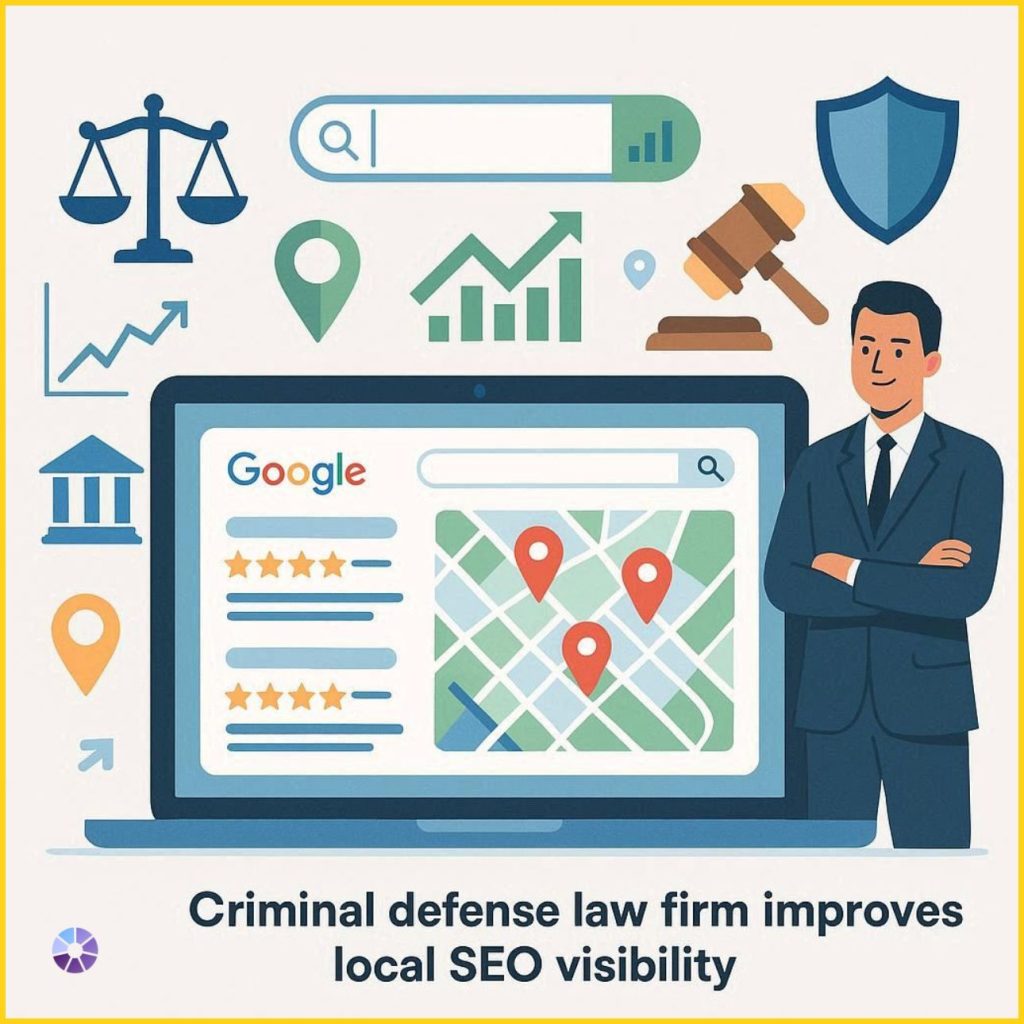
When someone is arrested or facing criminal charges, their first instinct is simple: search Google for a lawyer immediately.
If your criminal defense firm doesn’t appear in the top results or Google Maps, those potential clients will call your competitors instead.
In this guide, we reveal 10 proven local SEO strategies that help criminal defense lawyers rank higher on Google and attract high-intent legal clients.
What Is Local SEO for Criminal Defense Lawyers?
Local SEO is the strategic process of optimizing your law firm’s online presence to appear prominently in local search results, especially on platforms like Google Maps, the local 3-pack, and location-based organic queries. For criminal defense lawyers, this digital presence is crucial because prospective clients are often seeking immediate legal assistance — and they usually turn to Google first.
In modern SEO for lawyers, local search visibility plays a major role in attracting potential clients who are looking for immediate legal representation in their city.
Unlike traditional SEO, which targets broad or national audiences, law firm local SEO focuses on searchers within a specific geographic area. This means optimizing your website and listings so you show up when someone in your city or region searches for legal services such as:
“criminal defense lawyer near me”
“DUI attorney in New York”
“best defense lawyer for assault case [City]”
By appearing in these results, your law firm increases its visibility among users with strong intent to hire — many of whom are in urgent legal situations.
Key components of local SEO for criminal defense lawyers include:
• Google Business Profile optimization for visibility on maps and local packs
• NAP consistency (Name, Address, Phone Number) across all listings and directories
• Localized keyword targeting on service pages and blogs
• Client reviews and reputation management to build trust signals
• Location-specific landing pages for multi-city or regional practices
• Backlinks and citations from authoritative legal directories and local sites
• Mobile optimization for users searching on the go
Many law firms also invest in legal SEO services to strengthen their local visibility, improve rankings in competitive markets, and attract high-intent clients searching for criminal defense representation.
A well-executed local SEO strategy ensures that your law firm not only ranks well but also stands out as a trusted, local authority in criminal defense services.
By implementing these foundational practices, you create a competitive edge that drives organic traffic, increases phone calls, and leads to more consultations — all without relying solely on paid advertising.
1. Claim and Fully Optimize Your Google Business Profile (Most Important Local Ranking Factor)
Your Google Business Profile (GBP) is one of the most important assets for criminal defense lawyers who want to improve their local SEO visibility. Appearing in the Google Local 3-Pack or Google Maps results can significantly increase inquiries and phone calls from nearby prospects searching for legal help. For many law firms, this is the first place potential clients discover their services.
However, simply claiming your profile is not enough. To fully benefit from law firm local SEO, your Google Business Profile must be carefully optimized with accurate information and engaging content.
Start by claiming your profile at google.com/business, then follow these best practices to maximize your visibility in local search results:
Use your full legal business name
Always list your firm’s official registered business name and avoid adding extra keywords. Keyword stuffing in your business name can lead to inconsistencies across directories and may violate Google’s guidelines.
Add a consistent local phone number
Use a local phone number that matches the contact information listed on your website and other online directories. Maintaining NAP consistency (Name, Address, Phone Number) is essential for strong local SEO for criminal defense lawyers.
Provide an accurate office address
Enter your exact office location and verify that the Google Maps pin is placed correctly. Your address should match your website and citation listings to avoid confusion for both users and search engines.
Select the most relevant primary category
Choosing the right primary category helps Google understand your legal services. Examples include:
Criminal Defense Lawyer
Criminal Justice Attorney
Legal Services
Add relevant secondary categories
If your firm offers specialized services, add secondary categories such as:
DUI Lawyer
Trial Attorney
Legal Consultant
Upload high-quality photos
Include professional images of your office exterior, interior, legal team, and branding elements. Visual content improves engagement and increases click-through rates from Google Maps listings.
Set accurate business hours
Make sure your operating hours are correct, including holiday schedules, so potential clients know when they can contact your office.
Use the Q&A section strategically
Add frequently asked legal questions and provide clear answers. This helps potential clients understand your services and reinforces your expertise.
Write a compelling business description
Your description should clearly highlight your legal experience, service areas, and key practice areas. This is also a great place to naturally include keywords related to SEO for lawyers and your local service region.
Many law firms also partner with agencies that specialize in legal SEO services to ensure their Google Business Profile, citations, and website are fully optimized for competitive local search markets.
By fully optimizing your Google Business Profile, you signal credibility and trust to both Google and potential clients. This significantly increases your chances of appearing in the Local 3-Pack and attracting high-intent legal clients searching for criminal defense representation in your area.
2. Target Geo-Modified Keywords
One of the most effective ways to increase visibility for criminal defense lawyers in local search is by targeting geo-modified keywords. These are search phrases that combine a legal service with a specific city, region, or neighborhood. For example:
“Criminal defense lawyer in Dallas”
“Top DUI attorney in Miami”
“Assault defense attorney in San Diego”
“Drug possession lawyer near Atlanta”
These types of keywords indicate strong purchase intent, because users searching with location modifiers are usually looking to hire a lawyer nearby — often in urgent legal situations.
In criminal defense lawyer SEO, targeting city-based keywords helps your website rank for searches performed by people within your service area. This is a core strategy in law firm local SEO, allowing legal practices to appear in Google’s organic results as well as the local map pack.
To effectively optimize for geo-modified keywords, integrate them across several key on-page SEO elements, including:
Title Tags
Include both the legal service and the city name to clearly signal relevance to search engines.
Example:
“DUI Defense Lawyer in Houston | Trusted Criminal Attorney”
Meta Descriptions
Write compelling meta descriptions that include the location and legal service while encouraging users to click.
Example:
“Charged with a DUI in Houston? Our experienced criminal defense team can help. Call today for a confidential consultation.”
H1 and H2 Headings
Use location + service keywords in headings to strengthen topical relevance for search engines and improve content structure.
URL Slugs
Create clean, keyword-rich URLs that include both the legal service and the target city.
Examples:
/dui-lawyer-houston/
/criminal-defense-attorney-atlanta/
Internal Anchor Text
When linking between blog posts, service pages, and location pages, use descriptive anchor text that includes geographic keywords.
Example: “criminal defense services in Phoenix.”
Image Alt Text
Add descriptive alt text for images using service and location keywords to improve accessibility and provide additional SEO signals.
By strategically targeting geo-modified keywords across your website, your law firm can improve visibility in your service region, attract highly targeted traffic, and increase the chances of converting searchers into paying clients.
This approach is a fundamental part of SEO for lawyers, helping legal practices compete effectively in local search results without relying solely on paid advertising.
3. Create Dedicated Location Pages
If your criminal defense law firm serves clients in multiple cities or regions, creating dedicated location pages is essential for local SEO success. These pages help Google understand the geographic areas you operate in, and they allow you to rank for city-specific legal searches.
Instead of listing all cities on one general service page, develop individual, fully optimized landing pages for each location you serve. Examples include:
/dui-defense-dallas//assault-attorney-houston//criminal-lawyer-austin/
Each of these pages should be unique and locally relevant — not duplicated with just the city name changed. To strengthen the local signals, include:
A custom H1 and meta title with the service type and city name
Example: “Experienced DUI Defense Attorney in Dallas”Localized content that references:
City-specific legal regulations
Local courthouses or police departments (e.g., “Dallas County Criminal Court”)
Neighborhoods or districts within the city
Examples of past cases handled in the area (without disclosing confidential details)
Internal links to related practice area pages and blog content
Embedded Google Map showing your office location (if applicable)
Schema markup with local business and service area details
Client testimonials from individuals in that specific location
By building strong, well-structured location pages, your firm can attract qualified leads in each city, improve local keyword rankings, and provide a better user experience for potential clients searching in their area.
4. Collect Client Reviews (The #1 Trust Signal for Criminal Lawyers)
Client reviews play a critical role in local SEO for criminal defense lawyers. Not only do reviews influence your Google Business Profile rankings, but they also act as powerful trust signals that can convert searchers into actual clients.
In SEO for lawyers, reputation management is a key factor because people seeking legal help often rely heavily on reviews before contacting a law firm. When someone is facing a serious legal charge, they are far more likely to reach out to an attorney with credible, positive, and recent feedback from past clients.
That’s why review generation and management should be an ongoing part of your law firm local SEO strategy.
Here’s how to effectively collect and showcase client reviews:
Ask satisfied clients at the right time
Request a Google review shortly after a case concludes. At this stage, clients are more likely to leave feedback because the experience is still fresh in their minds.
Make leaving reviews easy
Provide a direct link to your Google review page through email, SMS, or in a follow-up thank-you message. Reducing friction significantly increases the chances of receiving reviews.
Encourage detailed and location-specific feedback
When appropriate, encourage clients to mention the type of legal service and location in their review.
Example:
“Attorney John helped me through a difficult DUI case in Charlotte.”
These location references strengthen your relevance in local search results.
Respond to every review
Whether the feedback is positive or critical, responding professionally demonstrates that your law firm values client communication and transparency.
Use keywords naturally in responses
Including service-related and location-based keywords in your responses can subtly reinforce your local SEO signals.
Example:
“Thank you for trusting us with your drug possession case in Atlanta. We’re glad we could help you reach a favorable outcome.”
Showcase reviews on your website
Display testimonials on key pages such as service pages, location pages, and your homepage. Embedding reviews or using testimonial widgets can improve trust and engagement for potential clients visiting your site.
Many law firms also work with agencies offering legal SEO services to implement review strategies, integrate testimonials into their website, and strengthen their overall online reputation.
A strong review profile not only improves your visibility in Google Maps and local search results, but it also builds credibility with high-intent clients who are actively looking for a trusted criminal defense attorney.
5. Add Local Business Schema Markup
Local business schema markup is a type of structured data added to your website’s code that helps search engines better understand your business, including what you do, where you’re located, and whom you serve. For criminal defense lawyers, implementing schema correctly can enhance local visibility, improve click-through rates, and increase eligibility for rich search results, such as business information panels and map snippets.
Google relies heavily on structured data to identify local service providers. Without schema, your firm may not be properly indexed for local intent, even if your content is relevant.
Here’s how to implement schema markup effectively:
Use the
LocalBusinessandLegalService(orAttorney) schema types to accurately describe your law firm.Include essential elements such as:
Business Name
Street Address
City, State, and ZIP
Phone Number
Website URL
Business Hours
Email Address
Geo-coordinates (latitude/longitude) for map accuracy
Service Areas, particularly if you serve multiple cities
Add aggregate rating schema if you have a substantial number of reviews — this can help show star ratings in Google results.
Use tools like Rank Math, Schema Pro, or Yoast SEO (with schema enabled) to implement structured data without manual coding.
Validate your schema markup using Google’s Rich Results Test or Schema.org validator to ensure it’s error-free.
By using schema markup, you’re giving Google structured clarity about your legal services, which increases the chance your firm appears in location-rich search results and Google Maps, helping you connect with high-intent, local clients.
6. Build Citations on Legal and Local Directories
Building consistent citations across reputable directories is a fundamental step in any local SEO strategy — especially for criminal defense lawyers. A citation is any mention of your law firm’s Name, Address, and Phone number (NAP) across the web. When search engines detect multiple, consistent citations from trustworthy sites, it reinforces the credibility and legitimacy of your business in a specific geographic area.
For law firms, getting listed in both legal-specific and local business directories helps improve local rankings, especially in Google’s Map Pack.
Start by submitting your firm to high-authority legal directories, including:
Avvo – A widely trusted legal directory where lawyers can claim profiles, display reviews, and highlight specialties.
Justia – Offers a strong SEO benefit due to its high domain authority and legal relevance.
FindLaw – One of the oldest and most reputable legal directories, used by both consumers and search engines.
Lawyers.com – Another valuable platform for building visibility and collecting reviews.
Yelp – Though not legal-specific, it’s a major local directory that influences map listings.
Additionally, submit your business to local directories such as:
Local Chamber of Commerce
Better Business Bureau (BBB)
City or regional business portals
Legal Aid societies or bar associations in your region
Make sure to:
Use the exact same format for NAP on every listing (down to punctuation).
Include a link to your website, business category, and a short business description with relevant keywords.
Keep a spreadsheet of all your citations for easy future updates.
Building consistent citations strengthens your local presence, increases trust with search engines, and supports higher rankings in your service area.
7. Publish Localized Blog Content
Publishing localized blog content is one of the most effective ways for criminal defense lawyers to build topical authority, answer high-intent search queries, and attract qualified local traffic. Rather than writing generic legal content, you should focus on addressing questions, laws, and procedures specific to your geographic area.
Localized content improves your ability to rank for long-tail search terms that include both legal services and location modifiers, such as:
“What to do after a DUI arrest in Charlotte”
“How the bail bond process works in Texas”
“Penalties for first-time drug possession in Miami”
“Can I refuse a breathalyzer in Illinois?”
These types of blog posts:
Match the search intent of people facing urgent legal issues
Help your website rank for low-competition, location-specific queries
Build trust with potential clients who are looking for local expertise
Tips for creating impactful localized blog content:
Use city or state names in your blog titles, headers, and internal links
Include references to local courts, laws, or police procedures
Example: “According to Mecklenburg County Court procedures…”Add local statistics or news headlines to show relevance and authority
Embed a Google Map or link to your location page to strengthen local signals
Answer frequently asked questions (FAQs) that reflect real client concerns
By publishing consistent, locally-relevant blog posts, your law firm will gain visibility for niche search terms while demonstrating deep knowledge of your service area — both of which are key to winning trust and driving more consultations.
8. Optimize for Mobile Users
In local SEO, mobile optimization isn’t optional — it’s essential. The majority of users searching for legal services like “criminal defense lawyer near me” are doing so from their smartphones, often in urgent situations. If your website doesn’t deliver a smooth and fast mobile experience, you risk losing potential clients within seconds.
A mobile-optimized site enhances both user experience and search engine visibility. Google prioritizes mobile-friendly websites in its local search rankings, especially in the Map Pack and for users searching from mobile devices.
Here’s how to ensure your law firm’s website is fully optimized for mobile users:
Ensure fast loading speeds, ideally under 2 seconds. Use tools like PageSpeed Insights to identify bottlenecks in image sizes, scripts, or server performance.
Implement a responsive design that automatically adjusts to various screen sizes — smartphones, tablets, and small laptops.
Use large, readable fonts and avoid small clickable elements. Touch targets should be at least 48px by 48px to prevent user frustration.
Include click-to-call buttons at the top of the page or in sticky headers, so users can contact your office instantly.
Streamline your navigation with a clean mobile menu and easy access to key pages such as “Practice Areas,” “Contact,” and “About.”
Avoid pop-ups or intrusive elements that may hinder the mobile experience, especially on legal blogs and service pages.
Test mobile usability regularly using Google Search Console’s Mobile Usability report or third-party tools.
By optimizing for mobile, you improve user engagement, reduce bounce rates, and send positive UX signals to Google — all of which contribute to better local rankings and more client inquiries.
9. Embed Google Maps on Contact and Location Pages
Embedding Google Maps on your law firm’s Contact and Location pages is a simple but highly effective local SEO technique. It not only helps users find your office easily but also strengthens your geographic relevance in the eyes of Google. For criminal defense lawyers, having a clear and verified physical presence can increase trust and improve visibility in Google Maps and the local 3-pack.
Adding a Google Map improves user experience and sends signals of local authenticity — which search engines use to assess whether your business is truly located where you claim to be.
Here’s how to implement this strategy effectively:
Embed an interactive Google Map iframe that points to your verified business location on your Google Business Profile. You can generate the embed code directly from Google Maps by searching your business name and selecting “Share” → “Embed a map.”
Place the map prominently on your Contact Us page and any dedicated Location pages. Ideally, position it near your NAP (Name, Address, Phone) details.
Ensure the address on the map matches the one listed on your site, Google Business Profile, and online citations.
Include directions or reference nearby landmarks, such as courthouses, police stations, or popular buildings.
Example: “Located two blocks from the [City] County Criminal Court.”Use schema markup (
LocalBusinessorPlace) to provide additional location details to Google.
By embedding Google Maps and aligning your location signals across your website and listings, you make it easier for both users and search engines to confirm your local presence — a key factor in ranking for geographic legal searches.
10. Use Internal Linking with Local Anchors
Internal linking is a core SEO practice that enhances site structure, distributes authority, and helps search engines understand topic relationships. For criminal defense law firms, internal linking with geo-targeted anchor text not only supports better indexing but also reinforces your local relevance.
By linking between related service pages, blog posts, and location-specific landing pages using local keyword-rich anchor text, you improve user navigation and help Google associate your firm with multiple practice areas and cities.
Here’s how to do it effectively:
Use location-based anchor text to connect services and regions.
Examples:“Explore our DUI defense strategy in Tampa”
“Learn how our Austin criminal defense attorneys handle assault cases”
“Contact our San Diego legal team today for a consultation”
Link from high-traffic blog posts to practice area or location pages using relevant keywords. This passes link equity and signals topical authority.
Add internal links in your footer or sidebar, especially to your most important location and practice area pages.
Avoid generic anchor text like “click here” or “learn more.” Instead, use descriptive phrases that include service type and location.
Maintain a clear hierarchy: Service category pages (e.g., Criminal Law) should link to sub-services (e.g., DUI, Drug Charges) and location pages.
Regularly audit your internal links using tools like Screaming Frog or Ahrefs to identify missed opportunities and broken links.
By creating a well-structured internal linking strategy with localized anchor text, your site becomes more crawlable, contextually rich, and geographically targeted — increasing the chance of ranking for city-specific legal searches and improving overall SEO performance.
Run Branded Local Google Ads
While organic local SEO builds long-term authority, running branded local Google Ads can give your criminal defense law firm an immediate visibility boost — especially in highly competitive cities. Branded ads allow you to target searches that include your firm name, attorney name, or even competitor names, capturing clicks from high-intent users who are actively looking for legal help.
These ads appear at the very top of Google search results, often above the local map pack, making them a powerful tool for capturing urgent leads.
Here’s how to implement this strategy effectively:
Target your own branded keywords, such as:
“WorkSEO Law Firm Atlanta”
“Smith & Associates Criminal Lawyer Dallas”
Bid on competitor brand names using comparison-style ad copy, such as:
“Why clients choose [Your Firm] over John Smith Law – Free Consultation Available”
“Looking for a better defense strategy than [Competitor Name]? Contact us today.”
Set geographic targeting to your city or service area to ensure your ads only appear to local searchers.
Use ad extensions like call buttons, location extensions, and site links to drive more conversions directly from the ad.
Monitor performance metrics (CTR, conversion rate, CPC) to fine-tune campaigns for cost-efficiency.
Avoid misleading ad copy — stay compliant with legal advertising rules set by your local Bar Association.
By running carefully structured branded Google Ads in parallel with your organic efforts, you can increase visibility, protect your brand name, and capture more high-intent leads who are ready to take action.
Post Weekly Updates on Google Business Profile (GBP)
One of the most underutilized features in Google Business Profile (GBP) is the Google Posts section. For criminal defense lawyers, publishing regular updates here provides a unique opportunity to engage potential clients, share local legal knowledge, and improve your law firm’s visibility and relevance in local search results.
Google Posts function like mini social media updates that appear directly in your business profile — often visible when someone searches your firm name or views your listing in the local map pack.
Here’s how to use Google Posts effectively for local SEO:
Publish at least one post per week to signal consistent activity to Google.
Share educational content such as:
Legal FAQs (e.g., “What happens after a DUI arrest in Texas?”)
Case summaries or anonymized success stories
Updates on changes in state or local laws
Legal tips relevant to your location or practice area
Add strong headlines and short, engaging descriptions that explain the topic clearly.
Use high-quality images or graphics to attract attention in search results.
Include calls-to-action (CTAs) like “Call now,” “Learn more,” or “Book a consultation.”
Keep your posts location-aware by referencing your city or neighborhood when appropriate.
Avoid promotional hype — instead, focus on trust, clarity, and helpfulness.
By consistently posting informative updates, you build local authority, increase user interaction, and give Google more content signals tied to your service area — all of which contribute to stronger rankings and more leads.
Track Local Rankings Monthly
Tracking your local rankings is essential for evaluating the effectiveness of your SEO strategy. For criminal defense lawyers targeting city-specific searches, relying solely on generic keyword positions is not enough. Search results vary by location, device, and search behavior — which is why you need to monitor how your firm performs in each specific city or neighborhood you serve.
Consistent local rank tracking helps you:
Understand what’s working
Identify areas with weak visibility
Prioritize optimization efforts geographically
Here’s how to do it the right way:
Use dedicated local SEO tools such as:
BrightLocal – Offers geo-grid rank tracking, citation monitoring, and Google Business Profile insights.
Local Falcon – Lets you visualize map pack rankings based on exact GPS coordinates around your office or service area.
Set up geo-grid tracking zones around your office or courthouse areas to see where your map rankings are strong or weak.
Monitor both Google Maps (3-pack) and organic positions for key keywords like:
“criminal defense attorney in [city]”
“DUI lawyer near [neighborhood]”
Track branded vs non-branded searches, and how often your GBP appears in “discovery” searches (non-name based).
Compare desktop and mobile visibility, especially since many users search from mobile devices.
Document rankings monthly to identify patterns, drops, or opportunities for optimization.
By tracking local performance city by city, you can make informed SEO decisions that directly impact your visibility, leads, and return on investment — all while staying ahead of competitors in your area.
FAQ: Local SEO for Criminal Defense Lawyers
How does SEO help criminal defense lawyers get clients?
SEO helps criminal lawyers rank on Google for searches like “criminal lawyer near me” or “DUI attorney in [city]”, bringing highly targeted leads.
How long does local SEO take for a law firm?
Most law firms start seeing results within 3–6 months, depending on competition and website authority.
Is Google Business Profile important for lawyers?
Yes. Google Business Profile is one of the most important local ranking factors for criminal defense lawyers.
Conclusion
For criminal defense lawyers, visibility in local search is no longer optional — it’s mission-critical. Whether a potential client is facing a DUI charge, assault accusation, or any other criminal matter, the first thing they do is search for legal help on Google — and often, from a mobile device in a time of urgency.
By implementing the 10 local SEO strategies outlined in this guide — from optimizing your Google Business Profile to targeting geo-specific keywords, collecting reviews, and publishing localized content — you’re not just boosting rankings. You’re building trust, authority, and accessibility in your service area.
The bonus tips, including branded ads, GBP posts, and rank tracking, further reinforce your firm’s presence and help you stay ahead in highly competitive local legal markets.
Local SEO is your modern-day referral system. Instead of word-of-mouth, people trust Google. And your position in local results can mean the difference between a new client call — or being invisible.
Need Help with Local SEO for Criminal Defense Lawyers?
At WorkSEO, we specialize in ethical, white-hat, and performance-focused SEO solutions designed specifically for legal professionals. Whether you’re a solo attorney or a multi-location criminal defense firm, we’ll build a custom SEO roadmap that aligns with your city, audience, and practice strengths.
✅ 100% White-Hat Legal SEO
✅ Google Business Profile Optimization
✅ Location-Based Content & Schema Setup
✅ Transparent Reporting & Growth Tracking
📞 Call or WhatsApp: +91 9442611433
Let’s get your law firm to the top — right where local clients are looking.
Latest Insights from Our SEO Experts
Stay updated with actionable SEO tips, strategies, and trends from the WorkSEO editorial team—designed to help your business grow organically and rank higher on search engines.
Completing a B.Sc. or M.Sc. in Geology is a significant achievement. During your studies, you gain knowledge about Earth’s structure, […]
In today’s digital world, every business wants to appear on the first page of Google. Whether you are a student, […]
In today’s digital world, many business owners believe that online success is impossible without spending thousands of rupees on advertising. […]