
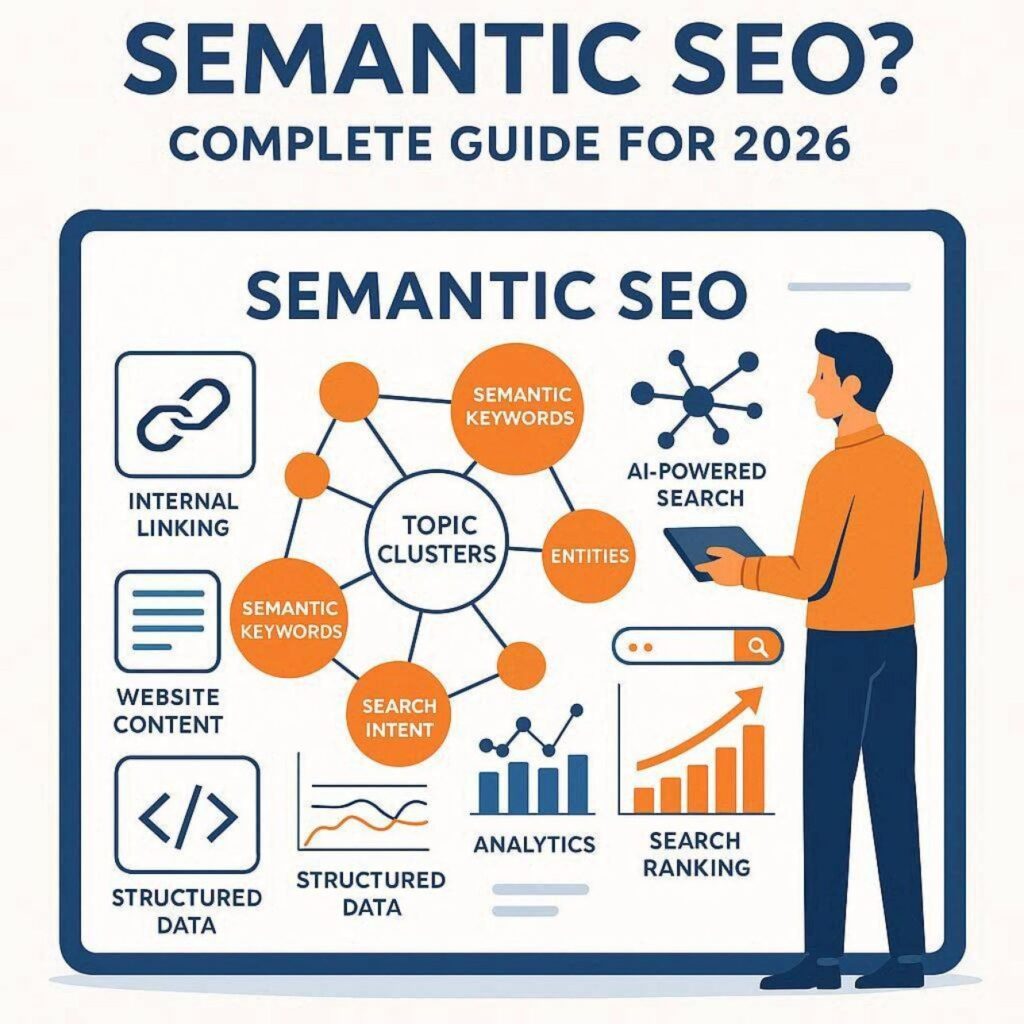
Search Engine Optimization (SEO) has evolved significantly over the past decade. Gone are the days when simply repeating a keyword multiple times on a page could help it rank higher in Google. Modern search engines have become smarter, focusing on understanding the meaning, context, and intent behind search queries.
This evolution has given rise to Semantic SEO, a strategy that helps search engines understand the relationships between topics, entities, concepts, and user intent rather than just matching keywords.
In this complete guide, WorkSEO explains what Semantic SEO is, how it works, why it matters in 2026, and how you can implement it to improve your website’s rankings and visibility.
What is Semantic SEO?
Semantic SEO is the practice of creating content that helps search engines understand the meaning and context of a topic rather than focusing on a single keyword.
Instead of optimizing a page for one exact keyword, Semantic SEO involves covering a topic comprehensively by including related terms, entities, concepts, questions, and contextual information.
For example:
Traditional SEO might target:
- Semantic SEO
Semantic SEO would also naturally include:
- Search intent
- Topic clusters
- Entities
- Natural language processing
- Knowledge graph
- User experience
- Related search queries
- Content relevance
This helps search engines understand the page as an authoritative resource on the subject.
Why Semantic SEO Matters in 2026
Search engines now use advanced artificial intelligence and machine learning technologies to understand content more like humans do.
Google’s algorithms analyze:
- User intent
- Context
- Relationships between topics
- Content quality
- Search behavior
- Entity recognition
As a result, websites that provide comprehensive and meaningful content often outperform pages that focus only on exact-match keywords.
Semantic SEO helps websites:
- Rank for more keywords
- Improve topical authority
- Increase organic traffic
- Enhance user experience
- Appear in featured snippets
- Improve voice search visibility
For businesses investing in SEO, semantic optimization has become essential rather than optional.
How Search Engines Understand Meaning
Modern search engines no longer rely solely on keywords.
They attempt to answer questions such as:
- What is the page about?
- Which entities are being discussed?
- What problem does the content solve?
- Does the content satisfy user intent?
- How does this topic relate to other topics?
For example, if someone searches:
“Best SEO strategy for a new website”
Google understands the searcher may also want information about:
- Keyword research
- Technical SEO
- Content marketing
- Backlinks
- Website structure
This contextual understanding is the foundation of Semantic SEO.
Semantic SEO vs Traditional SEO
| Traditional SEO | Semantic SEO |
|---|---|
| Focuses on exact keywords | Focuses on topics and meaning |
| Keyword density matters | Context and relevance matter |
| Individual pages optimized separately | Topic clusters optimized together |
| Limited keyword variations | Broad semantic coverage |
| Search engines match words | Search engines understand concepts |
While traditional keyword optimization still plays a role, semantic optimization provides a more complete SEO strategy.
Key Components of Semantic SEO
1. Search Intent Optimization
Search intent is the reason behind a user’s search query.
There are four main types:
Informational Intent
Users want information.
Example:
- What is Semantic SEO?
Navigational Intent
Users want a specific website.
Example:
- WorkSEO website
Commercial Intent
Users compare options before purchasing.
Example:
- Best SEO agencies in India
Transactional Intent
Users are ready to take action.
Example:
- Hire SEO consultant
Semantic SEO aligns content with the correct search intent.
2. Topic Clusters
A topic cluster is a collection of related content connected around a central theme.
For example:
Pillar Topic
Semantic SEO
Supporting Topics
- Keyword Research
- Search Intent
- Entity SEO
- Content Optimization
- Internal Linking
- Structured Data
This structure helps search engines understand topical relevance and expertise.
3. Entity Optimization
An entity is a person, place, organization, product, or concept that search engines can identify.
Examples include:
- OpenAI
- Google Search Console
Search engines use entities to understand content relationships and improve search accuracy.
Including relevant entities naturally strengthens semantic relevance.
4. Comprehensive Content Coverage
Semantic SEO requires covering a topic thoroughly.
For example, an article about SEO should naturally discuss:
- On-page SEO
- Technical SEO
- Link building
- Search intent
- Content marketing
- User experience
Comprehensive content signals expertise and authority.
5. Internal Linking
Internal links connect related pages throughout your website.
Benefits include:
- Improved crawling
- Better topic understanding
- Enhanced user navigation
- Increased authority flow
For Semantic SEO, internal links help establish topic clusters and content relationships.
Role of Google's Knowledge Graph
Google’s Knowledge Graph helps connect entities and concepts.
When you search for a well-known topic, Google often displays information panels containing:
- Definitions
- Related entities
- Key facts
- Associated topics
Semantic SEO aligns content with these knowledge structures.
The more clearly Google understands your content, the greater the chances of improved rankings.
Semantic Keywords Explained
Semantic keywords are words and phrases related to your primary topic.
For example:
Primary keyword:
- Semantic SEO
Related semantic keywords:
- Search intent
- Topic authority
- NLP SEO
- Entity optimization
- Content relevance
- Structured data
- User intent
- Knowledge graph
Using related terms naturally helps search engines understand the context of your content.
How to Find Semantic Keywords
Google Autocomplete
Start typing a keyword into Google and observe suggested searches.
These suggestions reveal related user interests.
People Also Ask
Google’s “People Also Ask” section provides valuable semantic questions.
These questions can become article subheadings.
Related Searches
Scroll to the bottom of search results.
Google often displays semantically related searches.
SEO Tools
Popular tools include:
- Ahrefs
- SEMrush
- Google Keyword Planner
- Ubersuggest
- Surfer SEO
These platforms identify related keyword opportunities.
Structured Data and Semantic SEO
Structured data helps search engines understand webpage content more effectively.
Common schema types include:
- Article Schema
- FAQ Schema
- Organization Schema
- Local Business Schema
- Product Schema
- Review Schema
Benefits include:
- Rich results
- Enhanced visibility
- Better indexing
- Improved click-through rates
Schema markup supports semantic understanding by providing additional context.
Semantic SEO Best Practices for 2026
Focus on Topics, Not Just Keywords
Build content around complete topics instead of individual phrases.
Answer User Questions
Address common questions within your content.
This improves relevance and increases featured snippet opportunities.
Use Natural Language
Write naturally for humans.
Avoid keyword stuffing.
Search engines understand synonyms and contextual variations.
Create Topic Clusters
Develop supporting articles around major topics.
Connect them through internal links.
Optimize for Voice Search
Voice searches tend to be conversational.
Semantic content performs better for spoken queries.
Strengthen E-E-A-T Signals
Google values:
- Experience
- Expertise
- Authoritativeness
- Trustworthiness
Demonstrating these qualities improves semantic relevance and credibility.
Common Semantic SEO Mistakes
Focusing Only on Exact-Match Keywords
Modern search engines prioritize meaning over repetition.
Ignoring Search Intent
Traffic without intent alignment rarely converts.
Thin Content
Shallow articles often fail to establish topical authority.
Poor Internal Linking
Disconnected content weakens semantic relationships.
Overusing Keywords
Keyword stuffing reduces readability and can hurt rankings.
How Semantic SEO Benefits Businesses
Businesses implementing Semantic SEO often experience:
Increased Organic Visibility
Pages rank for a broader range of keywords.
Better User Engagement
Visitors find more complete answers.
Higher Search Authority
Comprehensive content builds trust.
Improved Conversion Rates
Intent-focused content attracts qualified visitors.
Long-Term SEO Growth
Semantic optimization creates sustainable ranking improvements.
Semantic SEO Example
Imagine WorkSEO publishes a page targeting:
“Digital Marketing Course”
A semantic approach would also naturally cover:
- SEO training
- Google Ads
- Social media marketing
- Career opportunities
- Certification programs
- Course fees
- Placement support
- Internship training
As a result, the page may rank for dozens or even hundreds of related search terms.
Conclusion
Semantic SEO is the future of search optimization. In 2026, ranking success depends less on exact keyword usage and more on how well your content demonstrates relevance, context, expertise, and topical authority.
By focusing on search intent, topic clusters, entity optimization, structured data, and comprehensive content coverage, businesses can help search engines better understand their websites and improve visibility across a wider range of searches.
For brands looking to build long-term organic growth, Semantic SEO should be a core part of every content strategy. At WorkSEO, we recommend creating valuable, user-focused content that answers questions, covers topics thoroughly, and establishes authority within your niche. When done correctly, Semantic SEO can drive sustainable rankings, targeted traffic, and higher conversions for years to come.