
Introduction
If you’ve been following Google updates closely, one concept keeps appearing again and again — E-E-A-T.
In 2026, this is no longer optional. It’s a core ranking factor, especially after recent Google updates focused on experience-driven content.
If your website is not demonstrating strong E-E-A-T signals, your rankings may struggle — even with good keywords and backlinks.
In this guide, WorkSEO explains E-E-A-T in the simplest and most practical way, along with real strategies you can implement immediately.
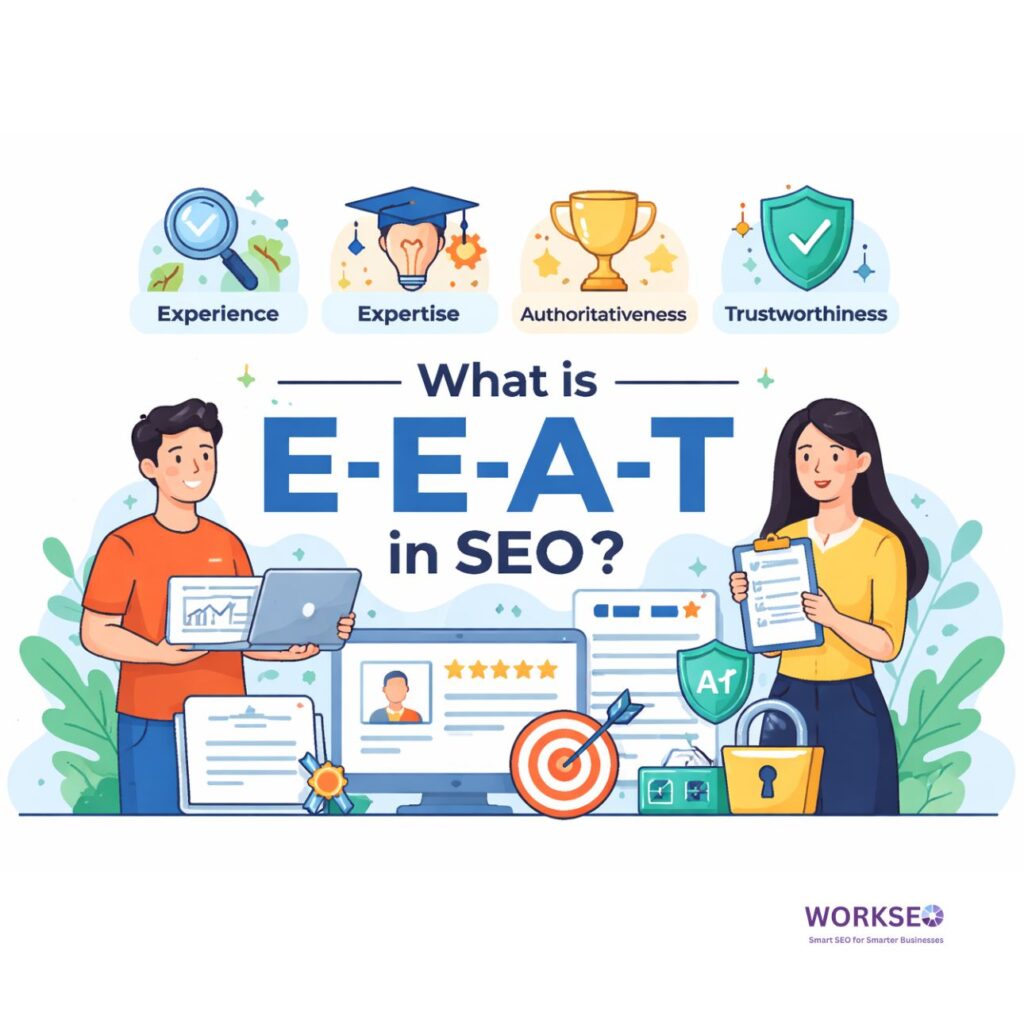
What is E-E-A-T in SEO?
E-E-A-T stands for:
- E – Experience
- E – Expertise
- A – Authoritativeness
- T – Trustworthiness
This concept comes from Google’s Search Quality Evaluator Guidelines and is used to evaluate content quality and credibility.
👉 In simple terms:
E-E-A-T = How much Google trusts your content, your website, and you as an author.
Why E-E-A-T is Important in 2026
After recent Google updates (especially spam + core updates), the focus has shifted to:
- Real-life experience
- Original insights
- Trust signals
- Author credibility
What changed?
- AI-generated content alone is not enough
- Generic blog posts are losing rankings
- Websites with real experience and authority are winning
👉 Especially important for:
- Health websites
- Finance blogs
- Business & SEO websites (like yours)
- E-commerce product pages
Breakdown of E-E-A-T (Simple Explanation)
1. Experience (New & Powerful Factor)
This is the biggest addition in recent updates.
Google now asks:
👉 “Has the author actually used or experienced this?”
Example:
- Writing about SEO tools after using them ✔️
- Writing product reviews without using them ❌
How to improve:
- Share real case studies
- Add screenshots
- Include personal insights
- Show results
2. Expertise
This measures your knowledge and skill level in a topic.
Example:
- An SEO expert writing SEO content ✔️
- A random writer writing medical advice ❌
How to improve:
- Create niche-focused content
- Show certifications
- Write detailed guides
- Avoid shallow content
3. Authoritativeness
This is about your reputation in your industry.
Signals include:
- Backlinks from trusted sites
- Brand mentions
- Social proof
- Guest posts
How to improve:
- Build backlinks
- Publish consistent content
- Get featured on other websites
- Build your brand (WorkSEO style)
4. Trustworthiness (Most Important)
This is the foundation of E-E-A-T.
If your website is not trustworthy, nothing else matters.
Trust signals:
- HTTPS (SSL)
- Contact details
- Privacy policy
- About page
- Transparent information
How to improve:
- Show real business details
- Add testimonials
- Avoid misleading content
- Keep information accurate
How Google Evaluates E-E-A-T
Google does not use a single “E-E-A-T score”.
Instead, it evaluates multiple signals like:
- Content quality
- Author profile
- Website reputation
- User experience
- External mentions
👉 It’s a combination of signals, not a single factor.
Practical E-E-A-T Strategies (WorkSEO Method)
This section is basically your execution plan.
Not theory — real actions that improve rankings in 2026.
1. Add Author Profile (Must Do)
What it means:
Google wants to know:
👉 Who is writing this content? Can we trust this person?
What you should do:
Create an Author Page or author section in every blog.
Include:
- Your name (Srisivam – good for branding)
- Your SEO experience (10+ years — strong signal)
- Certifications (Google, SEMrush, HubSpot — huge advantage)
- Profile photo
- LinkedIn or social links
Why it works:
This directly improves:
- Expertise
- Trust
👉 Without this, your content looks like “anonymous AI content”
2. Use Real Experience Content
What it means:
Google now prefers:
👉 “Content written by someone who actually did it”
Example:
❌ Weak content:
“Top SEO tools list”
✔️ Strong content:
“SEO tools I used for 3 years (with real results)”
What you should add:
- Screenshots (GSC, rankings, traffic)
- Real data
- Before/after results
- Case studies
Why it works:
This boosts:
- Experience (E)
- Makes your content unique (hard to copy)
👉 This is where most websites fail in 2026
3. Build Topical Authority
What it means:
Don’t write random topics.
Google prefers:
👉 Websites that go deep into one subject
Example:
Instead of:
- SEO + Travel + Health + Finance ❌
Do:
- Only SEO topics ✔️
(like you already do in WorkSEO)
Then go deeper:
- Keyword research
- Technical SEO
- Link building
- GSC fixes
Why it works:
This builds:
- Expertise
- Authority
👉 Google starts seeing you as a “specialist”, not general blogger
4. Improve Website Trust Signals
What it means:
Your website must look like a real business, not a fake or spam site.
What you must have:
- About Us page
- Contact page
- Privacy Policy
- Real email (you already have 👍)
- Phone number
Why it works:
This improves:
- Trustworthiness (most important factor)
👉 Missing these = ranking drop risk
5. Get Quality Backlinks
What it means:
Other websites should mention or link to you.
👉 That’s how Google measures your authority
What to focus on:
- Guest posting
- Niche websites
- SEO blogs
- PR mentions
What to avoid:
❌ Cheap backlinks
❌ Spam links
❌ Fiverr link packages
Why it works:
Backlinks = votes of trust
👉 But in 2026:
Quality > Quantity
6. Keep Content Updated
What it means:
Old content = low trust
Google prefers:
👉 Fresh, updated, relevant information
What to update:
- Statistics (very important)
- SEO strategies
- Screenshots (latest UI)
- Add new sections
Pro tip:
Add:
👉 “Last Updated: 2026”
Why it works:
This improves:
- Trust
- Rankings stability
- Long-term traffic
E-E-A-T for Different Websites
1. Blogs & SEO Websites
- Show expertise
- Publish in-depth guides
- Build author credibility
2. E-commerce Websites
- Add real reviews
- Show product experience
- Build trust with policies
3. Local Businesses
- Google reviews
- Local citations
- Real contact details
Common E-E-A-T Mistakes to Avoid
❌ Copying content
❌ AI-only content without editing
❌ No author details
❌ Fake reviews
❌ No trust pages
❌ Writing outside your niche
👉 These can reduce rankings significantly
E-E-A-T and AI Content (Important)
AI content is not banned.
But:
👉 AI + Human Experience = Ranking
👉 AI alone = Risk
Use AI for:
- Structure
- Ideas
Add human touch:
- Experience
- Insights
- Proof
Future of E-E-A-T (Beyond 2026)
E-E-A-T is not just a trend — it’s becoming the core foundation of Google’s ranking system. Moving beyond 2026, Google is expected to rely even more on real-world credibility signals rather than just traditional SEO factors like keywords and backlinks.
One major shift will be the rise of personal branding in SEO. Websites will no longer rank based only on domain authority — the individual behind the content will matter more. SEO professionals, business owners, and content creators must build their digital identity, including strong author profiles, consistent publishing, and presence across platforms like LinkedIn, YouTube, and industry forums.
Another key development is author verification. Google may increasingly connect content with verified entities, ensuring that the person writing the content is genuine and qualified. This could include integration with social profiles, credentials, and even real-world recognition.
We will also see stronger experience-based ranking signals. Content that includes first-hand usage, case studies, and real data will outperform generic AI-written or rewritten content. Simply explaining a topic will not be enough — proving it with experience will be essential.
At the same time, low-quality and generic content will continue to lose visibility. Websites relying only on mass content production without depth or originality will struggle to rank.
👉 The future of SEO is clear:
Human expertise + real experience + strong trust signals = sustainable rankings.
Final Thoughts (WorkSEO Conclusion)
E-E-A-T is not just a ranking factor — it is the foundation of modern SEO.
If you want long-term rankings:
✔ Build trust
✔ Show real experience
✔ Become an authority
👉 That’s the WorkSEO approach.
Quick Summary
- E-E-A-T = Experience, Expertise, Authority, Trust
- Trust is the most important factor
- Experience is the newest ranking signal
- AI content needs human validation
- Real value wins in 2026 SEO
Want to improve your website’s E-E-A-T and rankings?
👉 Contact WorkSEO Solutions today
📩 [email protected]
📱 +91 94426 11433
Get a complete SEO audit + E-E-A-T optimization strategy
Frequently Asked Questions (FAQ)
What is E-E-A-T in SEO?
E-E-A-T stands for Experience, Expertise, Authoritativeness, and Trustworthiness. It is a concept used by Google to evaluate the quality and credibility of content, websites, and authors.
Is E-E-A-T a ranking factor?
E-E-A-T is not a direct ranking factor, but it influences many ranking signals such as content quality, backlinks, and trust signals, which directly impact rankings.
Why is E-E-A-T important in 2026?
In 2026, Google focuses more on real experience and trust-based content. Websites without strong E-E-A-T signals may lose rankings, even if they have good SEO optimization.
How can I improve E-E-A-T on my website?
You can improve E-E-A-T by:
- Adding author profiles
- Sharing real experience and case studies
- Building backlinks
- Improving website trust signals
- Updating content regularly
Does AI content affect E-E-A-T?
AI content is acceptable, but it must include human experience, insights, and proof. Pure AI-generated content without value may not rank well.
E-E-A-T Checklist (WorkSEO Quick Implementation)
Use this checklist to quickly improve your website:
✅ Experience
- Add real case studies
- Include screenshots
- Share personal insights
✅ Expertise
- Focus on one niche
- Write in-depth content
- Show certifications
✅ Authority
- Build quality backlinks
- Get brand mentions
- Publish consistently
✅ Trust
- Add contact details
- Create About & Privacy pages
- Use HTTPS
- Show real business info