
Introduction
In the ever-growing world of e-commerce, Amazon keyword research is no longer just an option—it’s a necessity. For sellers in the household products niche, understanding what keywords shoppers use can significantly impact your product visibility, click-through rates, and ultimately, your sales.
With millions of listings competing for attention, the secret sauce to standing out lies in strategic keyword research tailored to your niche. This blog will guide you through the best Amazon keyword research strategies specifically for household products—whether you sell storage boxes, kitchen organizers, cleaning tools, or anything in between.
Why Keyword Research Matters for Household Products
Let’s face it: Household products are a highly competitive category on Amazon. Buyers are often searching for specific solutions to everyday problems, using detailed and practical search terms such as “under sink storage rack adjustable” or “space-saving dish drying rack.”
This high-intent, niche-driven search behavior makes keyword research essential. Without it, your product listings may never reach your target audience, no matter how useful or well-made your products are. Here’s why focused, data-backed keyword research is critical for household products:
Helps you rank organically on Amazon (A9 algorithm)
Amazon’s algorithm prioritizes relevance and conversion. By using high-performing keywords in your title, bullet points, and backend search terms, your product is more likely to appear in front of shoppers who are already looking for what you sell.Lowers your ACOS in Amazon PPC campaigns
When you target the right long-tail and high-converting keywords, your ads become more efficient. This leads to better click-through rates and conversions at a lower cost, reducing your Advertising Cost of Sales (ACOS).Improves product discoverability
Accurate keyword targeting ensures that your product surfaces in both organic searches and sponsored placements, increasing its visibility across multiple customer touchpoints.Increases overall sales and conversion rates
Reaching the right audience at the right time boosts your chances of turning clicks into purchases. Better alignment between keywords and customer intent leads to higher conversion rates.
In summary, keyword research is not just an optimization task—it’s a foundational step in your Amazon strategy that directly influences visibility, ad performance, and sales growth for household products.
Strategy #1: Use Amazon’s Autocomplete Feature
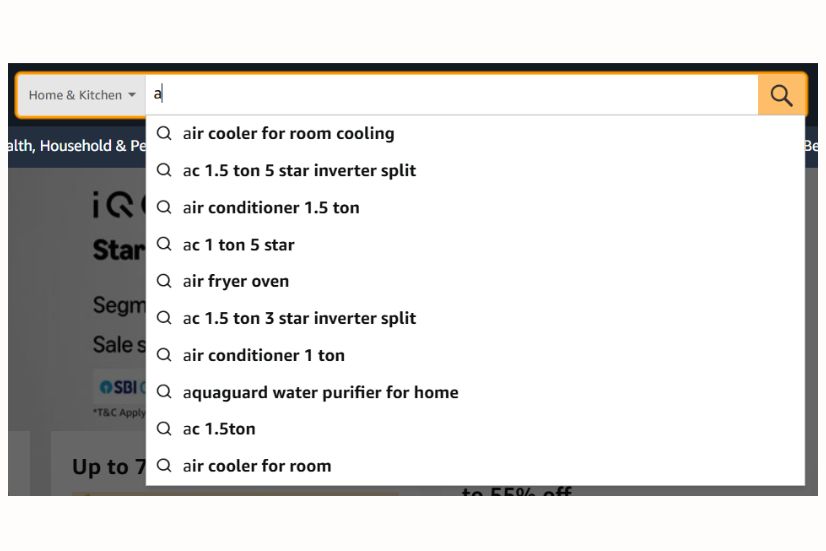
One of the simplest yet most powerful ways to start your keyword research is by leveraging Amazon’s own search bar. Begin by typing your main keyword, such as “kitchen organizer,” into the search box. As you type, Amazon will instantly generate a list of autocomplete suggestions. These are not random—they are based on actual searches being performed by Amazon shoppers.
This method gives you direct insight into what users are actively looking for in real time. These autocomplete results are valuable because they represent keywords with proven demand.
To get even more ideas, use a variety of seed terms that are relevant to your product category. For example:
“bathroom shelf”
“laundry organizer”
“home storage container”
“pantry racks”
“closet drawer organizer”
Take the time to note down all the suggestions that appear for each of these seed terms. You’ll often uncover useful long-tail keywords that you might not have thought of otherwise.
Why this works:
These suggestions are driven by real shopper behavior
You’re not guessing what people are searching for—Amazon is showing you exactly what’s trending.They reflect current, high-demand search trends
The autocomplete suggestions change over time, reflecting seasonal demand and new buying patterns.They help you identify long-tail keywords
These are more specific search terms that typically have less competition and higher conversion rates.
Using this strategy gives you a low-cost, fast, and effective way to build a strong keyword list based on actual user intent.
Strategy #2: Leverage Free Tools Like Helium 10 & AMZ Suggestion Expander
When you’re starting out and want to keep costs low, free keyword research tools can be incredibly helpful in building a solid keyword strategy—especially in a competitive category like household products.
Two standout Chrome extensions you can use are Helium 10 (Free version) and AMZ Suggestion Expander. Both can significantly enhance your keyword discovery process.
Helium 10 – Free Tools Worth Using:
Cerebro (Reverse ASIN Lookup):
Allows you to enter your competitors’ ASINs and uncover the exact keywords they are ranking for. This helps you understand what’s working in your niche and spot keyword opportunities you may be missing.Magnet (Keyword Research Tool):
A powerful tool that generates keyword ideas based on your seed keyword. It also shows volume, competition score, and other valuable metrics—even in the free version.
AMZ Suggestion Expander – Boost Autocomplete Results:
Enhances Amazon’s Search Suggestions:
Instead of only showing Amazon’s default autocomplete terms, this tool adds variations with prefixes and suffixes such as “top,” “cheap,” “best,” “small,” “compact,” and more.Uncovers Hidden Opportunities:
Helps you generate keyword ideas you may not have considered manually. These extended suggestions are useful for identifying untapped long-tail keywords with high intent.
Using these tools together allows you to create a wide and relevant keyword pool tailored specifically for household items—without spending anything upfront.
Strategy #3: Spy on Competitors Using Reverse ASIN Lookup
One of the most effective ways to uncover high-converting keywords is by analyzing what’s already working for your competitors. If a product similar to yours is ranking well and generating strong sales, you can discover the keywords behind its success using reverse ASIN lookup tools.
These tools allow you to input a competitor’s product ASIN and retrieve a comprehensive list of keywords that product ranks for on Amazon. Some popular tools for this include:
Helium 10’s Cerebro
Jungle Scout’s Keyword Scout
Viral Launch’s Keyword Research
Steps to perform a reverse ASIN lookup:
Find a top-selling product that closely matches your own.
Look for a best-seller in your category with similar features and pricing.Copy its ASIN from the product detail page.
The ASIN is usually listed under the product information section.Paste the ASIN into the reverse lookup tool.
Let the tool generate all the keywords the product is ranking for.Export the keyword list for deeper analysis.
You’ll receive valuable data including search volume, keyword ranking position, and more.
What you’ll learn:
High-performing keywords driving traffic and sales
Search volume for each keyword
Whether the product ranks organically or via paid ads
Keyword difficulty and competitiveness
Focus on extracting mid to long-tail keywords with solid search volume and lower competition. These keywords often provide the best balance between visibility and conversion potential—making them ideal targets for new or growing household product listings.
Strategy #4: Target Long-Tail & Low Competition Keywords
A common mistake new Amazon sellers make is focusing only on broad, high-volume keywords such as “storage box” or “kitchen organizer.” While these terms may bring a large number of searches, they are extremely competitive and often dominated by established brands with strong sales history and large advertising budgets.
Instead, shift your focus to long-tail keywords. These are more specific search phrases that typically consist of three or more words. Examples include:
“under bed storage box with lid”
“clear plastic pantry bins with handles”
“stackable shoe organizer for small spaces”
“adjustable under sink shelf for kitchen”
Why long-tail keywords are valuable:
They reflect higher buyer intent:
Shoppers using detailed phrases are usually closer to making a purchase because they know exactly what they need.Lower competition:
These keywords are less saturated, making it easier for new listings to gain visibility without high advertising spend.Higher conversion rates:
Because they are so specific, they tend to attract more qualified traffic that is likely to convert.
Tools to help you find long-tail keywords:
KeywordTool.io (Amazon filter) – Offers a large number of long-tail keyword suggestions based on your seed term.
Ubersuggest – Provides keyword ideas along with search volume, competition score, and SEO difficulty.
By targeting these niche, low-competition keywords, you can build organic traction, improve your rankings, and increase conversions—especially during the early stages of your product listing.
Strategy #5: Use Amazon Brand Analytics (If Available)
If you are enrolled in Amazon Brand Registry, you gain access to Amazon Brand Analytics (ABA)—an incredibly powerful set of tools that provide deep insights into customer behavior, keyword performance, and market trends.
This data is exclusive to brand-registered sellers and can give you a competitive edge, especially in the crowded household products category.
Key features of Amazon Brand Analytics:
Search Term Report:
See which keywords are driving clicks and conversions for your products and across your category. This helps identify top-performing terms and refine your keyword targeting strategy.Market Basket Analysis:
Understand what other products customers frequently buy alongside yours. This data is valuable for creating effective cross-sell and bundle opportunities.Repeat Purchase Behavior:
Learn which products are frequently reordered. This is especially useful for consumable or multi-use household items, helping you plan subscription offers or bundling strategies.
How to leverage this data:
Optimize your product listings:
Use high-converting keywords directly from the Search Term Report to improve your titles, bullet points, and backend search terms.Discover new keyword opportunities:
Identify relevant search terms that may not be part of your current strategy but are driving results for similar products.Create keyword-backed product bundles:
Use Market Basket insights to bundle related household items with strong, shared keyword performance.
By tapping into Amazon Brand Analytics, you move from guessing to making data-driven decisions that improve visibility, increase conversions, and strengthen your product strategy.
Strategy #6: Analyze Reviews and Q&A for Keyword Ideas
Not all keyword research needs to come from tools. Sometimes, your most valuable insights come directly from your customers. One often-overlooked method is analyzing the Reviews and Q&A sections of top-selling household products within your niche.
These sections provide authentic language and real-life use cases, offering a goldmine of long-tail keyword ideas that reflect how buyers actually talk about and search for products.
What to look for when analyzing reviews and Q&A:
Customer language and product descriptions:
Pay attention to the exact words people use when describing what they like or dislike. This language often aligns with how they search on Amazon.Pain points and specific needs:
Look for complaints or challenges that the product solves. These can lead to highly targeted keywords.Features, benefits, and materials mentioned:
Details like “foldable,” “stainless steel,” or “fits under bathroom sink” can be turned into long-tail keyword phrases.
Example in practice:
If a review says, “I love this over-the-door rack because it fits my narrow pantry,” then a potential long-tail keyword would be:
“over the door rack for narrow pantry”
This phrase combines functionality, intent, and specificity—all ideal for keyword targeting.
Why this strategy works:
It’s based on real customer feedback
It uncovers keywords competitors might miss
It helps align your listings with buyer expectations and search behavior
Incorporating customer-driven language into your keyword list not only improves search visibility but also enhances listing relevance and conversion potential.
Strategy #7: Structure Keywords Properly in Product Listings
Finding high-quality keywords is essential—but how you implement them in your product listing is just as important. Strategic keyword placement can make a significant difference in how your product ranks, how easily customers find it, and how well it converts.
Proper keyword structure ensures you’re not just visible but also relevant in Amazon’s eyes. Poor placement or keyword stuffing can hurt your performance and even reduce customer trust.
Ideal Keyword Placement Areas:
Product Title:
This is the most important field for keyword ranking. Place your highest-priority keywords here, starting with the most relevant terms that describe your product clearly and accurately.Bullet Points:
Use bullet points to naturally incorporate additional keywords while highlighting key features and benefits. Avoid forced language—make it informative and easy to read.Backend Search Terms:
Use this space to add relevant keywords not included elsewhere. Do not repeat words, and skip punctuation like commas. Focus on alternate spellings, abbreviations, and long-tail variants.Product Description or A+ Content:
These sections help reinforce keyword relevance and provide more context. Well-written content using natural language boosts readability and trust.Alt Text in A+ Images:
Adding descriptive alt text to your A+ images not only improves SEO but also enhances accessibility for visually impaired shoppers.
Key Tip:
Avoid keyword stuffing. Amazon’s algorithm values relevance and customer experience. Overloading your listing with keywords can lead to poor readability and reduced conversion rates. Focus on clarity, relevance, and user intent to drive better performance.
Strategy #8: Monitor & Adjust Using Performance Data
Keyword research and listing optimization are not one-time tasks—they require continuous monitoring and fine-tuning. Once your product listing is live, it’s essential to track performance data to understand what’s working and where improvements are needed.
Consistent analysis helps you stay competitive, adapt to changing search trends, and improve both organic and paid visibility over time.
Tools to help monitor keyword performance:
Helium 10 Keyword Tracker:
Allows you to track how your selected keywords rank over time. You can monitor daily position changes and spot trends across multiple ASINs.Amazon Search Term Reports (PPC):
These reports show which keywords from your ad campaigns are driving clicks and conversions. They help you identify high-performing and underperforming terms.Amazon Brand Analytics (for registered brands):
Offers deeper insight into customer search behavior, keyword conversion rates, and product comparisons within your category.
Key performance metrics to track:
Keyword ranking fluctuations:
Identify which keywords are climbing or dropping in rank and adjust your content or bidding strategy accordingly.Click-through rates (CTR) and conversion rates (CVR):
Understand how well your keywords are turning impressions into actions and sales.Emerging keyword trends:
Stay up to date with seasonal shifts, new search phrases, or competitor changes.
Action Steps:
Regularly update backend search terms
Adjust bullet points and titles based on keyword performance
Pause low-performing PPC keywords and scale high-converting ones
By consistently reviewing and optimizing based on real data, you ensure your household product listings remain relevant, visible, and profitable over time.
Strategy #9: Optimize for Voice Search and Natural Phrases
With the increasing use of voice-activated assistants like Alexa, Siri, and Google Assistant, consumer search behavior is changing. More shoppers are speaking their queries rather than typing them, especially when using smart devices. This shift makes it crucial to optimize your listings for voice search and natural language phrases.
Voice search queries are typically longer, more conversational, and phrased as questions. While traditional keywords like “laundry basket plastic” still matter, you should also include more natural, intent-driven phrases that mimic how people speak.
Examples:
Instead of: “laundry basket plastic”
Also include: “what’s the best plastic laundry basket for small spaces”
Or: “top-rated laundry bin that fits in a closet”
How to implement voice-friendly keywords:
Incorporate natural, question-based phrases into your bullet points and A+ Content. These should sound like how someone would ask a friend or voice assistant for a recommendation.
Use trigger words like “best,” “top-rated,” “affordable,” “easy to use,” and “for small spaces” to match high-intent voice queries.
Use tools like AnswerThePublic or Google’s “People Also Ask” section to find commonly spoken questions related to your product type.
Why this works:
Voice searches are typically long-tail, specific, and solution-focused
They align well with household product use cases like organizing, storing, or cleaning
Optimizing for voice also improves overall relevance and SEO friendliness
By adapting your listing to accommodate natural language and voice queries, you tap into a growing segment of buyers and improve your product’s visibility in the evolving search landscape.
Strategy #10: Use Seasonal and Trend-Based Keywords
Household product demand is heavily influenced by seasonal shifts and trending styles. From spring cleaning to festive home décor, each season brings a surge in specific search terms. If you want to maximize visibility and sales, your keyword strategy should account for these natural fluctuations.
Shoppers often look for solutions tied to a particular time of year or event. For example:
Storage bins and closet organizers during spring cleaning
Decorative cushions, table runners, or fairy lights around Diwali or Christmas
Bakeware and kitchen tools during holiday meal prep seasons
Tools to identify seasonal and trend-based keywords:
Google Trends:
Helps identify when certain keywords peak throughout the year.Amazon “Movers & Shakers”:
Shows products gaining rapid sales traction, hinting at current demand trends.Helium 10 Trend Analysis:
Offers keyword history and seasonality patterns to plan ahead.
Pro Tips for Implementation:
Plan 2–3 months in advance of peak seasons to allow time for optimization, inventory, and marketing.
Include both evergreen and seasonal keywords in backend search terms to stay visible year-round while boosting seasonal sales.
Run limited-time PPC campaigns around trending keywords to capture high-intent traffic during peak periods.
Why this matters:
By aligning your listings with seasonal and trend-driven keywords, you stay relevant, appear in timely searches, and capitalize on buyer urgency. This strategy not only increases short-term conversions but also keeps your listings dynamic and competitive throughout the year.
Bonus: Trending Keywords for Household Products in 2025
As consumer preferences evolve, so do the keywords they use when searching for household products. Staying updated with emerging trends ensures that your listings remain relevant and competitive throughout the year. In 2025, shoppers are increasingly driven by sustainability, functionality, and smart technology—so your keyword strategy should reflect these shifts.
Here are a few keyword trends gaining traction in 2025:
Eco-conscious and sustainability-focused terms:
biodegradable
BPA free
reusable
zero waste
These keywords reflect growing environmental awareness and are especially important for kitchenware, cleaning supplies, and storage solutions.
Space-saving and compact living solutions:
collapsible
stackable
compact
under bed storage
With more people living in apartments or shared spaces, storage efficiency is a major selling point.
Multi-functional and modular designs:
3-in-1
convertible
modular
Consumers now look for versatility in household products that can serve multiple purposes and adapt to different spaces.
Smart home integration and automation:
Alexa enabled
smart sensor trash can
motion-activated
As smart home adoption grows, products that integrate with existing systems are in higher demand.
How to use these keywords:
Add relevant trending terms to product titles and bullet points where applicable
Incorporate them naturally in product descriptions and backend search terms
Use trend-monitoring tools like Google Trends and Helium 10 to spot early keyword shifts
By incorporating these emerging keyword patterns into your listings, you position your products to meet evolving buyer expectations and stay ahead in a competitive market.
Final Thoughts
Mastering Amazon keyword research is the foundation of your success as a seller in the household products niche. It allows you to make data-driven decisions that improve visibility, lower ad costs, and boost sales.
The key is to combine Amazon-native insights with external keyword tools, focus on buyer intent, and constantly refine your strategy.
Need Help With Amazon SEO?
At WorkSEO.in, we specialize in keyword research and listing optimization tailored for Amazon sellers. Whether you’re launching a new household product or improving an existing listing, we can help you rank higher and sell faster.
📞 Contact us today at WhatsApp +91 9442611433 for a free consultation.
Latest Insights from Our SEO Experts
Stay updated with actionable SEO tips, strategies, and trends from the WorkSEO editorial team—designed to help your business grow organically and rank higher on search engines.
If you want a career that doesn’t depend on campus placements, coding degrees, or expensive masters programs — learning SEO […]
If you’re planning to build a career in SEO and want real job opportunities (not just a certificate), choosing the […]
Video content marketing is no longer optional. In 2026, brands that combine SEO + video strategy are dominating both Google […]